
Difference between O Antigen and H Antigen
The surface structures of bacteria have considerable antigenic heterogeneity. Often these antigens are used as part of a serologic classification system for the bacteria.
The classification of the 2000 or so different Salmonellae is based principally on the types of the O (LPS side chain) and H (flagellar) antigens.
The antigenic type of the bacteria may be a marker for virulence, related to the clonal nature of pathogens, although it may not actually be the virulence factor.
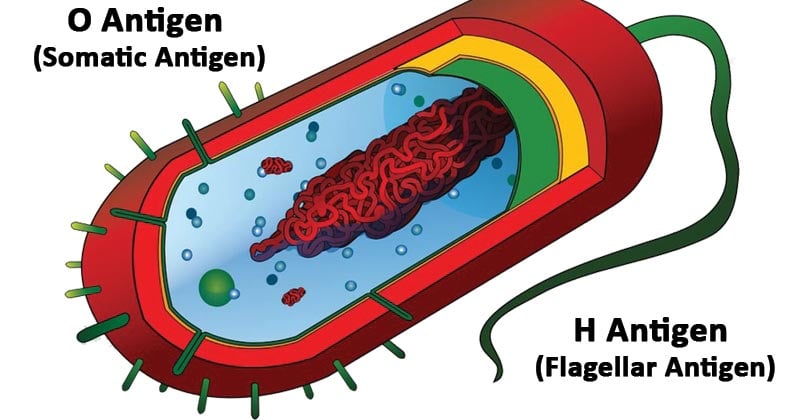
The major differences between O antigen and H antigen include:
S.N. |
Character |
O Antigen |
H Antigen |
| 1. | Referred to as | Somatic Antigen or Boivin antigen | Flagellar antigen |
| 2. | Determination | Based on oligosaccharides associated with lipopolysaccharide. | Based on flagellar proteins. |
| 3. | Cell wall | Part of the cell wall lipopolysaccharide (LPS). | Not a part of the cell wall. |
| 4. | Composition | Polysaccharide. | Proteinaceous (Flagellin). |
| 5. | Heat sensitivity | Somatic antigens are heat stable. | Flagellar antigens are heat-labile. |
| 6. | Alcohol sensitivity | Resistance to alcohol | Sensitive to alcohol |
| 7. | Formaldehyde sensitivity | Formaldehyde labile | Formaldehyde stable |
| 8. | Extraction | Trichloro-acetic acid is used for extraction of O antigens.
Since the property was first shown by Boivin, O antigen alternatively referred to as boivin antigen. |
Formaldehyde is used for extraction of H antigens. |
| 9. | Immunogenicity | Less immunogenic | Highly immunogenic |
| 10. | Antibody levels | Produces antibody formation with low titres. | Induces antibody formation with high titres. |
| 11. | Antibody formation | Rapid and Early | Rapid and Sustained |
| 12. | Lifespan | Antibody levels fall off quickly. | Persists for longer periods. |
| 13. | Antibody indicates | O antibody appears early, disappears early: indicates recent infection. | H antibody appears late, disappears late: lndicates convalescent stage. |
| 14. | Type of agglutination reaction shown | Produces compact, chalky and granular clumps. | Produces cottony, fluffy precipitates. |
| 15. | Reaction time | Agglutination takes place slowly | Agglutination takes place rapidly. |
| 16. | Optimum temperature for reaction | Optimum temperature for agglutination is 55’°C. | Optimum temperature for agglutination is 37’°C. |
| 17. | Reaction observed with | Round bottom Felix tube are used to see agglutination. | Conical bottom Dreyer’s tube is used to see agglutination. |
| 18. | Role as virulence factor | The most important virulence factor responsible for endotoxic activity; it protects the bacteria from phagocytosis and bactericidal effect of complement. | Makes the bacteria motile, hence contributing to their virulence. |
| 19. | Existence in phases | No phases | Flagellar antigens exist in two alternative phases- Phase I and II.
Most o f them are biphasic except S. Typhi which is monophasic. |
| 20. | Widal test | In Widal test, O antigen of Salmonella Typhi is used. | In WidaI test, H antigens of S.Typhi, S.Paratyphi A and B are used. |
| 21. | Use in classification | Serogrouping of salmonellae is based on the O antigen. | Serogroups are differentiated into serotypes based on H antigen. |
References
- Sastry A.S. & Bhat S.K. (2016). Essentials of Medical Microbiology. New Delhi : Jaypee Brothers Medical Publishers.
- Tille, Patricia M., author. (2014). Bailey & Scott’s diagnostic microbiology. St. Louis, Missouri :Elsevier
- https://microbiologyinfo.com/difference-between-o-antigen-and-h-antigen/
- http://microamaze.blogspot.com/2015/10/differentiate-between-h-and-o-antigen.html
