
Cotton (Gossypium hirsutum) is one of the major sources of fiber for textile and seed oil companies worldwide. Unfortunately, it is also a victim of insect pests, resulting in significant economic losses.
One way to mitigate such damage is by applying chemicals such as insecticides/pesticides. However, these chemicals can be toxic to consumers, non-biodegradable, and non-long-lasting. Would there be a way to tackle these problems? The closest we have is a transgenic cotton plant, known as Bt cotton.
What is Bt cotton?
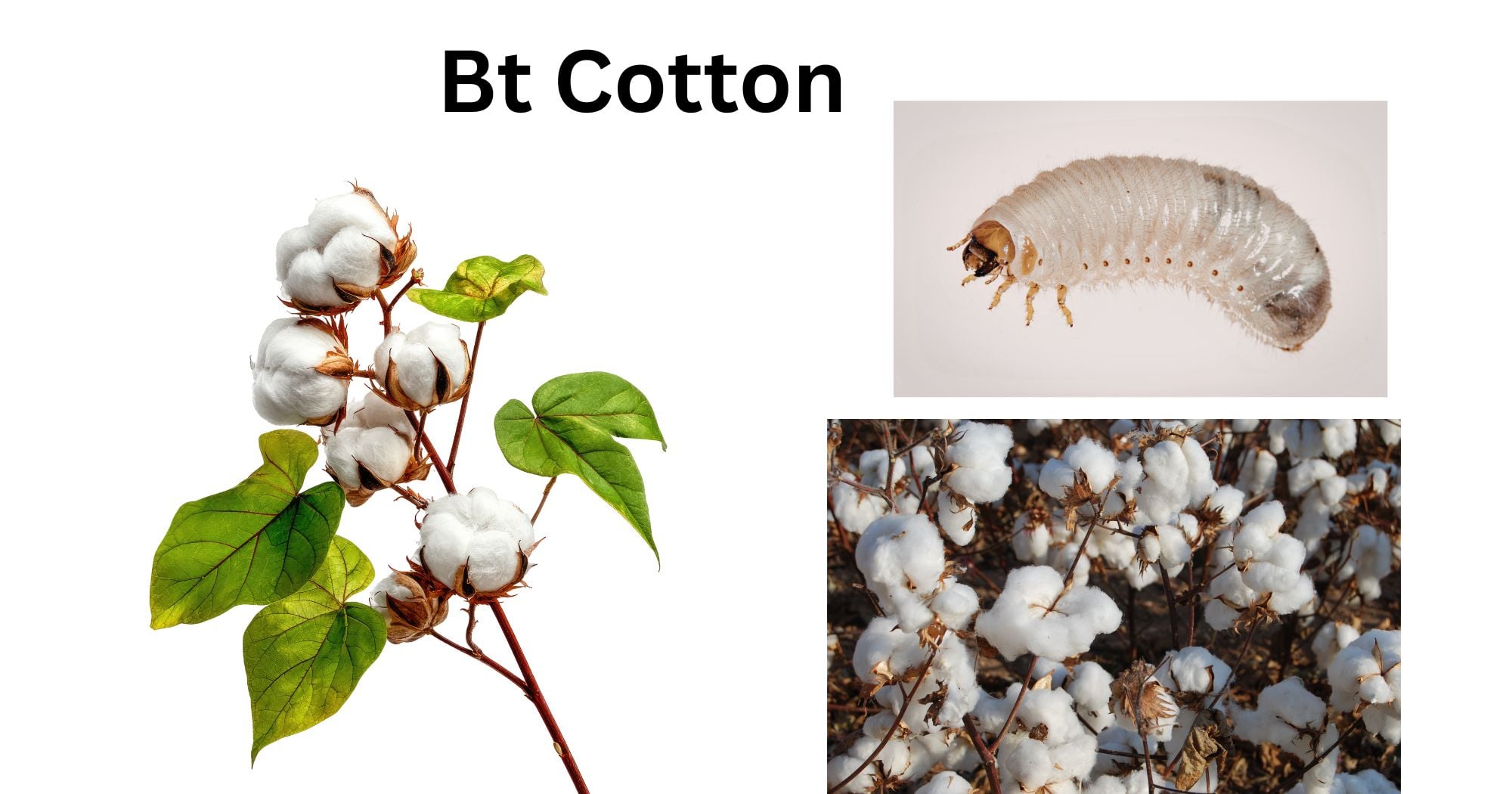
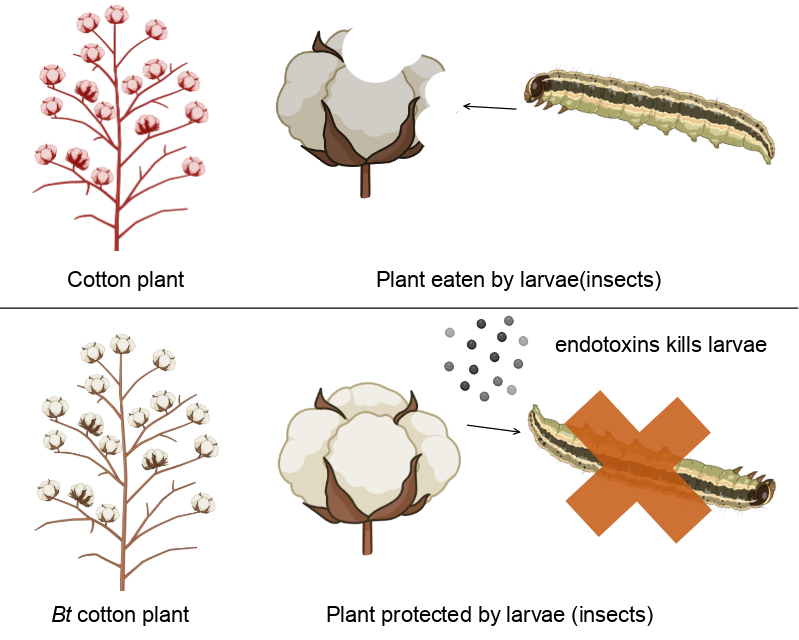
Bt cotton is one of the first genetically modified plants (GMPs) that have been modified to produce toxins against cotton-eating worms.
- This modified plant is derived from a rhizospheric bacterium, Bacillus thuringiensis, which produces over 200 different toxins called crystal insecticidal proteins (cry-proteins), that are capable of harming cotton pests such as caterpillars, budworms, and bollworms.
- Bt cotton is formed by the insertion of the cry genes of B. thuringiensis, which causes cotton plant cells to express cry proteins.
History and Development of Bt Cotton
- The discovery of B. thuringiensis toxins is not recent. In 1901, a Japanese scientist, Shigetane Ishiwata, isolated a bacterium that caused the death of silkworm larvae, naming it B. sotto. Then, in 1911, a German microbiologist, Ernst Berliner, isolated a related strain from moth larvae in a flour mill in the German state of Thuringia. He named the bacterium, B. thuringiensis.
- Only later, the insecticidal property of a protein within the bacterium was realized, and the first commercial insecticide, Bt, Sporine, was developed in 1930. However, the product suffered from the problem of biodegradability. It needed to be regularly reapplied during the growing season, drastically increasing the farmer’s expense.
- Because of this, research shifted towards developing toxins without the need for constant application. One way was to develop a protein by modifying the structure of the toxin to make it more stable. The other was to develop a transgene crop capable of synthesizing its toxin.
- In 1996, the transgenic Bt cotton was developed and approved for commercialization in the United States. The product contained the Cry1Ac gene of B. thuringiensis. In the following year, it was approved by the Chinese government. Presently, the product is commercially available in different countries like Australia, Mexico, South Africa, Argentina, India, etc.
- The area for the growth of Bt cotton increases every year. In 2014, India grew to be the largest Bt cotton producer in the world with 10.6 million hectares of crop land, followed by the US and China.
- Today, the transgenic crop is available from different seed companies around the world.
What is Bacillus thuringiensis?
B. thuringiensis is a soil-dwelling gram-positive bacterium used as a biological pesticide throughout the world. It occurs naturally in the guts of caterpillars, leaf surfaces, animal faeces, aquatic environments, flour mills, etc.
Crystalline bodies or δ-endotoxins
- Insects consume all kinds of organisms, even bacteria. In response to this, B. thuringenesis has evolved a defense mechanism against such predation.
- During the process of sporulation, this bacterium forms intracellular crystalline bodies that contain the insecticidal protein, δ-endotoxin or cry-proteins.
- δ-endotoxin is extremely toxic to insects, about 800-fold times more toxic than organophosphate insecticides (a major insect killer). Additionally, it is relatively selective, with varying strains of bacteria against different groups of insects.
| Type of δ-endotoxin | Effective against |
| CryI | Lepidoptera |
| CryII | Lepidoptera and Diptera |
| CryIII | Coleoptera (beetles) |
| CryIV | Diptera larvae |
| CryV | Nematode worms |
| CryVI | Nematode worms |
Mechanism of Action
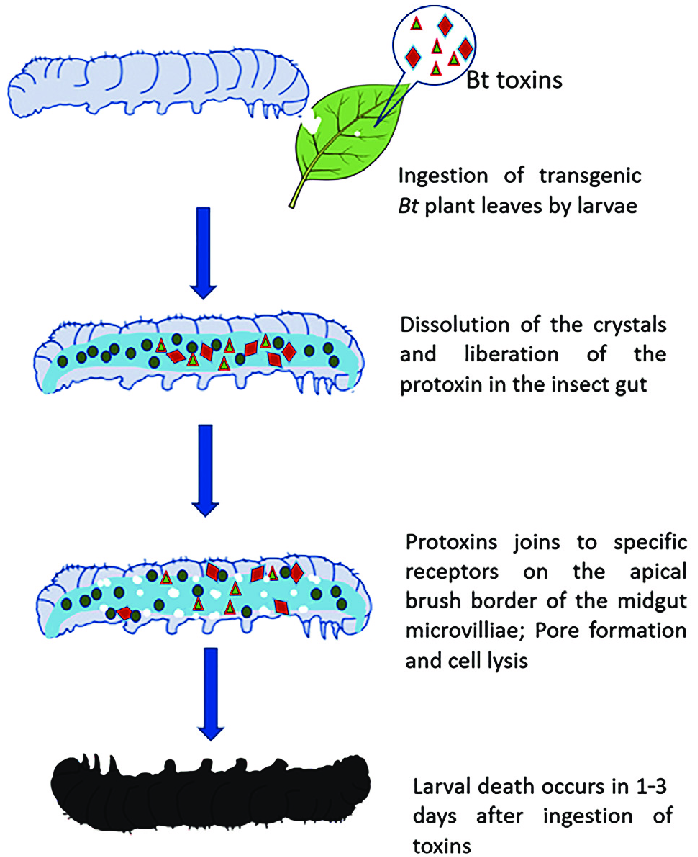
- The cry protein, or δ-endotoxin protein (protein size: 130 – 138 kDa) that accumulates in the bacterium is an inactive precursor (non-toxic) and insoluble at low pH. This is the same with the modified plant; therefore, it is not toxic to humans or other animals in any way. It dissolves after ingestion by the insect inside the gut. The high pH (> 9) of the insect’s gut reduces the precursor cry proteins to fragments about the size of 60 kDa.
- The gut proteases hydrolytically digest the protein to release core toxic fragments.
- The toxins bind to the inside of the insect’s gut and damage its surface epithelium. The epithelial cells develop pores, causing swelling. Eventually, the insect is unable to feed, and as a result, it starves to death. Additionally, the lower pH of the gut can cause bacterial spores to germinate, eventually leading to the death of the insect by septicemia.
- It is to be noted that there is variation in the structure of gut binding sites in different groups of insects. This might be the reason for the high specificity of the different types of δ-endotoxin.
Production of Bt cotton
Recombinant DNA
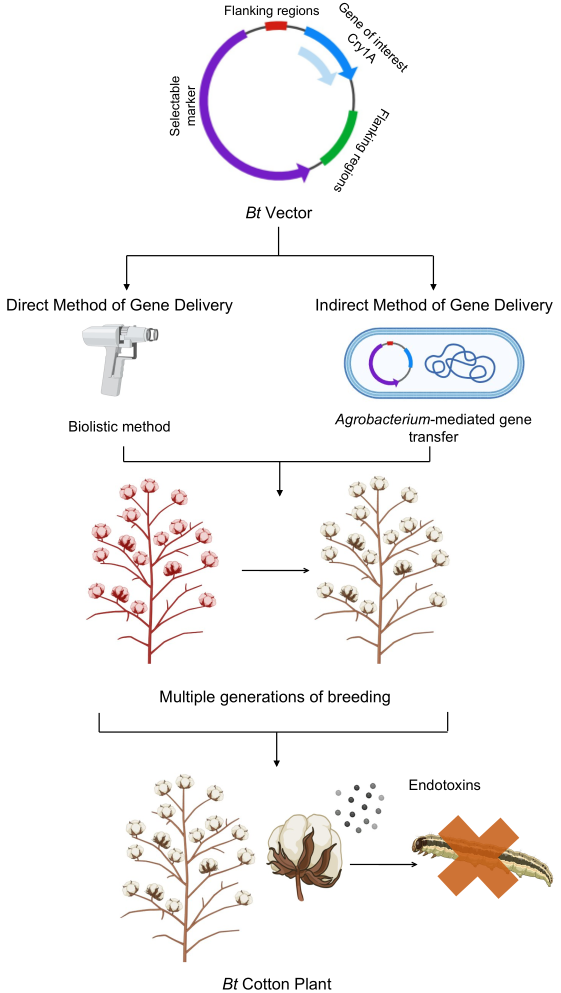
There are primarily three components of the transgene for insertion into cotton DNA, which are as follows:
Cry gene
The cry gene of B. thuringiensis encodes for the toxic δ-endotoxin. During the initial stage, Bt cotton used only one cry-protein gene, Cry1Ac. In subsequent years, other variations containing a “stacked” gene complex were inserted. To elaborate, the Bt cotton uses the Cry1Ac gene for insect control, and another gene to protect the cotton from the herbicide glyphosate.
Promoter
A promoter controls the amount of expression of the cry-protein gene, and in which part of the plant it is produced. Few promoters limit the expression of certain parts of the plant, such as leaves, pollen grains, or green tissues, whereas others, such as the Bt cotton, utilize the whole plant body to kill off worms.
Genetic Marker
A genetic marker allows identification of successful insertion of the gene into the plant’s DNA. This also helps breeders to develop new cotton lines with the Bt gene. One of the most common markers is the use of the herbicide tolerance gene linked to the Bt gene. The transgenic plant survives herbicide treatment, but those that have not been transformed fail to do so.
Transformation
Transformation into the host plant can be done via direct (biolistic) means or through indirect (Agrobacterium-mediated) means:
Direct (Biolistic) method
- The biolistic method, or particle bombardment method, uses gold/tungsten particles coated with the desired DNA construct at high speed and pressurized gas to transfer the modified DNA to the plant.
Indirect (Agrobacterium-mediated) method
- Agrobacterium tumifaciens, the natural genetic engineer, is used to transfer the genetically modified Ti-plasmid to the host cell.
Transformation can also be achieved by integrating the foreign gene into the chloroplast of the plant, thereby providing more expression in the host plant.
Following insertion, the subsequent transformed plants are developed into four or five generations to achieve stability and the desired expression of the δ-endotoxins.
Advantages of Bt Cotton
- Reduced use of chemical insecticides: As Bt cotton produces its insecticidal proteins, the application of chemical pesticides is minimal. This substantially reduces environmental contamination and risks while providing economic benefits to the farmer.
- Increased crop yield: The transgenic crop also offers better yields compared to normal varieties of the cotton plant.
- Non-toxic to non-target organisms: Since the cry proteins have high specificity towards targeted insects, the product poses no harm to other beneficial insects and pest predators.
- Better stability: Traditional chemical pesticides degrade with time. They are also washed away by environmental factors such as rain. In contrast to this, Bt cotton is resistant and can grow in the rainy season without the risk of insect damage.
Disadvantages of Bt Cotton
- Resistance to pests: The continuous exposure to Bt toxins can lead to resistance in target pests. This happens with gradual mutation in the receptor-binding protein of the insect’s gut epithelium. Few pests, such as Helicoverpa armigera, P. gossypiella, and others, have been reported to develop resistance against cry proteins.
- Climate change: Environmental conditions such as high temperature and low relative humidity reduce the concentration and effectiveness of δ-endotoxins in Bt cotton. This causes susceptibility to bullworm and other insects.
- Seed cost and dependency on biotech companies: Bt seeds are genetically engineered and patented, which makes them more expensive than regular seeds. Moreover, farmers need to purchase new seeds every season because the transformed seed has limited germination. This leads to increased dependence on biotech companies, raising ethical and socio-economic concerns.
Besides Bt cotton, there are numerous other transgenic plants (Bt crops) modified with the bacterial cry gene as follows:
| Bt Crop | Inserted Gene | Target Insects |
| Bt Corn (Maize) | cry1Ab, cry2Ab, cry1F, cry4Bb1 | European corn borer, Fall armyworm |
| Bt Potato | cry3A | Colorado potato beetle |
| Bt Rice | cry1Ab, cry2A | Rice stem borer |
| Bt Tomato | cry1Ac, cry1Ab | Tomato fruit borer |
References
- Bt Cotton & Management of Tobacco Budworm-Bollworm Complex. (2001). United States Department of Agriculture. https://www.ars.usda.gov/ARSUserFiles/oc/np/btcotton/btcotton.pdf
- Bt Cotton—UT Crops. (n.d.). Https://Utcrops.Com/. Retrieved July 16, 2025, from https://utcrops.com/cotton/insects-and-mites/biological-control/bt-cotton/
- Genetically modified cotton: How has it changed India? (n.d.). Retrieved July 19, 2025, from https://researchoutreach.org/articles/genetically-modified-cotton-how-changed-india/
- Gothandaraman, R., Selvaraj, A., & Rajasekaran, R. (2023). Bacillus thuringiensis in Pest Management. Plant Health Archives, 1, 1–13.
- Ibrahim, M. A., Griko, N., Junker, M., & Bulla, L. A. (2010). Bacillus thuringiensis. Bioengineered Bugs, 1(1), 31–50. https://doi.org/10.4161/bbug.1.1.10519
- Nagaraj, S., Rajasekaran, R., Palaniappan, J., Rangasamy, S., Narayanasamy, C., & Narayanan, M. B. (2024). Emerging technological developments to address pest resistance in Bt cotton. Journal of Cotton Research, 7(1), 30. https://doi.org/10.1186/s42397-024-00192-z
- TNAU Agritech Portal: Bio Technology. (n.d.). Retrieved July 17, 2025, from https://agritech.tnau.ac.in/bio-tech/biotech_btcotton_env.html
- ZAFAR, M. M., RAZZAQ, A., FAROOQ, M. A., REHMAN, A., FIRDOUS, H., SHAKEEL, A., MO, H., & REN, M. (2020). Insect resistance management in Bacillus thuringiensis cotton by MGPS (multiple genes pyramiding and silencing). Journal of Cotton Research, 3(1), 33. https://doi.org/10.1186/s42397-020-00074-0
