
In nature, distinguishing oneself from others can be vital for survival. Tiny bacteria have evolved to do just that. They live in groups called biofilms, which protect them from external environmental stressors. Biofilms are controlled by quorum sensing, which detects when and how to respond in different environments.
What is a biofilm?
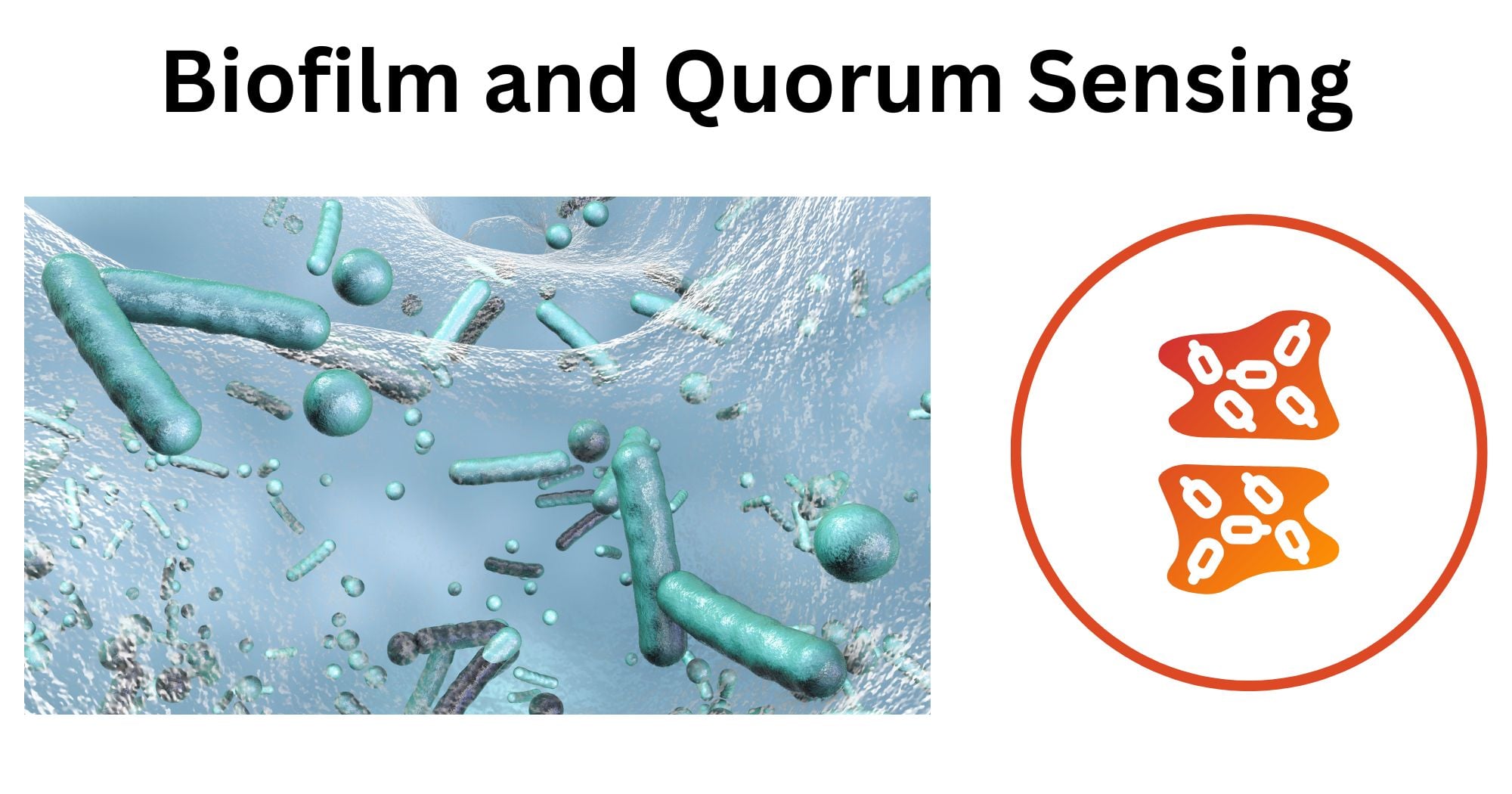
Biofilms are communities of bacteria attached to a surface that are embedded in a dense extracellular matrix made up of polysaccharides, proteins, and DNA. These matrices act as a fluid channel to provide access to nutrients and the removal of waste. Bacteria can adhere to the surface of host tissues, forming biofilms that are difficult for immune cells, antibiotics, and other antimicrobial agents to penetrate.
It is like an evolving home that protects the community of bacteria from external environmental agents such as extreme temperatures, disinfectants, pathogens, and so on. More than 90% of bacteria live and grow in the form of biofilms. A few of these bacteria include Staphylococcus, Enterococcus, Escherichia coli, etc.
Biofilms are regulated by Quorum sensing
- Quorum sensing is a regulatory mechanism of gene expression in bacteria that responds to the changing cell population and density. Bacteria synthesize small molecules called autoinducers that are either passively or actively released into the extracellular space.
- These tiny molecules accumulate extracellularly, and their concentration is sensed by specialized bacterial receptors. With this, the bacterial community can collectively alter its behavior in response to the changing bacterial cell density and environment.
- Quorum sensing helps regulate the formation of biofilms on a given surface. To elaborate, a community of bacteria coordinates the production of virulence factors that would be ineffective when the pathogen is in a lower concentration.
- They coordinate the production of virulence factors, which would be ineffective when the population density is low.
- Since bacterial quorum-sensing systems have a central role in regulating virulence factor production, they are attractive targets for antimicrobial therapies.
Role of Quorum Sensing in Biofilm
The formation of biofilm is a collective behavior regulated by quorum sensing. Quorum sensing controls the production of extracellular polymeric substances (EPS) that form a structural matrix, protecting them from embedded bacterial communities.
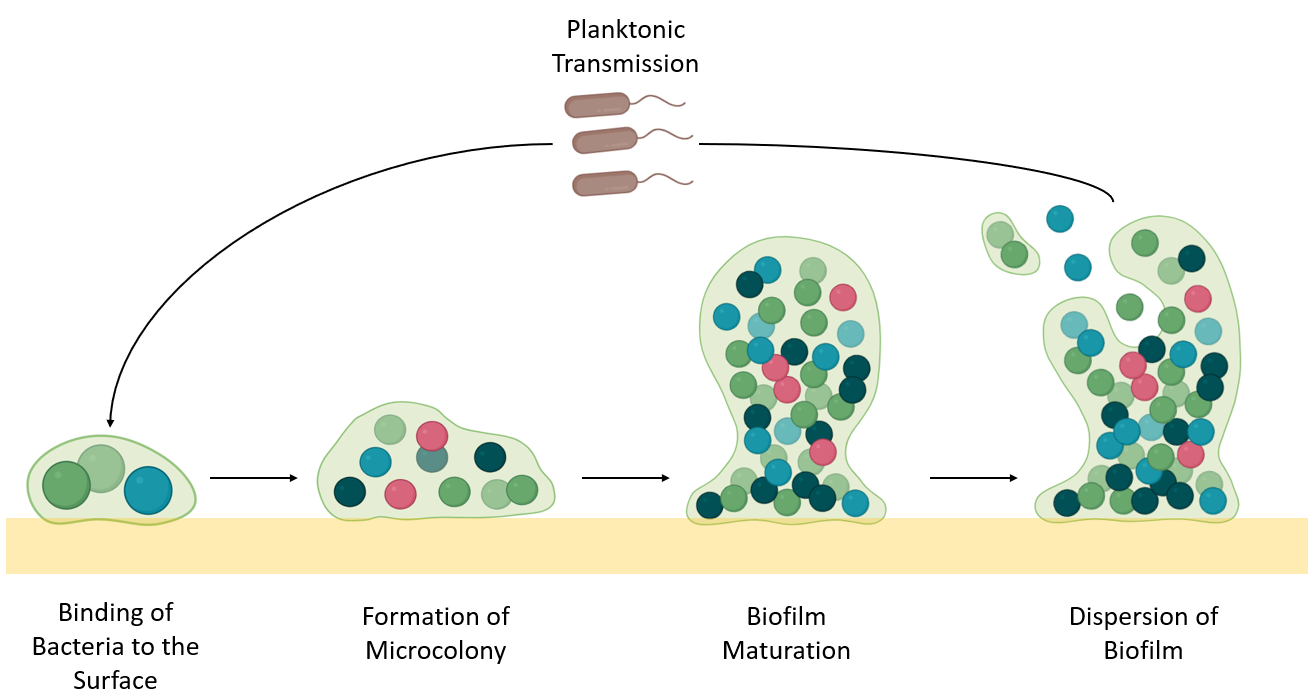
- Initial attachment: Free-floating planktonic bacterial cells reversibly (loosely) or irreversibly attach to a surface using flagella, pili, or other adhesins. They begin forming extracellular polymeric substances (EPS) for stable attachment.
- Formation of Microcolony: The attached cells divide and form small clusters or microcolonies. The quorum-sensing molecule continues to rise with the increasing cell density.
- Biofilm Maturation: The microcolonies grow into complex, 3D structures with specific shape, composition, and architecture. Water channels are created for nutrient flow. Bacterial communities differentiate into heterogeneous subpopulations of planktonic, persistent, sessile, and dead cells with numerous signaling and stabilizing quorum-sensing molecules such as acyl-homoserine lactones (AHL), polysaccharides, proteins, lipids, and extracellular DNA (eDNA). An EPS protects the mature biofilm from external stressors. Similarly, the mature biofilm may acquire a “mushroom” or “tower” shape with a three-layered structure: inner regulating layer, middle microbial basement layer, and outer layer inhabited by the planktonic form of microorganism for dispersal.
- Dispersion: Once the biofilm has matured, the bacterial cells or clusters actively burst or passively get transported by liquid flow-dispersion. Factors such as cell-population density, competition, lack of nutrients, variation in temperature, oxygen, metabolite accumulation, and upregulation and downregulation of genes play a significant role in biofilm dispersion.
Mechanism of Quorum Sensing
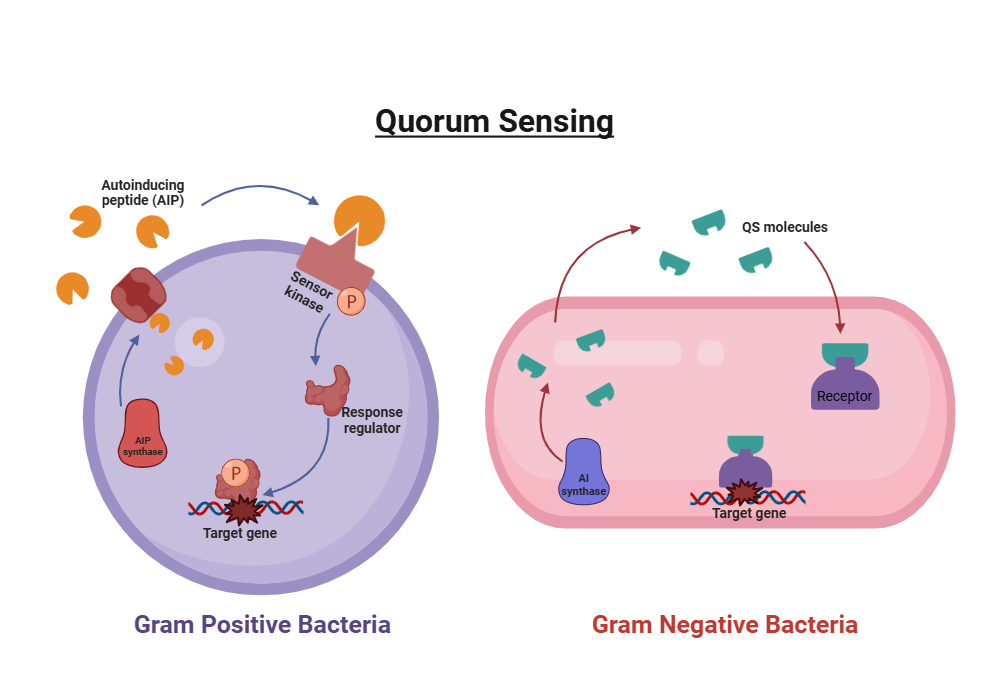
Quorum sensing senses bacterial cell population density through signaling molecules. There are three main components of quorum sensing as follows:
- Autoinducers (AI): Autoinducers are small molecules synthesized by the bacterium that accumulate with increasing bacterial population.
- Autoinducer receptor: These are sensor proteins (cytoplasmic in gram-negative bacteria and membrane-bound in gram-positive bacteria) that detect the threshold concentration of autoinducers.
- Response regulator: The binding of autoinducer and its receptor transmits a signal to a transcriptional regulator that activates or represses the expression of quorum-sensing-controlled genes.
The autoinducers for bacteria differ on the basis of their Gram staining category. They exist as follows:
- N-acyl-homoserine lactones (AHL) for gram-negative bacteria,
- Autoinducing peptide (AIP) for gram-positive bacteria, and
- Autoinducer-2 (AI-2) for both.
N-acyl-homoserine lactones (AHL)
Acyl-homoserine lactones are responsible for quorum sensing in gram-negative bacteria. These molecules diffuse across the cell membrane and into the cell, where they are detected by the LuxR receptor. Once a threshold concentration is reached, they activate transcription factors, LusI and RhIR. The activation of these factors upregulates the production of virulence factors such as exotoxins and elastases in response to high population density of bacteria.
Autoinducing peptide (AIP)
In gram-positive bacteria, a short chain of amino acids (oligonucleotides) known as an autoinducing peptide (AIP) serves as a signaling molecule for quorum sensing. It employs a two-component signal transduction system consisting of a sensor kinase and a response regulator. Initially, a precursor oligonucleotide is synthesized, processed, and secreted into the environment by a gram-positive bacterium. Once the AIP concentration reaches a sufficient threshold, it binds to a membrane-bound sensor kinase. The sensor kinases undergo autophosphorylation and signal transcription factors to activate or repress specific genes in response to cell density.
Besides these, another signaling molecule called autoinducer-2 (AI-2) functions to communicate between gram-negative and gram-positive bacteria.
Biofilm Habitat
Biofilms occur almost everywhere on an organic surface. This is because nearly all species of bacteria can adhere to the surface and even grow in extreme environments. They can be found on rocks, stagnant water bodies, hot springs, frozen glaciers, very acidic to very alkaline, and even inside/on host bodies.
A few of the major biofilms include:
- Rhizosphere: The rhizosphere is the soil surrounding the plant roots where rhizosphere growth-promoting bacteria reside. These rhizobacteria colonize the plant’s roots and exist in a symbiotic relationship with the host plant, providing protection against pathogens, fixing nitrogen, breaking down organic materials, and so on. Bacillus, Azospirillium, and Pseudomonas are the most common biofilms in the rhizosphere.
- Mammalian gut: The Mammalian gut is home to a diverse range of microorganisms that help in the digestion and processing of organic matter in the host body. In 2003, it was discovered that the immune system of the host supports the development of microbiota in the large intestine. The biofilms in the appendix help reinoculate the gut with good gut flora. Disruptions to this biofilm are associated with inflammatory diseases and even colorectal cancer.
- Dental plaque: Dental plaque is an oral biofilm that adheres to the teeth. It is caused when organic matter/food (especially fermentable dietary carbohydrate) gets stuck in the teeth. This gives tooth-decaying microorganisms, causing cavities and gum disease. Dental plaque is associated with numerous species of bacteria, most notably Streptococcus mutans. It can be prevented by constant removal of the biofilm (i.e., brushing, flossing), by reduced supply of fermentable carbohydrate (sugar), or by halting the dental plaque from maturing.
- Water bodies: Biofilms can be found at the bottom of rivers or streams and on the surfaces of stagnant water. They are a significant component of the food chain as they are eaten by aquatic invertebrates, fish, and others. Biofilms are established in components of a ship (biofouling), and as a result, other marine organisms such as barnacles can attach, slowing down the movement of the ship by 20%.
Biofilms are apparent in moist and warm environments. They can grow on sewage pipes, floors, and counters with increased food contamination, and many more.
Impact of Biofilms
In medicine
- Biofilms are often difficult to get rid of as they protect the bacteria against bactericidal agents like antibiotics. Because of this reason, they are responsible for persistent infections in the host body. They form clumps of colonies on the body surface and mitigate invasion from the body’s immune cells.
- It is estimated that 65% of human infections are a result of biofilms. Pseudomonas aeruginosa, Streptococcus pneumoniae, Escherichia coli, and Serratia marcescens are common pathogens that form biofilms to infect the host organism.
- Infection becomes more apparent on medical implants such as heart valves, prosthetic joints, pacemakers, catheters, intrauterine devices, and contact lenses. Malfunctioning implants can promote systemic infections because of “planktonic showering” when a large number of cells leave the biofilm and disseminate.
- Researchers are developing numerous ways to tackle biofilms, one of which is the use of bacteriophage therapy that can disperse and eliminate antibiotic-resistant biofilms. Another is the use of small amounts of electricity in the fluid surrounding the biofilm to reduce antibiotic resistance, termed the bioelectric effect.
In food
- Through the formation of biofilms, the sterilization of food becomes more difficult. Food-borne pathogens can survive for a longer period in water, meat, plants, etc., which severely impacts the shelf life of such products and poses detrimental health risks.
- Contamination becomes more rampant and harder to prevent, which can increase the economic burden for assessing quality control in food industries. This is especially true for dairy products, which have limited sterilization protocols. Milk products are pasteurized and delivered in a cold chain before consumption. The formation of biofilm can prevent proper sterilization, increasing health risk.
- Another widespread pathogen is Salmonella, common in poultry processing industries. When eggs or poultry meat are not processed or cooked properly, it can cause severe enteric fever.
- Few chemicals derived from plants or animals are used to inhibit the formation of biofilm and to completely negate pathogenic contamination in food products.
References
- Miller, M. B., & Bassler, B. L. (2001). Quorum Sensing in Bacteria. Annual Review of Microbiology, 55(Volume 55, 2001), 165–199. https://doi.org/10.1146/annurev.micro.55.1.165
- Moreno-Gámez, S., Hochberg, M. E., & van Doorn, G. S. (2023). Quorum sensing as a mechanism to harness the wisdom of the crowds. Nature Communications, 14(1), 3415. https://doi.org/10.1038/s41467-023-37950-7
- Quorum Sensing and Biofilm Formation | Define Quorum Sensing. (2024, September 12). https://qualitru.com/quorum-sensing-and-biofilm/
- Quorum Sensing for the Mutes. (n.d.). Small Things Considered. Retrieved June 27, 2025, from https://schaechter.asmblog.org/schaechter/2016/10/quorum-sensing-for-the-mutes.html
- Rather, M. A., Gupta, K., & Mandal, M. (2021). Microbial biofilm: Formation, architecture, antibiotic resistance, and control strategies. Brazilian Journal of Microbiology, 52(4), 1701–1718. https://doi.org/10.1007/s42770-021-00624-x
