
In the early twentieth century, two German scientists, August Köhler and Moritz von Rohr, discovered a light microscopy technique that used ultraviolet light to produce an image of the specimen, which they named Ultraviolet (UV) microscopy.
Ultraviolet (UV) microscopy is a light microscopy technique that uses ultraviolet light, with shorter wavelengths than visible light, to produce higher-resolution, higher-magnification images of microscopic specimens.
Ultraviolet light simply refers to light beyond violet, which means UV light has a wavelength shorter than violet light. Instead of using visible light as the light source, ultraviolet microscopy utilizes UV light of a short wavelength to produce highly magnified images with enhanced resolution compared to conventional microscopy techniques. UV light with short wavelengths in the range of 180 and 400 nm renders high magnification and greater resolution to the analyzed specimen images.
As the resolution of a microscope directly depends on the light’s wavelength, minute specimens can be observed with great clarity with the source of light having a shorter wavelength. In short, the longer the light’s wavelength, the lower the resolving power and vice versa. It is also considered that the magnification produced by the UV microscopy technique is nearly double that of the visible light used in conventional microscopy. As the samples in areas beyond the visible spectrum are viewed by UV microscopy, it has broad applications in cellular studies, research, quality assurance in pharmaceutical industries, petroleum and mineral analysis, and textile industries for dye identification. Specifically, it is used in manufacturing microelectronics, LED, and OLED displays that require more precision and accuracy.
Principle of Ultraviolet (UV) Microscopy
The working principle of the Ultraviolet (UV) Microscopy technique is based on the use of UV as the light source. In comparison to visible light, it has a shorter wavelength and interacts with the samples in a distinct manner. Moreover, this characteristic feature allows for significantly improved resolution, producing finely detailed images. The UV light, when directed to the sample, either gets absorbed or excites fluorescence in certain components. Some specimens can be stained with fluorescent dyes for visibility; however, some biological specimens naturally fluoresce under UV exposure.
When UV light is passed through the sample, it interacts with different molecular structures in the sample. The transmitted light is focused by the lenses onto the detector. The signal is then converted into an image by the UV-sensitive camera. Bright, high-contrast images are produced through a fluorescence mechanism where molecules emit longer-wavelength visible light on excitation by the UV. However, when molecular structures absorb the light, images appear dark against a bright background.
Instrumentation of Ultraviolet (UV) Microscopy
Ultraviolet (UV) Microscopy is a nondestructive imaging technique used for greater magnification of microscopic samples. The components of a UV microscope are designed to produce images by mechanisms including absorbance, emission, reflectance, and fluorescence in the visible, ultraviolet, and near-infrared regions. It provides smooth operation and some products are incorporated with browser-based image management software that aids in improved user interaction. Various components that make up a UV microscope, including the light source, optical system, and image recording system, are briefly described below:
Light Source: The source of light used in this technique is ultraviolet light. High-intensity UV light is generated through xenon lamps, mercury vapor lamps, or deuterium lamps, which provide optimal illumination for imaging.
Stage: UV-compatible transparent slides are accommodated in the stage or the sample holder. It ensures the transmission of light through the specimen.
Objectives: Quartz lenses are preferably used to ensure proper transmission of UV light and enhance focus. The use of glass lenses is avoided as they absorb UV light, restricting the penetration of UV rays. Besides, fused silica lenses are also used.
Filters and Detectors: Special types of filters are used to filter out the unwanted light to enhance the contrast of the image. They also prevent UV rays from passing through the eyepiece and analyze the emission of fluorescence from the sample.
Camera: Photographic plates are used to capture the images, as the UV rays are not visible to the human eye. UV cameras or photomultiplier tubes carry out the conversion of UV signals to a visible image for observation.
Sample Preparation for the Observation in Ultraviolet (UV) Microscopy
Historically, the use of stains to view biological samples has been suggested with the development of the Ultraviolet (UV) Microscopy technique. However, colorless samples capable of absorbing ultraviolet light are mostly analyzed using this technique. Similarly, to increase the contrast in the photomicrographs, ultraviolet staining, vital stains, and organic compounds with permeable cell membranes are preferred. Living cells are treated with the dye named ‘fluorochrome acridine orange’ and are imaged at a wavelength beyond the absorption band of nucleotides. In addition, nuclear stains are used to study DNA/RNA. They are photographed by adjusting the wavelength beyond the absorption band of the nucleotide polymers to minimize the masking of nuclear structures in the cytoplasm. Vital stains are used to study the morphological structures of microorganisms under Ultraviolet (UV) Microscopy.
Operating Procedure of Ultraviolet (UV) Microscopy
- First, the microscope is turned on, allowing the UV light source to warm up.
- The sample to be detected is prepared on UV-compatible slides, preferably quartz or fused silica. If necessary, apply appropriate stains to the specimen. For maximum clarity, the sample should be thinly sliced.
- The sample is secured on the stage to focus using coarse and fine adjustment knobs.
- The wavelength and intensity of the light source are adjusted for imaging and obtaining optimal contrast and clarity.
- The imaging system (UV-sensitive camera) is used to capture the image, and suitable software is used to analyze it
- After imaging the sample, the UV lamp is turned off.
- The slide containing the sample is removed, and the optical components of the microscope are cleaned properly after its use.
Applications of Ultraviolet (UV) Microscopy
- Ultraviolet (UV) Microscopy is widely used in biomedical research to view cellular structures, proteins, and nucleic acids (DNA/RNA).
- In forensic investigations, it is used to identify chemical residues and fingerprints and detect biological fluids, including saliva, blood, etc.
- This technique’s broad applications include widespread use in material science and nanotechnology. It is used to study nanoparticles and detect contaminants on semiconductor devices.
- It is used in the identification of pollutants and contaminants in air and water, including the detection of microorganisms.
- Histological examinations of tissues are performed using microscopy with ultraviolet surface excitation. This technique is instrumental in preclinical research, as it contributes to the diagnosis and treatment of tumors and many other diseases.
- In pharmacology, it is used for the localization of protein crystals, quality control, and imaging of active ingredient dispersal.
- In addition, it is used in the textile industries for the identification of dyes and in geology for petroleum analysis and mineral imaging.
Examples of Ultraviolet (UV) Microscope
Ultraviolet-Visible-NIR Microscope
- It operates on a deep Ultraviolet (UV) Microscopy technique that can view images in UV, visible, and near-infrared regions.
- It allows direct imaging and produces images with high resolution.
- It is easy to use and has high durability.
- Allows imaging through reflectance, transmission, polarization, and fluorescence.
X-taLight 100 – Microscope UV from Molecular Dimensions
- The system used an integration of UV and white light as light sources, allowing visualization of biomolecules from salt crystals.
- It is a cost-effective product as it allows direct attachment to lab microscopes.
- It is operated with minimal UV exposure time.
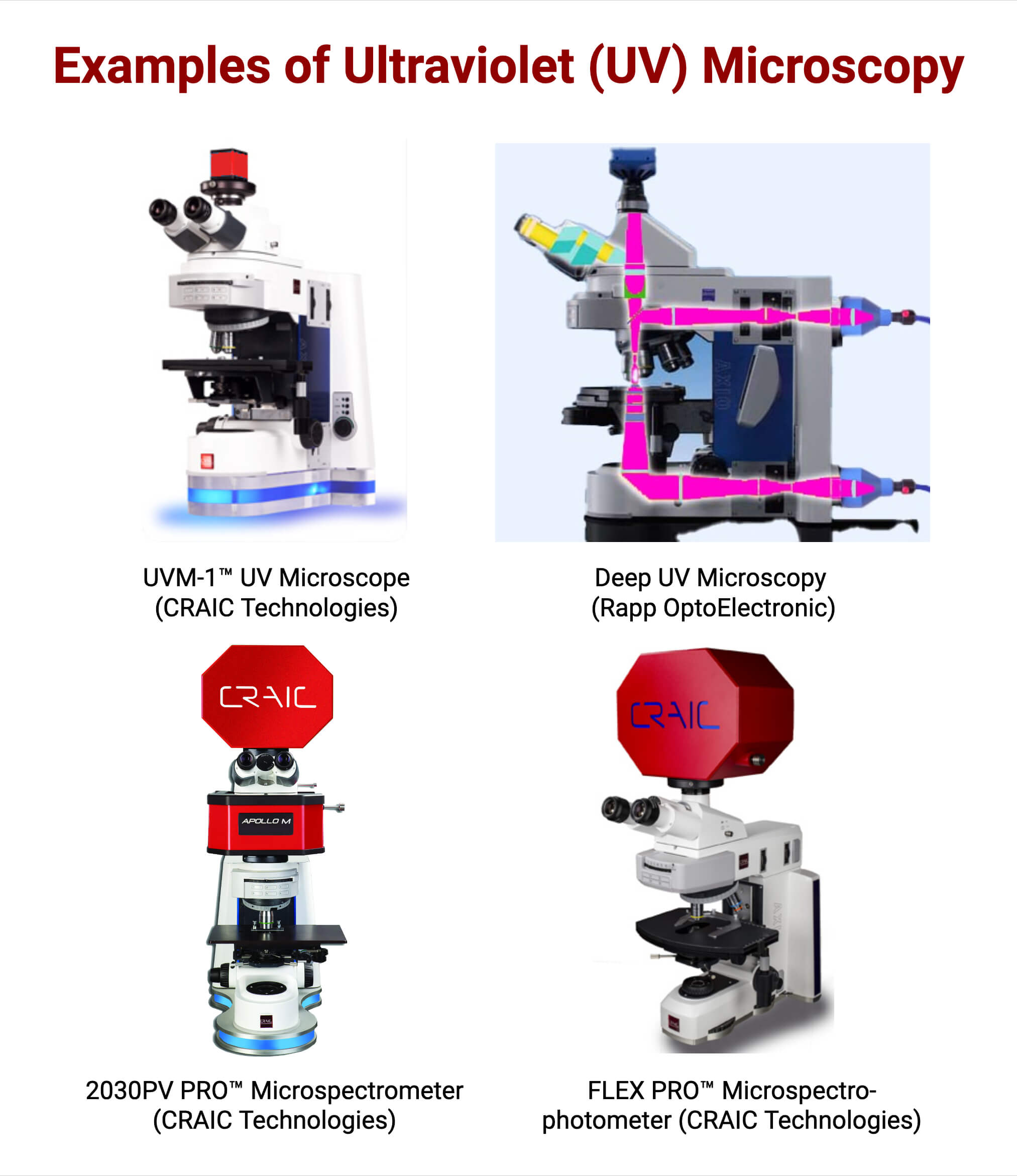
Deep UV Microscopy from Rapp OptoElectronic
- It allows imaging of samples below 320 nm.
- It is used for photoactivation and the measurement of the UV absorption spectrum of the sample at various spatial locations in the sample.
- It includes the transmission of deep UV wavelengths.
UV-Vis-NIR Microscope Imaging with Raman Microspectroscopy
- It is a simple and swift imaging technique used for spectrally selective or wideband visualization.
- It integrates an advanced system of detectors, optics, and software.
- It is equipped with Raman Microspectroscopy, which adds the ability to view the samples in the UV and Short Wave Infrared regions.
- Multiple techniques of visualization, including luminescence, are supported by this system.
Advantages of Ultraviolet (UV) Microscopy
- Images are viewed with increased contrast.
- Due to the shorter wavelength of UV light, it enhances image resolution, surpassing the diffraction limit of optical microscopes that utilize regular white light.
- The use of UV light as the source achieves a greater response of the specimen with regard to the surroundings.
- It offers imaging capabilities for various fluorescent molecules and wide bandgap semiconductors.
- It is a time-efficient and low-cost technique of microscopy.
Limitations of Ultraviolet (UV) Microscopy
- The high energy of UV light may damage the sample and cause darkening.
- The excitation of fluorophores can cause damage to the cells and produce reactive oxygen species.
- It offers a small penetration depth.
- It cannot be used to detect and analyze cellular functioning and activities.
Precautions using Ultraviolet (UV) Microscopy
- Laser eyewear, preferably polycarbonate-based, should be used to protect your eyes from the harmful effects of UV light.
- Avoid direct exposure to UV light on the skin.
- Care should be taken to ensure that no residues or scratches are left on the surfaces of UV optics.
- High precision should be maintained while operating UV optics.
- Proper ventilation should be ensured in rooms operating microscopes with UV light sources.
- The exposure time of UV light should be limited to prolong its lifespan.
Conclusion
In conclusion, the wide range of its applications, from biomedical research to pharmaceuticals, materials science, and forensic science, makes Ultraviolet (UV) Microscopy an indispensable technique across various fields of science and technology. It features exceptional fluorescence capabilities and offers high-quality visualization techniques, making it a flexible and accessible tool in scientific research with proper precautions.
References
- News-Medical. (2023, July 19). What is Ultraviolet Microscopy? https://www.news-medical.net/life-sciences/What-is-Ultraviolet-Microscopy.aspx
- UV microscopy — klar scientific. (n.d.). Klar Scientific. http://klarscientific.com/uv-microscopy
- Martin, P. (n.d.). UV Microscope | Microscopic Samples | Supplier. https://www.microspectra.com/support/the-science/uv-microscope-applications
- Fereidouni, F. et al. (2017). Microscopy with ultraviolet surface excitation for rapid slide-free histology. Nat Biomed Eng., 1, 957–966. https://escholarship.org/content/qt5n21m71b/qt5n21m71b_noSplash_4a65b8dbb1a84f7626b19d3a952252f1.pdf
- Hammond, C. & Evennett P.J. (2005). MICROSCOPY TECHNIQUES | Light Microscopy,
- Encyclopedia of Analytical Science. Elsevier. Second Edition. 100-106, https://doi.org/10.1016/B0-12-369397-7/00378-2. https://www.sciencedirect.com/science/article/pii/B0123693977003782
- News-Medical. (n.d.). Ultraviolet Microscopes Equipment | Review, compare, Get Quotes (RFQ) & prices. https://www.news-medical.net/Life-Science-and-Laboratory/Ultraviolet-Microscopes
- Taylor, E. W. (1953). The ultraviolet microscope. Journal of the Optical Society of America, 43(4), 299. https://doi.org/10.1364/josa.43.000299
- THE ULTRAVIOLET MICROSCOPE. JAMA. 1904;XLIII(17):1237. doi:10.1001/jama.1904.02500170055016
- Kita, N.T. et al. (2015). UV-light microscope: improvements in optical imaging for a secondary ion mass spectrometer. J. Anal. At. Spectrom, 30, 1207–1213. http://www.geology.wisc.edu/~wiscsims/pdfs/Kita_JAAS2015.pdf
- News-Medical. (n.d.-b). Ultraviolet-Visible-NIR microscope for spectral imaging. https://www.news-medical.net/UVM-1-Ultraviolet-Microscope-from-Craic
- News-Medical. (n.d.-c). X-taLight 100 – Microscope UV from Molecular Dimensions. https://www.news-medical.net/X-taLight-100-Microscope-UV-from-Molecular-Dimensions
- News-Medical. (n.d.-a). Deep UV Microscopy from Rapp OptoElectronic. https://www.news-medical.net/Deep-UV-Microscopy-from-Rapp-OptoElectronic
- News-Medical. (n.d.-d). UV-Vis-NIR Microscope Imaging with Raman Microspectroscopy. https://www.news-medical.net/CRAIC-UVM-1-UV-Visible-NIR-Absorbance-Reflectance-and-Fluorescence-Microscope-Imaging-Now-With-Raman-Microspectroscopy
