
Effective sterilization of medical devices is central to preventing healthcare-associated infections, especially in an era of multidrug-resistant pathogens. Failures in cleaning, disinfection, or sterilization of reusable and implant devices can directly lead to outbreaks and patient harm.
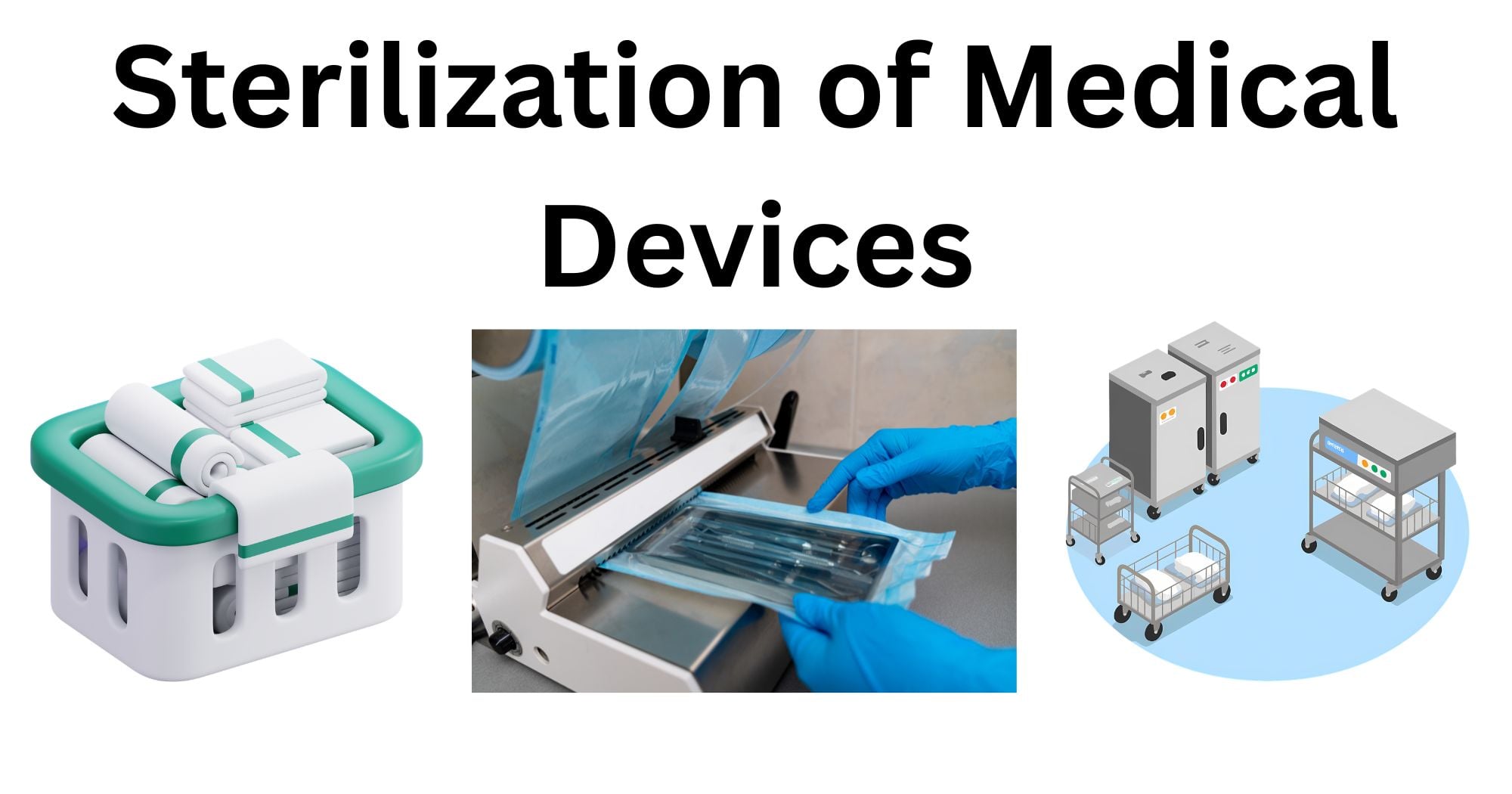
Sterilization is the physical or chemical process of complete or absolute removal of all microorganisms, including spores. It is usually expressed as a sterility assurance level (SAL) of 10-6. Most medical devices interact with human tissue, blood, or sterile body cavities, which makes sterilization an absolute necessity to ensure patient safety. Inadequately sterilized medical equipment leads to hospital-acquired infections with outcomes ranging from prolonged hospital stay to sepsis and death. So, sterilization is a cornerstone of infection prevention in hospitals and industry.
Principles and Mechanisms of Sterilization
Sterilization relies on physical and chemical processes that damage microbial structures or functions, thereby inactivating them.
The main principles are:
- The device must be sufficiently clean for the sterilant or heat to reach microorganisms, because bioburden affects kill time, and resistant spores take longer to inactivate than vegetative cells.
- The method must penetrate the load and the packaging, and the package must remain sterile during storage.
- The process must match the material, because sterilization can damage heat-labile polymers and other device components.
Mechanisms (by methods):
- Steam or moist heat kills by a time-temperature effect, with moisture penetration and air removal necessary for effectiveness.
- Dry heat acts more slowly, requiring higher temperatures, but it can penetrate oils, petrolatum, and closed containers that steam cannot.
- Ethylene oxide works mainly by alkylating susceptible cellular molecules, especially DNA and proteins. It is highly diffusive, but it needs humidity and good penetration, and the load must be aerated afterward because residual EtO is toxic.
- Ionizing radiation sterilizes by damaging DNA directly and indirectly through free radicals. Gamma rays penetrate packaged products well.
There is no single best sterilization method for all devices. The method is selected based on device complexity, required sterility assurance, package durability, consequences of non-sterility, effects on the device, and cost.
Classification of Medical Devices for Sterilization
The Spaulding classification is the global framework linking device risk to the required level of decontamination. It organizes devices into three tiers based on infection risk:
- Critical devices: Those devices that come directly in contact with sterile tissue or blood (surgical instruments, implants). Full sterilization is mandatory for these devices, as any contamination on these items creates a life-threatening infection risk.
- Semi-critical devices: Those devices that come in contact with mucous membranes or intact non-sterile tissues (e.g., endoscopes). They require high-level disinfection (reducing microbes to a safe level).
- Non-critical devices: Those devices that have contact with skin only (e.g., blood pressure cuffs, ECG electrodes). They require low-level disinfection rather than sterilization.
Spaulding must be interpreted alongside cleaning complexity and device design (e.g., narrow tubes, mixed materials), which can increase risk even within the same category.
Methods of Sterilization for Medical Devices
Heat-based method
Heat-based techniques include steam or moist heat (autoclave) and dry heat methods. This method is widely used for heat-stable devices. It is widely used worldwide because it is well-understood, inexpensive, and leaves no toxic residues.
Chemical method
This includes Ethylene dioxide (EtO), vaporized hydrogen peroxide, formaldehyde, liquid high-level disinfectants, and so on. They are applied to heat or moisture-sensitive devices or complex devices.
Radiation
High-energy gamma rays, electron beams, or X-rays are used to sterilize devices in their final sealed packaging. This is widely applied to modern single-use devices.
Filtration
It is used for sterilizing liquids, gases, and air streams by physically excluding microorganisms through membrane filters of pore sizes 0.22 µm or smaller.
Other methods
Ozone, supercritical CO2, cold plasma, UV, and pulsed light are being investigated as sustainable or on-site alternatives.
Steam Sterilization (Autoclaving) for Medical Devices
Steam sterilization is the most widely used and often most effective technique for heat-stable medical devices. This technique uses saturated steam under pressure for defined times to kill microorganisms (commonly 121° C at 15 psi for 15-30 minutes or 134° C for a shorter time). It applies to metal instruments, certain textiles, and other heat-resistant items; however, not suitable for many thermoplastics and electronics.
Healthcare and manufacturing are dominated by two autoclave designs: gravity-displacement units and prevacuum autoclaves. Effective steam sterilization depends on deep vacuum, air removal, steam penetration, and absence of non-condensable gases. Routine monitoring of the process is done by Bowie-Dick tests and process challenge devices (PCDs) to verify air removal and steam penetration.
Ethylene Oxide (EtO) Sterilization and Low-Temperature
EtO is a low-temperature gaseous sterilant for complex, heat- and moisture-sensitive devices, especially those with electronics. It has excellent penetration into complex geometry and packaging. EtO can be performed for a broad range of materials, and it has a high microbicidal efficacy, almost similar to steam sterilization. Despite the advantages, EtO sterilization possesses some limitations, as EtO is a human carcinogen and raises concerns about worker exposure. It is highly time-consuming as sterilized devices must undergo aeration to remove residual gas to safe limits before use or handling.
Alternative low-temperature technologies include vaporized hydrogen peroxide (VH2O2), low-temperature steam and formaldehyde, ozone, supercritical CO2, cold plasma, etc. VH2O2 is supported by ISO 22441:2022 as an alternative to EtO. It is effective, fast, and non-toxic, but it has limited penetration and material compatibility.
Radiation Sterilization (Gamma and Electron Beam)
Radiation (gamma rays, electron beam, and X-ray) is a primary industrial terminal sterilization (sterilization in the final container or packaging) method for single-use devices. Gamma radiation is high-penetration radiation suitable for bulk packaged products. An electron beam has shallower penetration and shorter cycles and is well-suited for smaller or thinner products. Radiation kills microorganisms by ionization and free radical formation, which causes DNA and structural damage. Radiation is efficient, but it may alter polymer chemistry, cross-linking, or degrade materials, so compatibility testing is essential.
Sterilization Validation and Monitoring (Biological and Chemical Indicators)
Validation and routine monitoring rely on physical, chemical, and biological indicators. Physical indicators might be tools such as gauges, digital displays, and sterilizer printouts.
Biological Indicators (BIs)
It is the most direct measure of sterilization efficacy. Examples include Geobacillus stearothermophilus for steam and H2O2 methods, Bacillus atrophaeus for the EtO method, etc. It contains a defined population (often ≥10⁶ CFU) of resistant spores, with specified D- and z- values, used to directly measure process lethality. The BIs are placed in different locations in a load, and the sterilization cycle runs. After completion, the BIs are incubated, and no growth indicates cycle validity; however, signs of growth indicate sterilization failure.
Chemical Indicators (CIs)
CIs respond to physical and chemical parameters of the process, such as temperature, time, humidity, or chemical concentration, by changing color or form. They provide fast feedback but confirm only that the conditions were met and not that organisms were actually killed. ISO 11140-1 classifies CIs into types I – VI based on their sensitivity and usage. Examples: external autoclave tape, Bowie-Dick test packs, etc.
Factors Affecting Sterilization Efficiency
The major factors influencing process success are:
- Bioburden and soil load: residual proteins and organic matter already present in the device from inadequate cleaning can protect microbes and reduce efficacy, especially for low-temperature processes.
- Device design and complexity: Designs like narrow lumens, joints, mixed materials, and complex geometries hinder cleaning and sterilant penetration.
- Process parameters: Temperature, pressure, time, humidity, sterilant concentration, and gas or steam penetration directly influence lethality.
- Packaging and load configuration: Poorly designed packs or overloading can create air pockets or diffusion barriers.
- Material compatibility and aging: Repeated cycles may affect defined performance or change how the sterilant interacts with surfaces.
Sterilization vs. Disinfection in Medical Devices
| Aspect | Sterilization | Disinfection |
| Definition | Eliminates all viable microorganisms, including bacterial spores | Removes most, but not all, microorganisms, and spores may remain |
| Used for | For critical items that contact sterile tissue or blood | For semicritical items (high-level disinfection) and for noncritical items (low-level disinfection) |
| Goal | Remove all microbes and prevent any contamination of sterile body sites | Reduce microbial load to a level that does not cause infections |
| Methods | Autoclave. Dry heat, EtO, H2O2 gas, etc. | Chemical disinfectants, thermal or chemical washer, etc. |
Advantages of Sterilization Methods
Each method has its strengths.
Steam: highest microbicidal margin, robust, relatively low cost
EtO: excellent penetration and material compatibility, suitable for multi-material, complex, and electronic devices
Radiation: highly reliable, suitable for mass production, terminal sterilization of prepackaged devices
Low-temperature H2O2 and related processes: Fast, no toxic residues, on-site usability in hospitals
Limitations of Sterilization Methods
Steam: limited to heat and moisture-stable materials, can deform thermoplastics or damage electronics
EtO: long cycles and aeration required, toxic and carcinogenic emissions, strict environmental and professional regulations
Radiation: high capital and operating costs, potential property changes
H2O2 plasma: limited penetration and compatibility, low performance under high bioburden conditions
Guidelines and Standards for Medical Device Sterilization (CDC, WHO, ISO)
International norms and national guidelines provide a framework for safe sterilization practices:
ISO standards
- ISO 22421:2021 and related standards specify requirements for terminal sterilization of medical devices and conditions for calling a device “sterile”.
- ISO 17665 covers steam sterilization; ISO 11135 governs EtO; ISO 11137 addresses radiation.
- ISO 22441:2022 supports VH2O2 as a low-temperature sterilization technology.
- ISO 11140-1 defines requirements for chemical indicators; ISO 11139 defines terminology, and ISO 14937 and ISO 17665 address validation and control of sterilization processes.
- ISO 15883 series specifies washer-disinfectant performance and shared responsibilities for cleaning.
EN (European) standards: EN 556-1 defines sterile designation; EN 285 and EN 867-5 address steam sterilizers and Bowie-Dick/helix Tests.
CDC and WHO: These public bodies underpin Spaulding-based classification and device reprocessing policies, emphasizing correct cleaning, disinfection, and sterilization to prevent device-associated infections.
Conclusion
Sterilization is the invisible line between a medical device and a medical device hazard. It is a really complex and highly regulated field that balances microbial safety, device performance, cost, and environmental impact. Robust cleaning, validated processes, and rigorous monitoring are essential to achieve reliable sterility and protect patients.
References
- Garvey, M. (2023). Medical Device-Associated Healthcare Infections: Sterilization and the Potential of Novel Biological Approaches to Ensure Patient Safety. International Journal of Molecular Sciences, 25(1), 201. https://doi.org/10.3390/ijms25010201
- Dempsey, D. J., & Thirucote, R. R. (1988). Sterilization of Medical Devices: A Review. Journal of Biomaterials Applications, 3(3), 454–523. https://doi.org/10.1177/088532828800300303
