
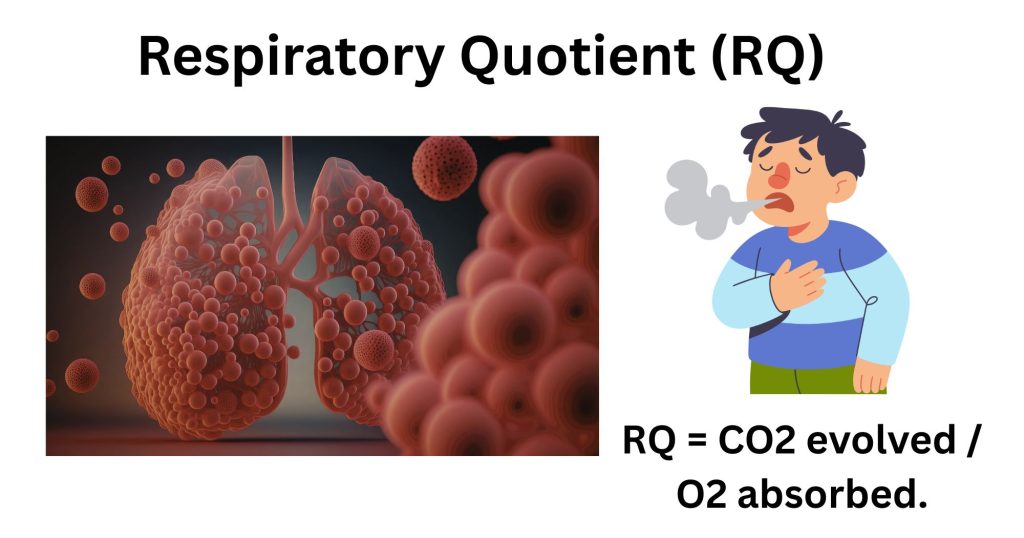
Respiratory Quotient (RQ) is the ratio of the volume of carbon dioxide that is emitted to the volume of oxygen used during respiration. It provides insight into the kind of respiratory substrate that is being utilized by an organism.
Carbohydrates, fats, proteins, and organic acids do not oxidize the same quantity of oxygen; hence, they do not produce the same amount of carbon dioxide as a result of oxidation because they differ in their chemical composition. Thus, RQ is characteristic of the metabolism that takes place in the body.
Formula of Respiratory Quotient (RQ)
The formula used to calculate RQ is: RQ = CO2 evolved / O2 absorbed.
The measurements of the two gases are done under identical temperature and pressure. The unit of RQ is non-existent since it is a ratio. Respiratory quotient is primarily meaningful during aerobic respiration, although abnormal or undefined values may be obtained under anaerobic conditions.
RQ Values of various respiratory substrates
For Carbohydrates
At respiratory substrates with carbohydrates, the RQ is 1.0. In the oxidation of carbohydrates, the quantity of oxygen used is equal to the quantity of carbon dioxide emitted. This form of respiration is typical of actively developing tissues, germinating starchy seeds, and green parts of plants.
For fats
The RQ approximates to 0.7 when the respiratory substrates are fats. The ratio of hydrogen to oxygen in fats is significantly high, hence requiring more oxygen to be totally oxidized, and the carbon dioxide produced is less. The oil seeds, such as mustard, groundnut, sunflower, and castor, are likely to undergo fat respiration during their early germination phase.
For proteins
Proteins give an RQ of about 0.8. When carbohydrates and fats are not made available, then protein respiration takes place. During protein oxidation, nitrogen is removed as nitrogenous wastes such as urea or ammonia, and since carbon dioxide is not the only end product, the RQ value varies depending on the amino acid composition.
RQ greater than one
An RQ value greater than 1.0 indicates respiration of organic acids such as malic acid or tartaric acid, which contain a higher proportion of oxygen in their molecular structure. The structure of these organic acids has more oxygen, hence they produce more carbon dioxide than the oxygen they use. Succulent plants, fleshy fruit, and ripening fruit are found to have high RQ values, and organic acids are abundant in them.
RQ less than one
Values of RQ below 1.0 represent the consumption of fats or proteins. This is of particular importance in oil seeds during germination. At first, oil seeds have low RQ values since fats are utilized as the principal respiratory substrate. The RQ increases as germination progresses because stored fats are gradually converted into carbohydrates.
RQ during seed germination
RQ assists in the comprehension of food material that is stored in seeds. RQ does not change significantly during germination in starchy seeds such as wheat and rice. RQ decreases at the beginning of the oilseed germination because of fat oxidation before it rises with a rise in carbohydrate as the major substrate. Therefore, variation of RQ during the germination process shows the metabolic alteration in the seed.
RQ Measurement: Indirect Calorimetry and Respirometry
RQ is calculated as the ratio of carbon dioxide emitted/ oxygen used up in the process of respiration. It is usually performed by indirect calorimetry, which estimates the activity of metabolism through the measurement of respiratory gases. The subject uses a mask or a mouthpiece in this method, which is attached to devices that measure the oxygen uptake and carbon dioxide output.
Respirometers are also used in plants and laboratories (the Ganong respirometer). These are the machines that detect respiratory changes in volume. Measurements are typically performed under controllable conditions, typically in darkness when working with plants, in order to exclude interference by photosynthesis. Indirect calorimetry is widely preferred because it is non-invasive, reliable, and suitable for continuous monitoring of metabolic activity.
Factors affecting RQ: diet, exercise, and metabolic state
One of the most significant aspects of RQ is diet. A carbohydrate-rich diet is associated with an increase in RQ to approximately 1.0, and a fat-rich diet is associated with RQ decrease in RQ to about 0.7. Diets that are rich in protein have intermediate RQ. Therefore, RQ is directly affected by the changes in food intake.
RQ is also dependent on the intensity of exercise. When a person is resting or doing some light activity, the primary energy source is fat, which leads to a decrease in the RQ values. The more the intensity of exercise, the more the carbohydrate that is used and the greater the RQ. During intense exercise, values greater than 1.0 may be observed due to additional carbon dioxide released during buffering of lactic acid, a condition often described as the respiratory exchange ratio rather than the true RQ.
Fat metabolism predominates during fasting or starvation, and the RQ reduces. Carbohydrate metabolism is more active during growth, recovery, or following meals, and RQ is elevated. Metabolism can be disturbed by diseases, hormone imbalances, and long-term illnesses that change the values of RQ.
Respiratory Quotient Influencing Factors in Plants
Respiratory substrate
The respired type of substrate is the most significant variable that influences the RQ. Carbohydrates exhibit a respiratory quotient of 1.0, fats provide a respiratory quotient of approximately 0.7, proteins provide a respiratory quotient of 0.8, and the organic acids provide a respiratory quotient of more than 1.0. When two or more substrates are concurrently used, RQ displays an intermediate value.
Age and type of Tissue
Young actively growing tissues tend to respire carbohydrates, and their RQ values are approximately 1.0. Mature tissues and storage tissues can be respiring fats or proteins, leading to reduced RQ values. Aberrant values of RQ in senescence tissues could be a result of disrupted metabolism.
Availability of Oxygen
Normal aerobic respiration requires an adequate supply of oxygen. In the case of a low concentration of oxygen, respiration changes into anaerobic routes. Under these circumstances, the uptake of oxygen reduces, and the production of carbon dioxide can still take place, leading to extremely high or unknown RQ. This is a common case with the waterlogged soils that affect the roots of plants.
Metabolic condition of the organism
RQ is greatly influenced by the metabolic condition of the organism. In the actively growing stage, there is a high energy demand, and carbohydrates are mostly utilized, providing high values of RQ. In the state of dormancy, starvation, or stress, fats and proteins are consumed, and the values of RQ are low.
Temperature
Heat influences the activity of enzymes and the metabolism rate. Optimal temperatures allow efficient respiration, in which RQ indicates actual use of substrates. Abnormal RQ values may be an effect of extreme temperatures that may disrupt the ordinary metabolic pathways.
Environmental Stress
Respiration is influenced by stress conditions like drought, salinity, nutrient deficiency, and flooding. Such stresses can cause plants to change their metabolism of carbohydrates to fat or protein metabolism and change the values of RQ. Anaerobic respiration and extraordinarily high RQ are common when flooding occurs.
Presence of photosynthesis
Photosynthesis involves the use of carbon dioxide and the emission of oxygen in green tissues. When RQ involves light, photosynthesis will interfere with gas exchange measurements, and therefore, RQ will not give the correct value. Thus, the measurement of RQ typically occurs in darkness.
RQ in Clinical Practice
RQ is applied in clinical practice to evaluate nutritional and metabolic conditions. A normal RQ will imply balanced nutrition, whereas abnormal values will be taken as being overfed, underfed, or having some metabolic disorders.
RQ is applicable in critical care units to deal with patients who are on artificial nutrition. An RQ of above 1.0 implies that there is too much carbohydrate intake, which escalates carbon dioxide production and may render breathing difficult among ventilated patients. A very small RQ means that the calorie intake is not enough or is excessively high. Thus, RQ assists physicians in modifying nutrition to prevent complications.
Carbohydrate metabolism cannot proceed normally in liver disease, as the liver is at the center of glucose storage and regulation. Consequently, the patients use fats and proteins more, resulting in low values of RQ. Tracking RQ assists in learning metabolic changes and designing the right diet.
Application of RQ in exercise physiology and fitness
In exercise physiology, the RQ has been employed in the investigation of the energy consumption of the body in relation to physical activity. It assists in identifying the usage of carbohydrates and fats in various exercise levels. Athletes who have a lower RQ at moderate levels have been said to be more metabolically efficient since they are able to utilize fats efficiently and maintain glycogen levels.
RQ can be used in the design of training and nutrition plans in fitness training. Endurance training decreases the RQ of a particular workload, with the increase in fat use being better. RQ would aid in enhancing stamina, minimizing fatigue, and meeting fitness objectives like weight loss.
RQ in ecology and environmental science (Plants, animals, ecosystems)
RQ is applied in the study of the respiration of seeds, roots, fruits, and other tissues in plants. It assists in determining the nature of the substrate being utilized in seed germination, in fruit ripening, and in stress situations. As an illustration, fat respiration makes oil seeds exhibit low RQ, whereas fruit with a high content of organic acids exhibits high RQ.
In animals, RQ is useful in comprehending metabolic changes in relation to diet, climate, and lifestyle. In cold areas or in hibernation, animals use more fat and exhibit reduced values of RQ.
At the ecosystem level, RQ is used to estimate the respiration rates, Carbon cycling, and flow of energy. It is applicable in the study of forest respiration, soil metabolism, and ecosystem reaction to climatic change.
Drawbacks of the respiratory quotient
RQ has several limitations. Respiration normally does not include a single substrate at a time, and therefore, RQ can be an average value of fuel instead of an individual source. RQ becomes unreliable under anaerobic conditions, oxygen deficiency, or abnormal breathing patterns.
RQ values can be distorted by factors such as hyperventilation, acid-base imbalance, and metabolic disorders. RQ is, therefore, to be interpreted in combination with physiological and environmental conditions.
Conclusion
Respiratory Quotient is a good measure of respiratory metabolism and fuel use. It assists in the study of energy application in health, illness, sport, plants, and ecosystems. Despite these shortcomings, the correct interpretation of RQ can help in generating a good understanding of the metabolic process in different biological systems.
References
- Patel, H., & Bhardwaj, A. (2023, February 13). Physiology, respiratory quotient. StatPearls – NCBI Bookshelf. https://www.ncbi.nlm.nih.gov/books/NBK531494/
- Revision Notes – Respiratory substrates and respiratory quotient (RQ) | Energy and respiration | Biology – 9700 | AS & A Level | Sparkl. (n.d.). Sparkl. https://www.sparkl.me/learn/as-a-level/biology-9700/respiratory-substrates-and-respiratory-quotient-rq/revision-notes/4300
- McClave, S., Lowen, C., Kleber, M., McConnell, J., Jung, L., & Goldsmith, L. (2003). Clinical use of the respiratory quotient obtained from indirect calorimetry. Journal of Parenteral and Enteral Nutrition, 27(1), 21–26. https://doi.org/10.1177/014860710302700121
- Goldenshluger, A., Constantini, K., Goldstein, N., Shelef, I., Schwarzfuchs, D., Zelicha, H., Meir, A. Y., Tsaban, G., Chassidim, Y., & Gepner, Y. (2021). Effect of Dietary Strategies on Respiratory Quotient and Its Association with Clinical Parameters and Organ Fat Loss: A Randomized Controlled Trial. Nutrients, 13(7), 2230. https://doi.org/10.3390/nu13072230
- Yartsev, A. (n.d.). Daily nutritional requirements of the critically ill patient. Deranged Physiology. https://derangedphysiology.com/main/required-reading/gastrointestinal-intensive-care/Chapter-115/daily-nutritional-requirements-critically-ill-patient
- Wang, S., Carter, C. G., Fitzgibbon, Q. P., & Smith, G. G. (2020). Respiratory quotient and the stoichiometric approach to investigating metabolic energy substrate use in aquatic ectotherms. Reviews in Aquaculture, 13(3), 1255–1284. https://doi.org/10.1111/raq.12522
- D, N. (2016, September 16). Notes on respiratory quotient | Plants. Biology Discussion. https://www.biologydiscussion.com/plants/respiration-plants/notes-on-respiratory-quotient-plants/51540
- Anwar, I., & Anwar, I. (2025, November 4). Respiratory quotient and Aerobic respiration: Characteristics, related terms, and application. Careers360. https://www.careers360.com/biology/respiratory-quotient-aerobic-respiration-topic-pge
- Verma, P. S., & Agarwal, V. K.Cell Biology, Genetics, Molecular Biology, Evolution and Ecology. S. Chand & Company.
- Pandey, S. N., & Sinha, B. K.Plant Physiology. Vikas Publishing House.
