Protista is an eukaryotic organism that is neither a plant nor an animal, nor a fungus. Protists are typically unicellular but can also exist as colonies of cells. Most protists live in water, in moist terrestrial environments, or parasitically.
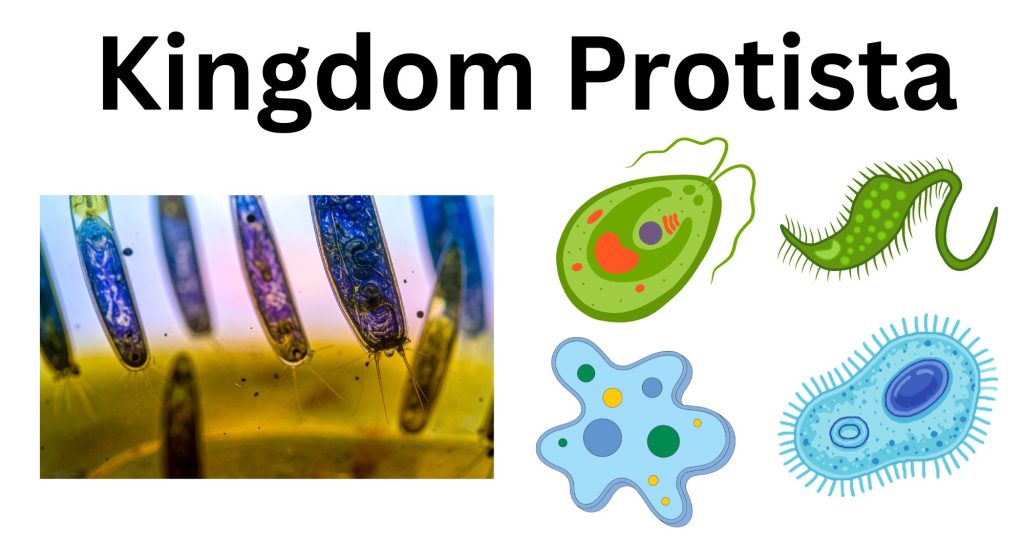
‘Protista’ is an English word taken from the Greek word “protistos”, which means “the very first”. These organisms are typically unicellular, and their cells have a nucleus that is attached to the organelles. They also have structures to facilitate locomotion, such as flagella or cilia.
Characteristics of Protists
- The only characteristic common to all protists is the fact that they are eukaryotic organisms. They contain a nucleus enclosed by a membrane.
- They are typically aquatic, found in soil or moist regions.
- They can either be autotrophic or heterotrophic.
- Members of this class show symbiosis. For example, kelp (seaweed) is a multicelled protist that gives otters shelter from predators within its dense kelp.
- Protists are seen to move due to cilia and flagella. Some organisms from the kingdom Protista possess pseudopodia by which they can move.
- Protista grows asexually. Sexual reproduction is very rare and takes place only in times of stress.
Major groups of Protista
The major groups of Protists are given below:
Protozoans- All protozoans are heterotrophs and are predators or parasites. They are also thought to be primitive, animal-like relatives.
There are four major protozoan groups.
Amoeboid protozoans: These protozoans reside in fresh water, seawater, or damp soil. They also creep and engulf their prey by extending pseudopodia (false feet), like in the case of Amoeba. Marine protozoa possess silica shells on their outer surface. A few of them, like Entamoeba, are parasites.
Flagellated protozoans: These members are free-living or parasitic. They possess flagella. Parasitic ones produce diseases like sleeping sickness. Example: Trypanosoma.
Ciliated protozoans: These are aquatic and actively mobile organisms due to the presence of thousands of cilia. They possess a cavity (gullet) opening towards the exterior of the cell surface. The synchronized movement of the rows of cilia results in the water with food being deflected into the gullet. Example: Paramoecium.
Sporozoans: This encompasses a varied group of organisms that possess an infectious spore-like stage in their life cycle. The most infamous is Plasmodium (malarial parasite), which inflicts malaria, a disease that has a climatic impact on the population of humans.
Algae– This class comprises photosynthetic, plant-like protists that are primarily aquatic and unicellular and include Chlamydomonas, Euglena, and Diatoms. They are major primary producers of aquatic communities. Some, for example Euglena, are mixotrophic and may alternate between autotrophy and heterotrophy.
Slime Molds
Slime molds are protist-like fungi with both amoeboid movement and spore production. They live as free, amoeboid cells in favorable environments, but under adverse conditions, they fuse into multicellular fruiting bodies that discharge spores. The best known is Physarum.
Cell structure of Protists
Protists’ cell structure is eukaryotic. Protists have a covering of the plasma lemma (cell membrane). It can be externally covered with pellicle, cuticle, shell, or cellulose wall. Organelles such as mitochondria, Golgi complex, endoplasmic reticulum, 80S ribosomes, etc., are present.
They possess characteristic 9+2 fibrils. Nucleus possesses a characteristic structure, a perforated nuclear envelope, chromatin, nucleolus, and nucleoplasm. Most varieties possess more than one similar or different nucleus. Centrioles are found in several types. Chloroplasts with internal thylakoids are found in photosynthetic varieties. Cilia and flagella are found in several varieties.
Protists’ nutrition
The nutrition in protists includes carbohydrates, proteins, fats, vitamins, minerals, and water. Some of the different feeding strategies adopted by the different organisms to acquire nutrients are autotrophy, heterotrophy, and mixotrophy.
The examples of nutritional modes most commonly found in protists are autotrophy, heterotrophy, and mixotrophy; these are by far not the only ones.
Autotrophic Protists- These can synthesize food through either the process of photosynthesis or chemosynthesis. Photosynthetic protists (e.g., algae) produce pigments so that they can collect sunlight and subsequently convert it into energy via photosynthesis.
There are chemosynthetic protists, including some bacteria, that do not use light to produce energy.
Heterotrophic protists- The heterotrophic protists acquire their nutrients outside. Again, they can be categorized depending on the form of nutrition-
Phagotrophic protist- Phagotrophic protists eat solid food items. This occurs through a process termed phagocytosis; the organism or animal swallows its food into a vacuole to be digested in the future. Those organisms that practice this mode of nutrition are amoebae and ciliates, with some flagellates included.
Osmotrophic protists- Osmotrophic protists obtain nutrients in their environment by the process of simple diffusion or through active transport. A majority of the parasitic protists apply this mechanism, and also include the Plasmodium protist, which is a malaria-causing parasite in human beings.
Mixotrophic protists- The mixotrophic protists are more of autotrophs or heterotrophs, depending on the environment and the nutritional demands.
Symbiosis– Several protists have developed special mechanisms to incorporate nutrition. Some dinoflagellates, for example, harbor endosymbiotic algae, which are a source of their nutrition.
Locomotion Mechanisms in Protists
Protists have three primary structures that enable them to move: flagella, cilia, and pseudopodia, which are as follows-
Flagella– Flagella are whip-like appendages that are long, either single or in pairs. They undulate or rotate to thrust or pull the cell forward through fluid. Example: Euglena uses one flagellum at the front to move.
Cilia– Cilia are brief, hair-like extensions found in numbers. They beat in a synchronized fashion to propel the organism or sweep food into the mouth aperture.
Example: Paramecium moves rapidly through the assistance of thousands of cilia.
Pseudopodia- Pseudopodia, or “false feet,” are transient extensions of the cytoplasm. The organism advances by moving its body into the elongated pseudopodium.
Example: An Amoeba moves along surfaces using pseudopodia.
Reproduction Mechanism in Protists
The following are the two significant ways of reproduction in protists. They are:
Asexual Reproduction– It includes only one parent. All the offspring formed asexually possess the same genetic make-up as the parent and are referred to as clones.
Binary Fission: It is the splitting of the parent organism into two equal daughter organisms by mitosis. Examples: Amoeba, Euglena, and Paramecium.
Multiple Fission: It refers to the division of the parent organism into multiple daughter individuals. Examples: Amoeba and Plasmodium.
Plasmotomy: It is the division of a multinucleate protist into two or more multinucleate offspring through the division of cytoplasm but not nuclear division. It takes place in Opalina.
Spore Formation: In certain protists, spores are produced for asexual reproduction. Spores possess some kind of covering to endure unfavourable conditions. When it germinates, each spore forms a new individual. Example: Slime moulds.
Budding: During budding, a small projection arises from the parent body, which becomes detached and grows into a new individual. Example: Arcella (a sarcodine)
Sexual Reproduction– It came into being in protists. Sexual reproduction consists of two basic steps: meiosis, which decreases the chromosome number from 2n to n, and fertilization, or the union of two gametes to produce a 2n zygote (fertilized egg).
There are two types of sexual reproduction:
Syngamy: Complete fusion of two gametes to form diploid zygotes.
Syngamy occurs in three forms:
- Isogamy (two fusing gametes are equal, e.g., Monocystis),
- Anisogamy (two fusing gametes are unequal, e.g., Ceratium) and
- Oogamy (large non-motile gametes are fertilized by smaller motile gametes, e.g., Plasmodium).
Conjugation– It is a temporary union of two cells to share their haploid pronuclei to form a zygote nucleus. Each cell bearing a zygote nucleus forms a daughter cell by binary fission. It happens in Paramecium.
Ecological Significance of Protists
Protists are of significant importance in ecosystems as primary producers and decomposers:
Primary Production: Photosynthetic protists such as diatoms, dinoflagellates, and Euglena create the foundation of aquatic food webs. They conduct photosynthesis, which involves the transformation of sunlight into energy and oxygen production. In oceans, phytoplankton (predominantly protists) account for more than 50% of the world’s oxygen.
Decomposition: Certain protists, such as slime molds and some protozoans, are saprotrophic, consuming dead plant tissue. By breaking down the decaying matter, they provide nutrients back to the environment and maintain soil health.
Protists in Human Health
Protists influence human life in positive and negative ways:
Beneficial Protists:
Euglena is photosynthetic as well as heterotrophic, and is commonly utilized in the laboratory for experiments and as a model organism.
Diatoms and protists similar to algae are applied in the production of filters, polishes, and even toothpaste because of their silica coverings.
Symbiotic protozoans, such as those in the gut of termites, assist in breaking down cellulose.
Pathogenic Protists: Certain protists infect and cause severe diseases in humans:
Plasmodium spp. leads to malaria, spread by female Anopheles mosquitoes.
Entamoeba histolytica results in amoebic dysentery, which contributes to intestinal issues.
Trypanosoma brucei leads to African sleeping sickness, spread by the tsetse fly.
Giardia lamblia causes giardiasis, a watery diarrheal disease due to contaminated water.
Economic significance of protists
Several important economic uses of protists exist, especially in food, biofuel, and biotechnology. Plant-like protists, Algae, are consumed worldwide as food. An example is red algae such as Porphyra, used in the preparation of sushi wrapping. Using algae, brown and green algae such as Laminaria and Ulva are eaten as sea vegetables, which have high nutritional value. Although technically cyanobacteria, blue-green algae like Spirulina are typically considered as members of the protists and have wide use as supplements due to their high concentrations of protein and antioxidants.
Some microalgae, such as Chlorella, Botryococcus, etc., are becoming relevant in the renewable energy sector because they have great potential to produce large amounts of oil that can be transformed into biodiesel. They can therefore be described as a clean source of energy that does not consume usable farm land unlike food crops.
Biotechnology also has uses with the protists. Nanotechnology, and as biological filters, Diatoms, with their complex cell wall structures of silica. Among the many materials that are provided by red algae are agar and carrageenan, which are widely used as thickeners in the food industry and perhaps also as culture media in the lab of microbiology. Organisms like Euglena (protists) are also used in scientific laboratories because Euglena has both the features of plants and animals, and a Protist is an ideal model organism. As a rule, protists are useful economically because they can be used in a multi-purpose manner in many industries.
Kingdom Protista to Eukaryotic Supergroups
All the eukaryotic life that was non-animal, non-plant, and non-fungal fell historically into the single kingdom Protista. However, with the introduction of molecular biology and intense genetic investigation, scientists discovered that the kingdom Protista was polyphyletic, i.e., it had species that did not have a common ancestor. Recent classification did therefore not follow the ancient pattern of five kingdoms, but instead it groups protists into several eukaryotic supergroups based on genetic, morphological, and evolutionary relationships.
The most important super-groups in the contemporary world are Excavata, SAR (Stramenopiles, Alveolates, Rhizarians), Archaeplastida, Amoebozoa, and Opisthokonta. These clades are better depictions of evolutionary relatedness. As an example, both green and red algae are treated as Archaeplastida alongside land plants since they have a common ancestor. Similarly, ciliates, diatoms, and apicomplexans fall under the SAR clade. Increased understanding of protist diversity may be carried out by scientists to study evolutionary lineages, understand the origins of multicellularity, and protist diversification.
Key points on Protist diversity and evolution
Protists form a highly varied collection of eukaryotic organisms that includes unicellular, colonial, and primitive multicellular organisms. They possess a wide range of nutritional pathways, including photosynthetic, heterotrophic, and mixotrophic, and a variety of locomotion factors, such as flagellates, cilia, and pseudopodia. The ecological niches of protists include primary producers, decomposers, parasites, and symbionts.
Evolution- The protist evolutionary record is considered part of the major evolutionary transitions in life on Earth, including the origin of eukaryotic cells, the endosymbiotic origin of photosynthesis, and the rise of multicellularity. They are assumed to play leading roles in the process of the appearance of complex life on the planet. It is the same as the shift of the kingdom Protista to present-day supergroups, which is the reflection of scientific growth with better tools, that is, the availability of genomic data and phylogenetics, which gives a clearer picture of life and its branching out and diversities.
Conclusion
Protists: Protists are an interesting and diverse group of eukaryotic organisms that lie on a continuum between unicellular complexity and multicellularity. Previously considered a single kingdom, modern science differentiates their advanced organic evolution by dividing them into distinct eukaryotic supergroups. Their variety of uses, in ecology, medicine, industry, and evolutionary history, contributes to their significance to nature and scientific study. It is not only an indication of the starting point of higher life, knowing of the protists, we also learn that microscopic diversity is even vital in maintaining the balance of life on earth.
References
- Protist | Classification, Characteristics & Habitat – Lesson | Study.com. (n.d.). study.com. https://study.com/learn/lesson/what-is-a-protist.html
- Libretexts. (2021, March 6). 8.3: Protist characteristics. Biology LibreTexts. https://bio.libretexts.org/Bookshelves/Introductory_and_General_Biology/Introductory_Biology_(CK-12)/08%3A_Protists_and_Fungi/8.03%3A_Protist_Characteristics
- Kingdom protista. (n.d.). BIOLOGY4ISC. https://biology4isc.weebly.com/kingdom-protista.html
- Manisha, M. (2016, September 6). Protists: Occurrence and Structure (With Diagram). Biology Discussion. https://www.biologydiscussion.com/protists/protists-occurrence-and-structure-with-diagram/52095
- Manisha, M. (2016, September 6). Modes of Nutrition in Protists: 7 modes. Biology Discussion. https://www.biologydiscussion.com/protists/modes-of-nutrition-in-protists-7-modes/52102
- The Editors of Encyclopaedia Britannica. (2025, July 19). Protist | Definition, Characteristics, Reproduction, Examples, & Facts. Encyclopedia Britannica. https://www.britannica.com/science/protist/Reproduction-and-life-cycles
- OpenStaxCollege. (2012, August 22). Ecology of protists. Pressbooks. https://pressbooks-dev.oer.hawaii.edu/biology/chapter/ecology-of-protists/
- Anwar, I., & Anwar, I. (2025, July 2). Protista: Definition, characteristics, reproduction, examples, classification. Careers360. https://www.careers360.com/biology/protista-topic-pge
- National Council of Educational Research and Training. (2006). Biology: Textbook for Class XI (Chapter 2: Biological Classification). New Delhi: NCERT.
- Pan, S. (2024, March 22). Kingdom Protista – Characteristics, classification, reproduction, life cycle, examples – Biology Notes online. Biologynotesonline.com. https://biologynotesonline.com/kingdom-protista/
