
Plant redifferentiation refers to the biological process where dedifferentiated or partially differentiated plant cells reacquire their ability to be structurally, anatomically, and physiologically specialised by losing their ability to divide again.
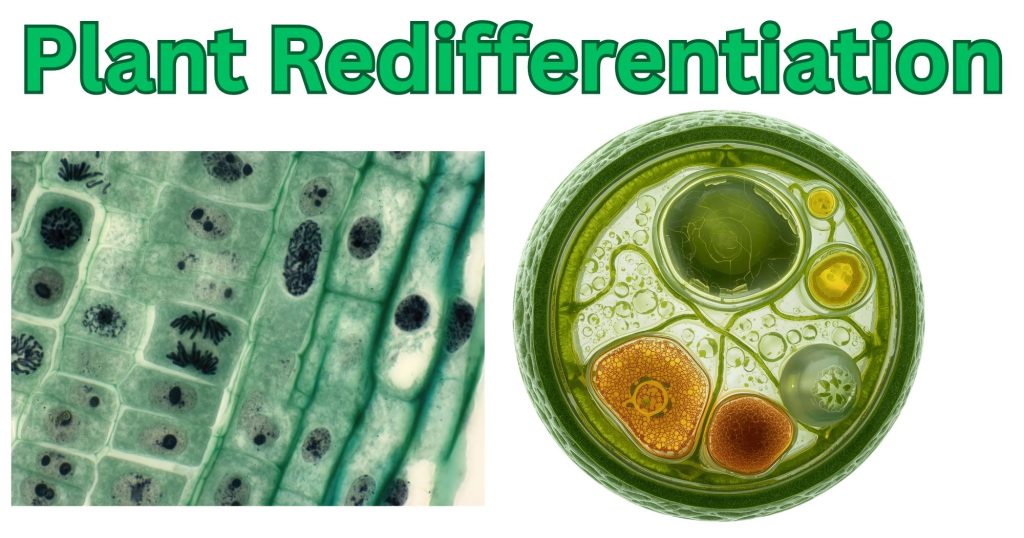
Cells develop permanent attributes in the process of redifferentiation, and these include definite shape, size, wall structure, and metabolic functioning. This process leads to the formation of mature permanent tissues and plays an important role in secondary development, tissue repair and regeneration, as well as normal development of plants.
Redifferentiation emphasises the developmental plasticity of the plant cells, and it also makes a distinction between plant and animal development.
Cellular events of redifferentiation
The actively dividing cells stop the process of mitosis and change into a sequence of well-organised cell alterations during redifferentiation.
The enlargement of the central vacuole leads to a significant extension of the cytoplasm to the cell periphery and decreases the cytoplasmic density. The nucleus is made smaller and less conspicuous, and the chromatin activity is relocated from generalised gene expression to selective gene regulation.
Cell walls are widely modified according to the tissue that is being developed.
Similarly, in mechanical and conducting tissues, there is deposition of a secondary wall, which is usually accompanied by lignification. Organelles, including mitochondria, plastids, and endoplasmic reticulum, remodel to facilitate specialised metabolic processes. The consequence of these changes is loss of totipotency and the achievement of functional stability.
Role of plant hormones in redifferentiation
The plant hormones are responsible for the regulation of redifferentiation by controlling gene expression, the maturation of the cell, and tissue patterns.
Auxin
The most significant hormones in redifferentiation are the auxin, especially in the formation of vascular bundles. The high level of auxin facilitates the process of differentiation of cambium into xylem elements by stimulating cell elongation, secondary thickening of the cell wall, and lignification. Polarity is another effect of auxin, which is necessary to have the right spatial organisation of differentiated tissues.
Cytokinin
Differentiation and maintenance of living tissues, particularly phloem elements, are the functions of cytokinins. They control cell maturation, inhibit senescence, and stimulate the differentiation of sieve tube cells and companion cells. The auxin to cytokinin ratio is important as the relative concentration of these two hormones will dictate whether the cells will divide or differentiate, or whether they will be meristematic.
Redifferentiation is also facilitated by other plant hormones. Gibberellins induce cell growth and differentiation in secondary growth, especially in the stem tissues. Ethylene has an effect on tissue maturation and senescence-related differentiation and maturation under stress. Abscisic acid is also involved in differentiation during stress conditions, enhancing stability in the cells and preventing excessive division. A combination of these hormones assures the correct redifferentiation and functioning of tissue development.
Examples of redifferentiation
Secondary xylem
A classic example of redifferentiation that occurs during secondary growth is the formation of secondary xylem. The cells that form inside the vascular cambium are redifferentiated into tracheids, vessels, xylem fibres, and xylem parenchyma. The thick and lignified secondary walls are formed by these cells, and in most instances, the protoplasm degenerates. The resulting tissue helps in water and mineral conduction provides mechanical support to the plant.
Secondary phloem
The vascular cambium also forms secondary phloem, but towards the outside. The redifferentiation of the cambium cells occurs into sieve tube elements, companion cells, phloem parenchyma, and phloem fibres. Most phloem cells are alive as opposed to xylem elements. Through redifferentiation, specialised structures, including sieve plates, are formed, which facilitate the movement of photosynthetic products in the plant more efficiently.
Phelloderm
The formation of phelloderm takes place on the cork cambium in secondary growth. The cells generated on the inner surface of cork cambium redifferentiate into living and thin-walled parenchymatous cells, normally referred to as phelloderm. The work of these cells is primarily in the storage and protection. The periderm, which is replacing the epidermis in older stems and roots with cork, is made up of phelloderm.
Redifferentiation in plant tissue culture and regeneration
Redifferentiation is observed in the dedifferentiated callus cells of plant tissue culture in acquired specialisation under regulated environmental and hormonal conditions. Callus cells experience organogenesis or somatic embryogenesis when cultured in a nutrient medium with special proportions of auxins and cytokinins. High auxin concentration favours root formation, whereas high concentration of cytokinin favours shoot formation.
The callus cells acquire structured forms during the redifferentiation, regain their polarity, and form specialised tissues, vascular components, epidermis, and meristem areas. This results in the regeneration of whole plantlets based on a mass of unspecified cells. Micropropagation, clonal multiplication, generation of disease-resistant plants, and the preservation of endangered and rare species are based on redifferentiation in tissue culture.
Epigenetic and molecular mechanisms of redifferentiation
Molecular control is needed to regulate redifferentiation by regulating the expression of genes. In such a process, there is a down-regulation of genes involved in cell division and an up-regulation of tissue-specific genes. Transcription factors are important as they control developmental gene networks, which maintain cellular identity.
The stabilisation of redifferentiation depends on epigenetic mechanisms.
Permanent silencing of meristematically-related genes is caused by DNA methylation, whereas histone modifications, including acetylation and methylation, reverse chromatin structure to permit or inhibit transcription. The accessibility of differentiation-related genes is also regulated by chromatin remodelling complexes.
These modifications in the molecule and epigenetics make sure that the redifferentiated cells do not regress to a meristematic stage under normal conditions. This type of regulation offers a stable developmental state with little flexibility in extreme circumstances like regeneration or stress.
Outer Stimuli Producing Redifferentiation
The redifferentiation of plants can be induced by various factors like mechanical damage, hormonal imbalance, and environmental stress conditions. One of the most frequent stimuli that triggers redifferentiation is that of wounds. In the case of plant tissue injury, adjacent cells dedifferentiate and redifferentiate to differentiate into specialised tissues necessary to repair the injury, e.g., wound periderm or vascular tissues. This will help in bridging the gap of the injured region and restore purposeful continuity.
Redifferentiation is also triggered by hormonal changes, which occur because of external factors. Local concentrations of auxins, cytokinins, ethylene, and abscisic acid are usually changed either by injury or by environmental signals. Such hormones control the expression of genes and direct the cells to particular differentiation routes. Redifferentiation can also be evoked by environmental stresses that alter hormonal signalling and cellular metabolism, e.g., drought, salinity, extreme temperatures, and nutrient deficiency. Redifferentiation leads to the formation of adaptive tissues in plants that help them endure an adverse environment.
Application of redifferentiation in crop improvement, cloning, and biotechnology
Redifferentiation is extensively used in horticulture, agriculture, and biotechnology. Redifferentiation is used in crop improvement programs to regenerate whole plants using cultured cells, tissues, or organs. This is a property necessary to make genetically superior crops by the use of tissue culture and genetic engineering methods.
In cloning and in micropropagation, redifferentiation makes mass reproduction of genetically identical vegetation using one parent possible. This is very helpful, especially when the crops are desired to possess desirable characteristics (high yield, disease resistance, or homogenous quality, etc.).
Redifferentiation plays an important role in biotechnology to regenerate the transgenic plants once the gene transfer has occurred. It is also applied in the production of virus-free plants, conservation of endangered species, and the maintenance of elite germplasm. Therefore, redifferentiation is the basis of contemporary plant biotechnology.
Challenges and Risks of Redifferentiation- Abnormal Growth and Somaclonal Variation
Although redifferentiation comes with its benefits, it is linked with multiple challenges and risks, particularly when done in artificial environments, such as in tissue culture. Improper balance of hormones can result in abnormal organ growth, development of tissue malformation, or uncontrolled growth. Such defects are capable of decreasing the plant’s vigour and its fertility.
Somaclonal variation is one of the greatest risks involved in redifferentiation. These are the genetic and epigenetic differences that transpire in the regeneration of plants originating from cultured cells. These differences could lead to undesirable characteristics, such as disturbed morphology, low yield, or lack of uniformity. Somaclonal variation is induced by chromosomal rearrangements, mutations, or epigenetic instability with extended culture. Hence, these risks should be mitigated by using a high level of control over culture conditions.
Environmental impacts and adaptive significance of redifferentiation
Redifferentiation has a significant role to play in adapting to the environment and stability in the ecosystem. It allows plants to regenerate lost tissues, secondary growth, and to adequately respond to environmental stress. The redifferentiation process produces specialised tissues in plants to increase water transport and mechanical strength as well as resistance to biotic and abiotic stress.
Ecologically, redifferentiation helps in the flexibility and survival of plants. It enables the plants to adjust to fluctuating conditions, stabilise the population, and assist the ecosystem processes like carbon fixation, soil erosion, and habitat development. Therefore, redifferentiation is important in adaptation and ecology.
Conclusion
Redifferentiation is a fundamental developmental process in plants, which re-establishes cellular differentiation following dedifferentiation. It involves coordinated cellular, hormonal, molecular, and environmental control and plays a role in the development of growth, regeneration, secondary development, as well as stress adaptation. The wide use of redifferentiation in biotechnology and agriculture, as well as abnormal growth and somaclonal variation, are some of the difficulties that come with redifferentiation. Altogether, redifferentiation brings forth the extraordinary developmental plasticity and adaptability of plant cells.
References
- GeeksforGeeks. (2022, September 7). Differentiation, dedifferentiation and redifferentiation in plant growth. GeeksforGeeks. https://www.geeksforgeeks.org/biology/differentiation-dedifferentiation-and-redifferentiation-in-plant-growth/
- Fehér, A. (2019). Callus, dedifferentiation, totipotency, somatic embryogenesis: what these terms mean in the era of molecular plant biology? Frontiers in Plant Science, 10, 536. https://doi.org/10.3389/fpls.2019.00536
- Molecular Mechanisms of Plant Regeneration from Differentiated Cells: Approaches from Historical Tissue Culture Systems | Plant and Cell Physiology | Oxford Academic. (n.d.). https://academic.oup.com/pcp/article/64/3/297/6956281?utm_source=chatgpt.com&login=false
- Tang, L. P., Zhang, X. S., & Su, Y. H. (2020). Regulation of cell reprogramming by auxin during somatic embryogenesis. aBIOTECH, 1(3), 185–193. https://doi.org/10.1007/s42994-020-00029-8
- Pan, H., Liao, R., Zhang, Y., Arif, M., Zhang, Y., Zhang, S., Wang, Y., Zhao, P., Wang, Z., Han, B., & Song, C. (2024). Establishment of callus induction and plantlet regeneration systems of Peucedanum Praeruptorum dunn based on the tissue culture method. Plant Methods, 20(1), 174. https://doi.org/10.1186/s13007-024-01300-5
- NCERT (Class 11 Biology), Chapter 15: Plant Growth and Development.
- SATHEE CUET: Chapter 15 Plant Growth and Development. (n.d.). https://cuet.iitk.ac.in/sathee-cuet/cuet-ug/biology/english/study-materials/ncert/nb-bio-11/bio-11-chapter-15-plant-growth-and-development/?utm_source=chatgpt.com
- NEET notes on Redifferentiation by Unacademy. (2022, June 9). Unacademy. https://unacademy.com/content/neet-ug/study-material/biology/redifferentiation/?utm_source=chatgpt.com
- Krishnamurthy, K. V. (Ed.). (2015). Growth and Development in Plants. Scientific Publishers, India.
- Bhojwani, S. S., & Razdan, M. K. (1996). Plant Tissue Culture: Theory and Practice. Elsevier/Studies in Plant Science Series.
- Bhatla, S. C., & Lal, M. A. (2019). Plant Physiology, Development and Metabolism. Springer.
