
Plant growth rate is the rate at which a plant or its components grow in size, mass, or complexity due to irreversible physiological reactions. It involves a series of irreversible changes effected by multicellular processes of cell division, cell enlargement, cell differentiation, and accumulation of organic material.
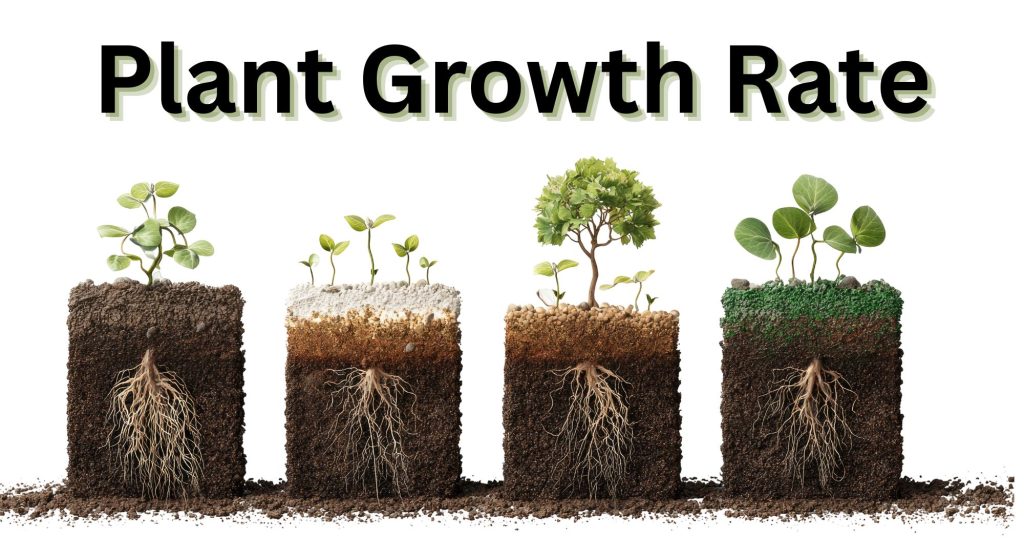
The rate of growth indicates the net difference between the anabolic rate, i. e., photosynthesis, protein, carbohydrate, and lipid biosynthesis, and the catabolic rate, i. e., respiration. Because plants grow throughout their life, the rate of growth changes with the development stage, environmental conditions, and intricate regulation processes, since plant growth is sustained by the existence of meristems.
Measuring Growth Rate: Height, Biomass, and Leaf Area Metrics
There are various ways to measure plant growth rate, each giving different physiological insights.
The most common and easiest way is to increase in height or length, which is mostly applicable in the study of stem and root elongation. Nevertheless, height is not a measure of actual growth since it fails to measure tissue density and accumulation of biomass.
A better measurement of growth is biomass measurement. It may be in terms of fresh weight or dry weight. Fresh weight contains water and can change with the state of the environment, thus dry weight measurement reflects the real amount of organic matter synthesised by photosynthesis, and thus it is applicable as the best measure of growth rate in physiological research.
Leaf area measurement is important in growth analysis, as the leaves are the main organs of photosynthesis. The growth rate is directly affected by an increase in leaf area that increases light interception and carbon assimilation.
Leaf area index (LAI) and other parameters have been widely applied in crop science to determine the canopy growth, yield potential, and productivity. Growth rate may take mathematical form in the form of absolute growth rate, AGR, and relative growth rate, RGR, to enable comparisons between plant sizes and growth stages.
Growth Stages: Lag, Exponential, Maturation, and Senescence
Growth of plants is represented by an S-shaped curve or sigmoid curve, over a period of time, which signifies the variations in growth rate within varying periods of development.
Lag phase
The first stage of growth is the lag phase, whereby cells are preparing to divide by synthesizing enzymes, nucleic acids, and structural components. However, it has low visible growth but high metabolic activity.
Exponential phase
This is succeeded by the exponential or the log phase, where the growth rate attains a high rate. This stage is marked by a high rate of cell division and lengthening of cells, resulting in an increase in biomass and size. It is the stage of greatest efficiency of growth.
Maturation phase
As growth continues, the plants reach the maturation stage, wherein there is a reduction in the growth rate. At this stage, differentiation takes place, and resources are redirected to reproductive systems and not to vegetative growth.
Senescence
The last phase is senescence, which is the end of growth, and degradation of physiological functions takes place. Senescence is the breakdown of chlorophyll, decreased photosynthesis, and programmed cell death, which is accompanied by the translocation of nutrients to growing seeds or storage organs.
Internal factors affecting Growth rate (Genetics, Hormones, Age)
Intrinsic factors are very crucial in determining the rate of growth in plants-
Genetics
The genetic composition determines the natural growth potential of a plant, which affects the height, leaf size, branching pattern, and growth period. The genetic control of differences in growth rate amongst species, varieties, and hybrids is mainly genetically regulated.
Hormones
Plant hormones are chemical regulators that coordinate growth processes on both cellular and organ levels. Auxins induce cell elongation, gibberellins induce elongation and mobilization of stored food in the stem, cytokinins induce cell division and senescence inhibition, and abscisic acid inhibits growth, especially in stress. Ethylene controls growth by affecting cell expansion, fruit ripening, and aging.
Age
The growth rate depends greatly on the age of the plant or the tissue. Tissues that are young and meristematic are highly mitotic and thus have high growth potential, whilst older and fully differentiated tissues have less or no growth potential. With the age of plants, the growth rate gradually changes to reproductive development rather than vegetative growth.
Extrinsic factors affecting Growth rate (Light, Temperature, Water, Nutrients, and CO2)
Environmental factors greatly affect plant growth by influencing metabolism and physiology.
Light
Light does have indirect and direct effects on growth. The intensity of light dictates photosynthesis, whereas the quality of light and photoperiod affect morphogenesis and developmental responses.
Temperature
Enzyme reactions to metabolism are regulated by temperature. There is a range of minimum, optimum, and maximum temperatures within which a plant species can grow. Low temperatures below or above the optimum level decrease the efficiency of the enzyme, resulting in a low rate of growth.
Water
Cell turgidity, nutrient circulation, and biochemical interactions can only be preserved by the availability of water. Water shortage decreases cell growth, stomata close, and photosynthesis, thus slowing down growth. The surplus water can also cause growth inhibition through oxygen deprivation of roots.
Nutrients
Nitrogen, phosphorus, potassium, calcium, magnesium, and micronutrients are mineral nutrients that are essential in protein synthesis, energy metabolism, and enzyme activation. Direct effects of nutrient deficiency are limiting the growth rate, and the deficiency results in typical deficiency symptoms. The rate of photosynthesis is dependent on the carbon dioxide concentration. The elevated CO2 concentrations tend to increase growth, especially in C3 plants, as the plants can fix carbon efficiently and also reduce photorespiration.
The Law of Minimum and Limiting Factors of Growth of Plants
The German scientist Justus von Liebig formulated the Law of the Minimum, which states that if one essential plant nutrient is deficient, plant growth will be poor even when all other essential nutrients are abundant.
Indicatively, in the case where we have enough nitrogen, phosphorus, potassium, light, and water, and insufficient iron, the growth of plants will be limited until the level of iron is replenished. After the iron deficiency is rectified, other limiting factors might also set in, which is how the growth limitation is dynamic.
Comparison of Growth in C3, C4, and CAM plants
The rate of growth in plants is different between C3, C4, and CAM plants because of the dissimilarity in the efficiency of photosynthesis, carbon fixation mechanisms, and water use techniques-
C3 Plants
C3 vegetation employs the Calvin cycle as the main form of carbon fixation pathway, in which CO2 is directly reduced by the enzyme RuBisCO. Nevertheless, oxygen also reacts with RuBisCO and causes photorespiration, causing loss of fixed carbon and energy. This decreases net photosynthesis and growth rate, particularly during high temperatures, intense light, and low CO2 concentration. The C3 plants, therefore, grow best in cool and moist environments.
C4 Plants
C4 plants have a spatial segregation of carbon fixation of mesophyll and bundle sheath cells. CO2 is first trapped in four-carbon compounds, which are subsequently de-carboxylated close to RuBisCO, which raises the CO2 level and inhibits photorespiration. This adaptation enables C4 plants to show an increase in growth rate, an increase in biomass accumulation, and high productivity, especially in tropical and subtropical setups. They have a great nitrogen-use efficiency, which increases the growth even more.
CAM Plants
CAM plants have the characteristic of temporal separation of fixation, whereby they fix CO2 during the night and store it in the form of organic acids. Stored CO2 is emitted to be used in photosynthesis during the day, with stomata closed to reduce water loss. Even though the use of CAM plants has high water use efficiency, the rate of growth is relatively low due to the fact that carbon uptake is constrained by storage and fixation at night.
Stress of the environment and lowering the growth rate
Drought Stress
Drought decreases the growth rate mainly because of decreased water potential, which causes decreased cell turgor pressure. This suppresses cell extension, leaf growth, and meristematic development. Closing of stomata minimizes the entry of CO2, thus reducing photosynthesis. Prolonged drought enhances the generation of reactive oxygen species (ROS) that results in oxidative stress on membranes and proteins, which leads to a further reduction of growth.
Salinity Stress
Salinity has an effect on the growth of plants via osmotic stress and ionic toxicity. The high salt content decreases water absorption, disrupts ionic equilibrium, and leads to the build-up of contrasting ions like sodium and chloride, which are toxic to the organism. The effects also render enzyme activity ineffective, cause structural damage to chloroplasts, have inhibitory effects on protein synthesis, making the growth rate slow, and lead to early senescence.
Heat Stress
Heat stress increases respiration in the process but suppresses photosynthesis, resulting in decreased carbon gain. A hot environment disrupts the integrity of the membrane, denatures enzymes, and destroys hormonal balance. The length of growth phases is also decreased, and developmental transitions are premature, decreasing total biomass gain.
Manipulating Growth Rate for Agriculture- Fertilizers, Light Management, and Hydroponics
Fertilizer Management
Availability of nutrients has a direct effect on the rate of growth, as it controls the metabolic pathways. Nitrogen encourages the vegetative growth and protein synthesis, phosphorus stimulates the transfer of energy and root formation, whereas potassium controls the activation of enzymes and osmotic equilibrium. Accurate nutrient control enhances growth efficiency as well as reduces environmental losses.
Light Management
Photosynthesis, flowering, and senescence are influenced by manipulation of photoperiod and intensity of light. The LED technology enables the quality of light to be controlled, which permits optimization of the growth rate due to the possibility of controlling the ratio of red and blue light, which affects chlorophyll synthesis and stem elongation.
Hydroponics
Hydroponic systems remove the limitations associated with soil and enable the control of the root environment. Improved oxygen levels and equal supply of nutrients lead to improvement in the rate of growth, even development, and increased yields per hectare. Hydroponics also minimizes the level of diseases and wastage of resources.
Practical Applications- Growth Rate in Crop Yield, Forestry, and Horticulture
Growth rate analysis is used in crop production to choose high-yielding varieties and to manage the crops in the best way. The rate of growth defines canopy growth, photosynthetic capacity, and yield.
Measuring growth rate is necessary in forestry to estimate rotation time, biomass production, and potential to sequester carbon. The afforestation and bioenergy production prefer fast-growing species.
Controlled growth rate is used in horticulture to guarantee homogeneous flowering, maturation of fruits, and quality aesthetics. Growth regulators have been heavily utilized to control plant size and flowering.
Monitoring Growth Rate- Tools, Sensors and Modelling Approaches
Current growth measurement techniques involve remote sensing, which includes satellites and drones, to measure vegetation measures, including NDVI, which are associated with biomass and growth rate. Plant growth under different environmental conditions can be continuously monitored with the help of automated imaging systems and machine learning models.
Growth modelling is a combination of the physiological data and the environmental variables to forecast the growth pattern and provide the results. These instruments are essential in precision farming and climate-sensitive farming.
Conclusion
The rate of growth in plants can be regarded as the composite effect of genetic potential, the physiological processes, and environmental factors. It is controlled by the internal factors like the control of hormones and the level of development, and limited by external factors like the availability of resources and the stress of the environment. Appreciating the dynamics of growth rates is essential to enhance crop production, natural ecosystems, and come up with sustainable agricultural systems. The biotechnological breakthroughs, environmental management, and modelling of growth give new possibilities to optimize the growth of plants in varying climate conditions.
References
- NCERT. (2023). Biology: Class XI, unit 15: Plant growth and development. National Council of Educational Research and Training.
- Taiz, L., Zeiger, E., Møller, I. M., & Murphy, A. (2018). Plant physiology and development (6th ed.). Sinauer Associates.
- Biology Discussion. (n.d.). Growth in plants: Definition, regions and measurement. https://www.biologydiscussion.com
- BYJU’S. (n.d.). Plant growth and development. https://byjus.com/biology/plant-growth-and-its-development/
- Vedantu. (n.d.). Plant growth and development. https://www.vedantu.com/biology/plant-growth-and-development
- Soil Management India. (n.d.). Law of minimum and limiting factors in plant growth. https://www.soilmanagementindia.com
- Unacademy. (n.d.). Measurement of plant growth. https://unacademy.com
- Khamis, G., Alsherif, E. A., Korany, S. M., et al. (2025). Drought stress differentially influences growth, physiology, and metabolite accumulation in Triticum aestivum (C₃) and Amaranthus caudatus (C₄). BMC Plant Biology, 25, 1199. https://doi.org/10.1186/s12870-025-07022-7
- Sage, R. F., & Kubien, D. S. (2007). The temperature response of C₃ and C₄ photosynthesis. Plant, Cell & Environment, 30(9), 1086–1106. https://www.researchgate.net/publication/6022742_The_Temperature_Response_of_C3_and_C4_Photosynthesis
