
Plant Differentiation is the biological process by which unspecialized, actively dividing meristematic cells develop into structurally and functionally specialized permanent cells.
Through the process of differentiation, cells undergo specific changes in size, shape, internal structure, and physiological functionality to perform certain roles in the plant body. It is through differentiation that a range of tissues and organs, like roots, stems, leaves, xylem, and phloem, are formed. When a cell becomes completely differentiated, it usually loses the ability to divide and becomes permanently specialized.
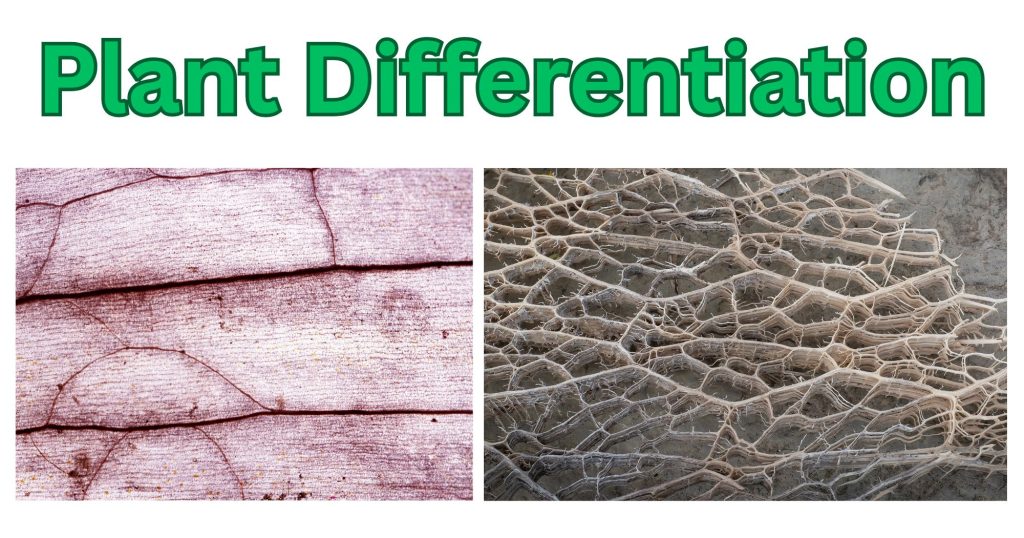
Meristematic Cells
Meristematic cells are undifferentiated cells in growing parts of the plants, like the root apex, shoot apex, and Cambium. These are tiny, living, thin-walled cells with dense cytoplasm, a large nucleus, and a small or non-existent vacuole. Continuous cell division is their main role, and new cells are used in growth and differentiation.
Some of the meristematic cells stop dividing as they start differentiating as growth continues. This transition entails modification of gene expression that directs the cell along a given path of development, which leads to the development of different permanent tissues. Therefore, all the differentiated plant tissues derive their origin from the meristematic cells.
Permanent Tissues
The meristematic cells develop into permanent tissues, having lost the property to divide. The structure and function of these tissues have categorized them into three major tissue systems.
The outer protective covering of the plant body is made of the dermal tissue system. It consists of trichomes, epidermis, and stomata. It is a tissue that safeguards the plant against mechanical damage, wasteful loss of water, and invasion by pathogens.
Transportation of water, minerals, and food takes place through the vascular tissue system. It is composed of xylem and phloem. Xylem conducts water and minerals to the aerial parts, and phloem takes the organic food materials of the leaves to the remaining parts of the plant.
The bulk of the plant body consists of the ground tissue system, which is made up of parenchyma, collenchyma, and sclerenchyma. These tissues are implicated in storage, photosynthesis, mechanical support, and metabolism.
Modifications due to differentiation- Cell Wall, Vacuoles, and Cytoplasm
The process of differentiation is also accompanied by various structural changes in the cell which are mentioned below-
Cell wall
Modification of the cell wall is one of the significant changes. Secondary wall thickening of many differentiated cells is achieved by deposition of lignin, cellulose, or suberin, a rigorous and strong component, which is observed in xylem vessels and sclerenchyma.
Vacuole
The other significant change is the increase in the size of the vacuole. The vacuoles in meristematic cells are small in size or non-existent, whereas in differentiated cells, there is a formation of a large central vacuole. This assists in turgor pressure maintenance, metabolite storage, and cell extension.
Cytoplasm
There is also a change in the cytoplasm. The cytoplasm of meristematic cells is dense, whereas differentiated cells typically exhibit lower cytoplasmic density and specialized organelles based on their function, e.g., chloroplasts in photosynthetic cells or mitochondria in active metabolic cells.
Role of hormones in differentiation- Cytokinin, Gibberellin, and Auxin
Plant hormones are also important for regulating differentiation since they affect cell behavior and gene expression, which are as follows-
Auxin
Auxin is mainly involved in the elongation of cells and the development of the vascular bundles. It enhances the xylem tissues and is important in the differentiation of roots.
Cytokinin
Cytokinin triggers cell division and shoot differentiation. It is antagonistic to auxin in the regulation of organ formation. In tissue culture, the ratio between auxin and cytokinin regulates the formation of roots or shoots.
Gibberellins
Gibberellins enhance the elongation of cells, the development of stems, and the differentiation of specific tissues. They play a special role, especially in the internodal elongation and the formation of vascular tissues. These hormones have a balanced relationship that dictates the differentiation and development of plant organs.
Differentiation in the root, shoot, and leaf- Organ Specialization
Cell differentiation leads to the development of unique organs, including roots, shoots, and leaves, that are specialized in certain physiological activities.
Roots
The differentiation of roots results in the formation of tissues which include the epidermis containing root hairs to absorb, the cortex to store, the endodermis to selectively uptake minerals, the pericycle to form lateral roots, and the vascular tissue to conduct. These specialized tissues enable roots to provide a good anchorage for the plant and help it to absorb water and soil nutrients.
Shoots
Differentiation in shoots results in the formation of support, conduction, and photosynthetic tissues. The epidermis shields the shoot and prevents water loss, and the cortex and the pith store and provide the shoot with mechanical strength. Vascular bundles divide into xylem and phloem to provide effective transportation of water, minerals, and organic nutrients. The differentiation of shoots into nodes and internodes also occurs, which allows an appropriate arrangement of the leaves and access to light.
Leaves
The photosynthetic differentiation of leaves is high. The mesophyll then differentiates to form palisade parenchyma, which has several chloroplasts to capture light effectively, and spongy parenchyma that allows the exchange of gases. Epidermal cells are developed into guard cells that control the transpiration and gaseous exchange. This specialization makes every part as physiologically efficient as possible.
Examples of Differentiation
Examples of differentiated types of vascular tissues are xylem and phloem. The xylem cells differentiate into tracheids, vessels, fibers, and parenchyma, which play a role in conveying water and providing mechanical support. Structural specialization is gained by these cells, usually by losing their protoplasm, which leads to the formation of thick, lignified cell walls.
Phloem is a structure comprising sieve tube elements, companion cells, phloem parenchyma, and fibers. These living cells then differentiate to transfer organic food materials to every part. In differentiation, the nucleus in sieve tubes is lost, and companion cells remain metabolically active to provide translocation support.
Epidermal outgrowths, which are known as trichomes, differentiate to either protect the plant against herbivores, minimize the loss of water, or secrete substances. Guard cells are distinct from epidermal cells, and their cell shape is kidney-shaped, providing them the ability to open or close stomata to control the process of transpiration and the exchange of gases.
Genetic and Molecular basis of plant Cell differentiation
Differentiation of plant cells is regulated by gene expression and not by genetic alterations. Depending on the developmental signals, particular genes are turned on or off, which causes the production of the proteins that are specialized. Transcription factors are significant in defining the fate of the cells through the regulation of developmental pathways.
DNA methylation and histone modification are also epigenetic modifications that determine the process of differentiation by making genes accessible or inaccessible. Environmental cues and signal transduction pathways triggered by plant hormones in biological systems activate molecular networks, which help guide cells towards a particular differentiation pattern. Most plant cells remain totipotent, that is, they are capable of dedifferentiating and re-differentiating to appropriate conditions, despite differentiation.
Environmental factors affecting differentiation
Environmental conditions have been instrumental in controlling the differentiation of the plant cells by modulating the expression of genes, the balance of hormones, and metabolic activities.
Light
Among the external factors, light is among the most significant factors of differentiation, particularly in aerial portions of the plant. It regulates photomorphogenesis, chloroplast differentiation, and the development of leaves. When light is present, the undifferentiated plastids, through the differentiation process, turn into chloroplasts, which allows photosynthesis to occur. By comparison, plants cultured in darkness have been observed to etiolate, which is a process involving lengthening of stems, a decrease in leaf expansion, and poor differentiation of chloroplasts, suggesting that light is vital in the normal tissue specialization process.
Water
Water availability also contributes greatly to differentiation as it controls cell expansion, the development of vacuoles, and metabolic activity. Sufficiency of water enhances proper differentiation of tissues through regulating cell turgidity and enzymatic reactions. On the other hand, differentiation may be inhibited by water stress, which can limit the extent of cell growth and the movement of nutrients. Long-term droughtful situations can cause underdeveloped vascular tissues and decreased leaf differentiation, whereas water overload or waterlogging can result in the lack of oxygen in roots, which leads to abnormal differentiation.
Nutrients
Nutrients also play a significant role in the regulation of differentiation since they provide the raw materials needed in cell division, protein synthesis, and the generation of energy. Such vital elements as nitrogen, phosphorus, potassium, calcium, and magnesium are directly related to the production of the structural components and enzymes. The absence of nutrients may affect normal differentiation, leading to retarded growth, deformed tissues, and poor organ development. Therefore, an environmental background has a profound influence on the differentiation pattern and functional efficiency of plant tissues.
The relevance of Differentiation to the Growth, Development, and Survival of Plants.
Differentiation is essential for plant growth and development, as it enables the cells to obtain specialized structures and functions. Differentiation is a process that involves the arrangement of a plant body into tissues and organs, which include roots, stems, leaves, flowers, and vascular systems. The structural organization facilitates separation of labor to cells, efficiency in the absorption of water and minerals, transportation of nutrients, photosynthesis, mechanical assistance, and reproduction.
Differentiation leads to stability and flexibility in development as well. Xylem and phloem are specialized tissues that give the system mechanical strength and efficiency in providing food, respectively. The epidermal differentiation prevents water loss and environmental degradation of plants. In the absence of differentiation, the plants would still be plain, undifferentiated masses of cells with no capacity to carry out coordinated physiological processes. As such, differentiation is not only necessary to grow but also to adapt in a changing environment in the long run.
Implementation of differentiation in agriculture and biotechnology
The knowledge of plant differentiation can be used in agriculture and biotechnology. Plant tissue culture is one of the most critical applications whose principle works on the idea of cellular totipotency. Under controlled laboratory conditions, differentiated plant cells can dedifferentiate into callus tissue and subsequently re-differentiate into a whole plant body. This method is very popular in clonal rapid propagation, the generation of disease-free plants, and the preservation of endangered plant species.
In crop improvement programs, differentiated knowledge is used to manipulate the plant growth regulators to regulate the development of tissues, flowering, and the formation of fruit. The use of genetic engineering also depends on controlled differentiation to bring out the desirable traits, such as increased yield, tolerance to stresses, pests, and diseases. Therefore, differentiation is critical in enhancing agricultural production and food security.
The Misconceptions of Plant Differentiation
The common myth about plant differentiation is that, once a cell has differentiated, it permanently becomes incapable of dividing. In practice, a large number of differentiated plant cells can dedifferentiate and re-enter meristematic activity. The second common mistake is that sometimes people think that differentiation is a modification in genetic material. The process of differentiation is regulated by the selective expression of genes and not by DNA sequence changes.
Growth is also mistakenly used with differentiation. The concept of growth is defined as an increase in cell size or numbers, whereas differentiation is defined as the attainment of specialized structure and functionality. These differences are vital to the proper interpretation of plant development processes.
Conclusion
Plant cell differentiation is a developmental process that allows the formation of special functions and organs that are required to support the growth, functioning, and survival of plants. It is controlled by genetic, plant hormones, and environmental factors like light, water, and the availability of nutrients. Differentiation enables the plants to attain structural complexity, physiological efficiency, and adaptation to environmental changes. It is used in agriculture and in biotechnology, where its significance is shown in crop enhancement, plant multiplication, and food sustainability. The differentiation concept should thus be well understood to progress the science of plants and to help tackle the world’s agricultural problems.
References
- Libretexts. (2025, July 28). 3.1.3: Plant tissues. Biology LibreTexts. https://bio.libretexts.org/Bookshelves/Botany/Botany_(Ha_Morrow_and_Algiers)/03%3A_Plant_Structure/3.01%3A_Cells_and_Tissues/3.1.03%3A_Plant_Tissues
- Plant Development I: Tissue differentiation and function | Organismal Biology. (n.d.). https://organismalbio.biosci.gatech.edu/growth-and-reproduction/plant-development-i-tissue-differentiation-and-function/
- Meindl, G. (n.d.). Chapter 12 ~ Plant Form and Physiology. Forest Ecology. https://wisc.pb.unizin.org/forestecologyoer/chapter/plant-form-and-physiology/
- Admin. (2022, August 12). Plants : Differentiation and Development Process. BYJUS. https://byjus.com/biology/plants-differentiation-and-developmental/
- SATHEE: Plant Growth and Development. (n.d.). https://sathee.iitk.ac.in/ncert-books/ncert-books-theory/class-11/nbt-bio-11/bio-11-chapter-15-plant-growth-and-development/
- Rose, R. J. (2016). Molecular cell biology of the growth and differentiation of plant cells. https://doi.org/10.1201/b20316
- Wu, W., Chen, L., Liang, R., Huang, S., Li, X., Huang, B., Luo, H., Zhang, M., Wang, X., & Zhu, H. (2025). The role of light in regulating plant growth, development and sugar metabolism: a review. Frontiers in Plant Science, 15, 1507628. https://doi.org/10.3389/fpls.2024.1507628
- Verma, P. S., & Agarwal, V. K. (2014). Cell biology, genetics, molecular biology, evolution and ecology. S. Chand Publishing.
- National Council of Educational Research and Training. (2023). Biology: Textbook for Class XI (Chapter 13, Growth and Development). NCERT. https://ncertbooks.net/textbook/pdf/kebo113.pdf
- Hussain, S., Nanda, S., Zhang, J., Rehmani, M. I. A., Suleman, M., Li, G., & Hou, H. (2021). Auxin and cytokinin interplay during leaf morphogenesis and phyllotaxy. Plants, 10(8), 1732. https://doi.org/10.3390/plants10081732
