
An oxygen concentrator is an essential medical device in modern oxygen therapy, as they provide a continuous, on-demand source of medical-grade oxygen without the need for refilling cylinders.
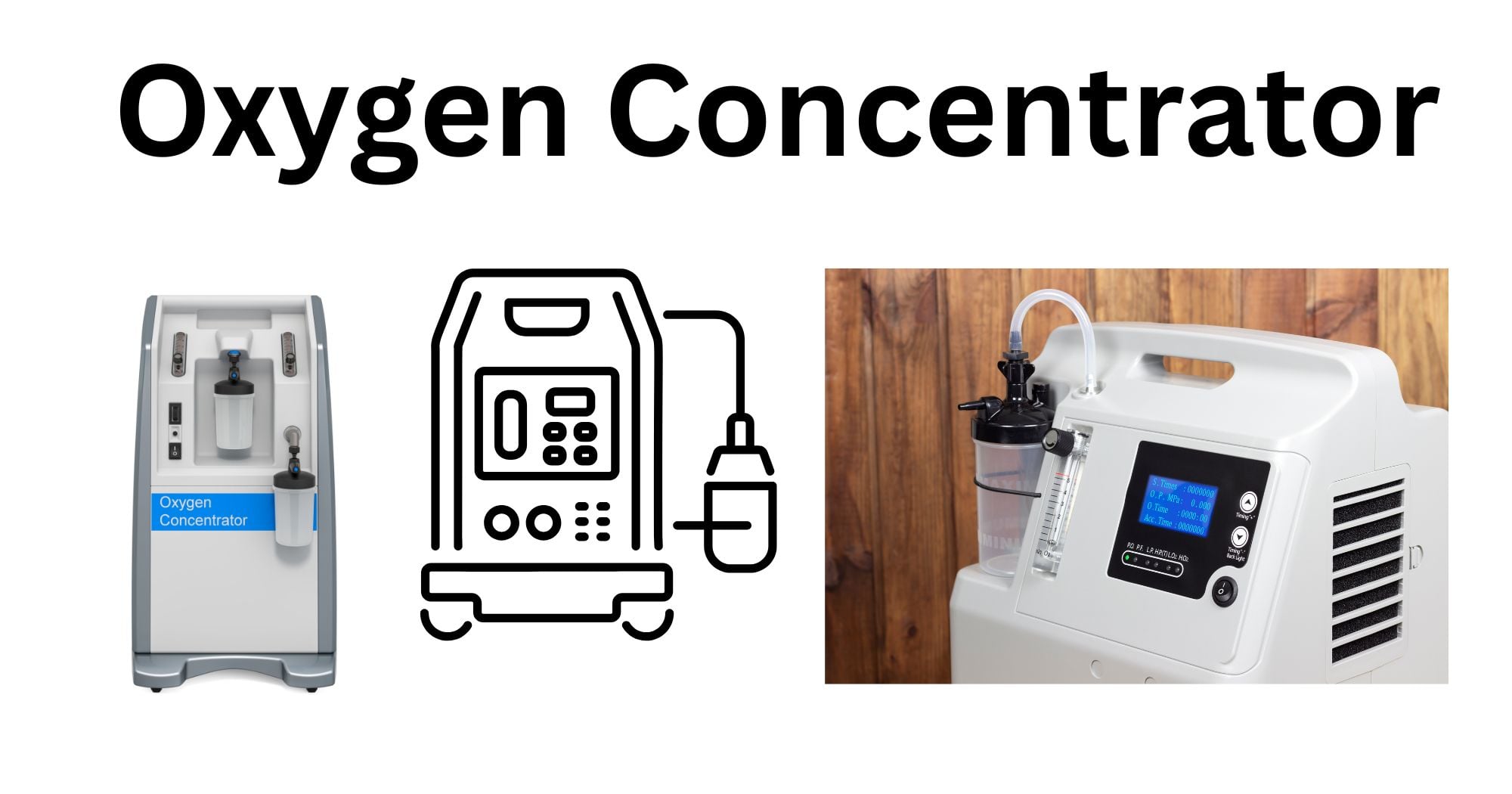
What is an Oxygen Concentrator?
An oxygen concentrator is a powered medical device that takes in room air (containing about 21% oxygen, 78% nitrogen), removes most of the nitrogen, and delivers a continuous supply of concentrated oxygen (90-95% purity) to people with hypoxemia.
Unlike traditional oxygen cylinders, which store a finite supply of compressed gas, an oxygen concentrator generates oxygen itself from surrounding air as long as a power source is available. It does so by using adsorption or membrane technologies. They are central to oxygen therapy in hospitals, clinics, homes, and disaster zones, and in low-resource environments where cylinder supply chains are unreliable. They are renewable, cost-effective, and portable alternatives for patients requiring long-term supplemental oxygen therapy.
History and Evolution
The history of supplemental oxygen dates back to the 18th century when J. Priestley isolated oxygen in 1774. However, the practical clinical application emerged in the 19th century with experiments treating pneumonia and respiratory distress. The early clinical use relied on large and impractical cylinders. The major shift came when Pressure Swing Adsorption (PSA) technology was developed in the 1960s, which made it possible to separate gases from air using zeolite molecular sieves. This then paved the way for the first stationary home oxygen concentrators in the 1970s. Since then, advances in adsorbents, miniaturization, and pulse-flow techniques have driven the development of portable oxygen concentrators (POCs), enabling ambulatory oxygen therapy and expanding use in low-resource, military, and disaster settings. The COVID-19 pandemic dramatically accelerated global demand from 2019 to 2022.
How does an Oxygen Concentrator Works?
The core mechanism used by most medical concentrators is Pressure Swing Adsorption (PSA). Atmospheric air is composed of 78% nitrogen, 21% oxygen, and 1% other gases. The concentrator selectively removes nitrogen using zeolite, whose uniform nanopores trap nitrogen molecules while allowing oxygen molecules to pass through. Zeolite is a crystalline alumino-silicate mineral. The PSA cycle is given step by step below:
- An air compressor draws in ambient air and pressurizes it.
- The pressurized air passes through a column filled with zeolite granules (molecular sieves).
- Zeoite selectively adsorbs nitrogen and other gases due to its pore structure and surface charge, and oxygen-enriched air flows towards a product tank.
- The column is depressurized, releasing the trapped nitrogen back to the atmosphere.
- A second column simultaneously adsorbs nitrogen while the first regenerates, maintaining continuous oxygen output. The cycle continues to give continuous output.
- The result is oxygen, typically approx 90-95% pure at medical flow rates.
Key Parts and Components of an Oxygen Concentrator
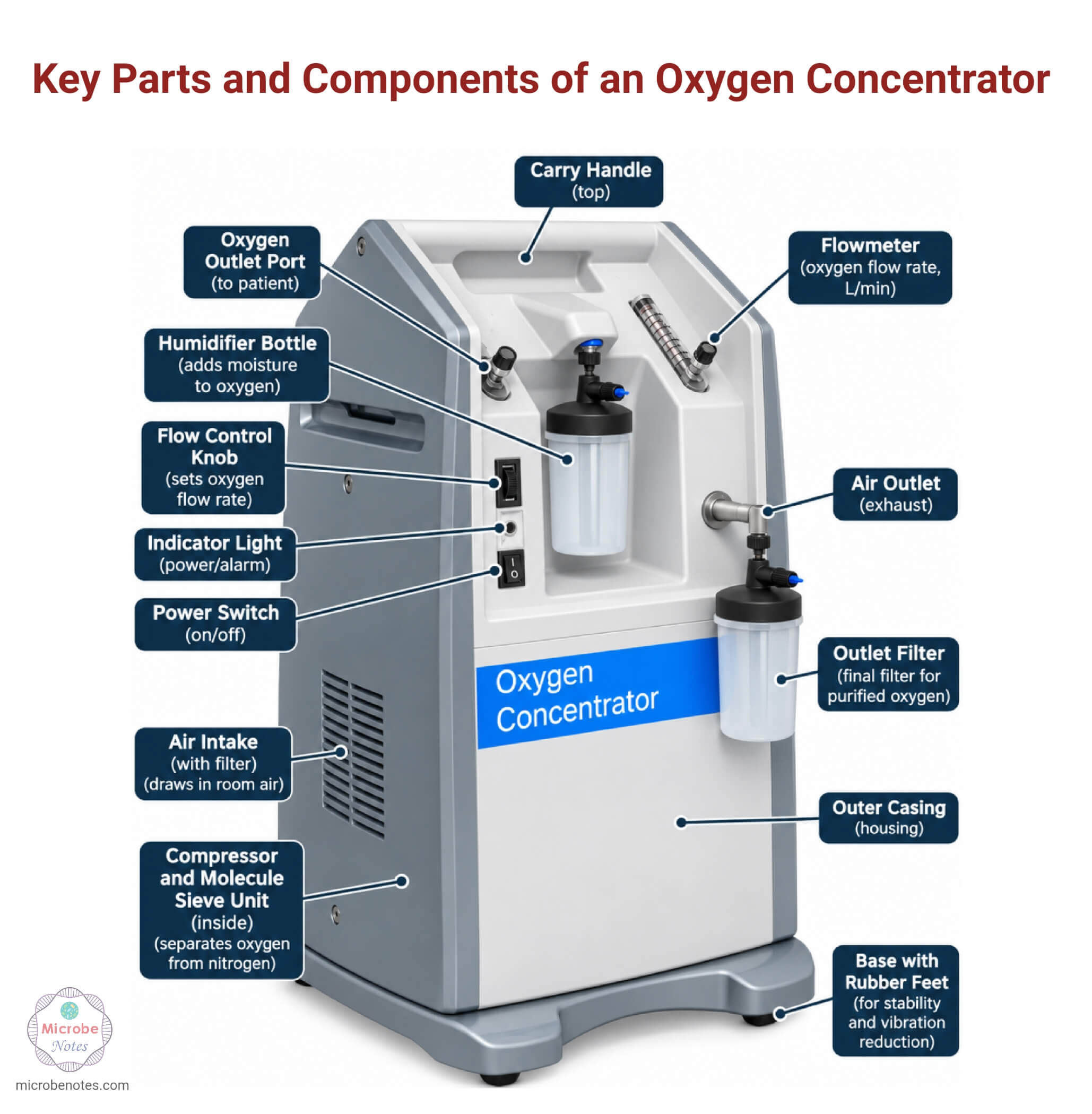
The common components of an oxygen concentrator and their functions are:
- Air compressor: It draws in air and pressurizes it to initiate the process.
- Inlet air filter: It removes dust, bacteria, and particulate matter from the air.
- Zeolite sieve beds: They adsorb nitrogen and alternate between adsorption and regeneration cycles.
- Valves: They control timed switching between the two sieve beds.
- Product tank: It stores concentrated oxygen.
- Flow meter: It regulates and displays oxygen delivery rate (L/min).
- Oxygen sensor: It monitors purity and triggers an alarm if the concentration drops.
- Outlet connector/ cannula port: It delivers oxygen to the patient via nasal cannula or mask.
- Alarm system: It alerts for low purity, power failure, or system fault.
- Power supply: It allows for portable operation.
Types of Oxygen Concentrators
There are different types of oxygen concentrators, classified by size and setting and by separation technology.
By size and setting
- Stationary or home concentrators: They are typically greater than 10 kgs used for continuous high flow for long-term oxygen therapy (LTOT) at home or hospitals. They are fixed.
- Portable oxygen concentrators (POCs): Their weight generally ranges from 1-9 kg and are designed for ambulation. They have rechargeable batteries and are ideal for travel, work, or activities. They support pulse-dose (delivering oxygen only during inhalation) or continuous flow.
By separation technology
- Molecular sieve (PSA): It consists of beds of Zeolite that act as a molecular sieve. It is the most dominant technology and provides 90- 95% purity. It is used both for stationary home concentrators and POCs.
- Membrane enrichers: They use semi-permeable polymeric membrane technology. It provides approx. 30- 50% purity. It has very niche usage in an industrial setting or wellness application.
How to Use an Oxygen Concentrator Safely and Correctly
- Place the device on a firm, flat surface at least 30 cm away from walls to allow for adequate ventilation.
- Check and clean the inlet filter.
- Attach power and humidifier (if needed).
- Connect the nasal outlet to the outlet port.
- Allow 5- 10 mins for oxygen purity to stabilize.
- Set flow rate as prescribed.
- Breathe normally.
- Document usage hours and report any alarms to the health care provider for monitoring.
Correct use generally includes certain recommendations, such as:
- Use only with a prescription and individualized oxygen dose.
- Ensure good ventilation around the device.
- Do not alter flow settings without medical guidance.
- Use the prescribed delivery system, either a nasal cannula or a mask.
Patients and caregivers need to have proper training and education for safe and correct application.
Understanding Oxygen Concentrator Parameters: Purity Levels, Flow Rate, and Battery Life
Oxygen purity levels: Medical oxygen concentrators typically provide approx. 90- 95% oxygen purity for most applications. However, flexible designs can adjust purity based on clinical needs.
Flow rate: Many home or portable devices deliver 1- 10 L/min flow rate, but higher flow rates are possible with optimized systems (up to 15-21.7 L/min in advanced designs). Portable concentrators have lower maximum flow rates of about 2- 6 L/min.
Battery life/ operating time: The battery life varies widely. It ranges from 2 to 6 hours. The average maximum continuous operating time for POCs is about 3.8 hours on portable power. It varies with flow rate, altitude, and temperature. Operation for longer hours is possible if electricity is available.
Applications and Importance of Oxygen Concentrators
Oxygen concentrators are critical in:
- Home long-term oxygen therapy (LTOT) in chronic hypoxemia.
- Rural and low-resource hospitals as a primary oxygen source.
- Disaster, military, and prehospital care, where using cylinders is difficult.
- Post-surgical recovery and anesthesia support in low-resource settings.
- COVID-19 and pneumonia management.
Oxygen concentrators are used to treat hypoxemia in conditions such as COPD, chronic bronchitis, pneumonia, and COVID-19, improving survival and quality of life. The patients regain mobility, can travel, and form social connections without worrying about the logistics of cylinder refill.
Limitations of Oxygen Concentrators
The limitations include:
- They are electricity-dependent, so unreliable in areas with unstable electric supply.
- They are unsuitable for procedures requiring 100% pure surgical oxygen, like some surgeries.
- Performance decreases with altitude due to lower surrounding oxygen density.
- A hot and humid climate may reduce zeolite efficiency.
- High initial cost and maintenance needs.
When Does a Patient Need an Oxygen Concentrator?
A patient needs an oxygen supply through an oxygen concentrator when the patient has sustained hypoxemia and chronic lung disease. The parameters for long-term oxygen therapy are:
- Resting arterial oxygen tension (PaO2) ≤ 55 mmHg or resting SpO2 ≤ 88%
- PaO2 above 55 mmHg (SpO2 ≥ 89%) but with complications like pulmonary hypertension, polycythemia, cor pulmonale, or CNS dysfunction.
- Significant desaturation (PaO2 ≤ 55 mmHg) during sleep or exercise.
Common underlying diagnoses include COPD, interstitial lung disease, pulmonary fibrosis, cystic fibrosis, pulmonary hypertension, heart failure, and severe pneumonia.
Clinical Complications: Oxygen Toxicity and Mucosal Dryness
Oxygen toxicity
Prolonged exposure to elevated FiO2 (fraction of inspired oxygen) generates reactive oxygen species (ROS), leading to alveoli damage, pulmonary edema, and acute respiratory distress syndrome (ARDS)-like pathology. Pulmonary toxicity occurs at FiO2 > 0.6 for prolonged periods but varies among patients. In neonates, excess oxygen also causes retinopathy of prematurity.
Mucosal dryness
Dry oxygen without humidification (flow rate ≥ 4 L/min) desiccates nasal and pharyngeal mucosa, causing crusting and discomfort. A humidifier attached to the device can add moisture and is recommended for higher-flow prescriptions. It causes nasal irritation, which can be relieved by saline nasal sprays.
Guidelines for Safe Operation and Avoiding Fire Hazards
Oxygen gas greatly increases combustion, so to avoid fire hazards, several guidelines have been set forth for safe operations. Safe operation guidelines emphasize the need to use concentrators in accordance with medical and technical instructions, proper placement and ventilation, and avoiding misuse. Key fire safety measures are:
- No smoking or vaping within 3 meters of the device.
- Keep away from open flames.
- Use water-based lubricants and never oil-based lubricants or flammable solvents.
- Ventilation near the device is a must, as overheating is a fire risk.
- Keep a fire extinguisher accessible.
- Use properly grounded electrical outlets and not extension cords.
Critical Maintenance: Cleaning Filters, Disinfection, and Troubleshooting Alarms
Cleaning filters: The particles trapped in the inlet filter should be removed and washed with soap and water every 1-2 weeks, rinsed, air-dried, and reinserted. The internal bacterial filter should be replaced as per the manufacturer’s recommendation (typically 6-12 months).
Disinfection: The device should be disinfected by wiping externally with 70% ethanol. The humidifier should be cleaned with soap and water, rinsed with sterile or distilled water to avoid contamination or mineral deposits, and air-dried daily.
Troubleshooting alarms: There are various kinds of alarms, such as
- Low purity/ O2 alert: Due to clogged filter, zeolite saturation, high humidity. Check or clean the filter.
- No power or power failure: Due to a main supply disruption, an unplugged damaged fuse. Switch to backup or check connections.
- High temperature: Due to blocked ventilation, the room temperature. Move the device away from the walls and ventilate the room.
- Low flow: Due to a blocked tube, a blocked cannula, or a compressor fault. Inspect the tube, replace the cannula, and service the device.
When these alarms sound, immediate action should be taken to resolve the issue, and if it cannot be resolved by basic checks, qualified personnel should be consulted.
Conclusion
Oxygen concentrators are lifesaving medical devices crucial for delivering safe, continuous, and relatively economical oxygen therapy in homes, hospitals, and low-resource environments. They work by selectively removing nitrogen and other gases from ambient air using molecular sieves and generating high-purity oxygen tailored to patient needs. They have provided a safer and more convenient alternative for bulky cylinders with smarter controls, a portable design, and delivery of more personalized and widely accessible oxygen therapy.
References
- Harris, N. D., & Stamp, J. M. (1987). Current developments in oxygen concentrator technology. Journal of Medical Engineering & Technology, 11(3), 103–107. https://doi.org/10.3109/03091908709018150
- Madankar, T. A., & Deshpande, Y. (2023). Development of Portable Oxygen Concentrator—A Review. E3S Web of Conferences, 430, 01265. https://doi.org/10.1051/e3sconf/202343001265
- What Is an Oxygen Concentrator? (n.d.). Cleveland Clinic. Retrieved June 2, 2026, from https://my.clevelandclinic.org/health/treatments/25183-oxygen-concentrators
- WHO. (2016). Technical Specifications for Oxygen Concentrators: WHO Medical Device Technical Series. World Health Organization. https://iris.who.int/server/api/core/bitstreams/6a4ae877-d02b-4db5-80d2-751090650f69/content
- Oxygen Concentrator: Uses, Types and Safety Precautions. (n.d.). Retrieved June 2, 2026, from https://www.webmd.com/lung/oxygen-concentrator-what-is
- https://intermountainhealthcare.org/ckr-ext/Dcmnt?ncid=528287605
