
- Chromatography is a crucial technique because it offers the most efficient and accurate way to separate, identify, and measure the distinct parts of very complex mixtures.
- It’s indispensable across almost every area of science and industry because it’s so versatile and sensitive, capable of analysing everything from tiny trace amounts to large quantities of substance.
- Constituents of a mixture are unevenly distributed between a stationary phase (the fixed material) and a mobile phase (the moving liquid or gas). This differential partition is the principle of chromatography that separates a mixture based on the different rates at which its components are carried through a system by a fluid.
- This difference in speed is governed by how the analytes distribute themselves, or “partition,” between two phases
- Chromatography is classified in many ways, but the most common categorization is based on the physical state of the mobile phase and the mechanism of separation.
- These techniques, mostly falling under Liquid Chromatography, separate compounds based on specific molecular properties.
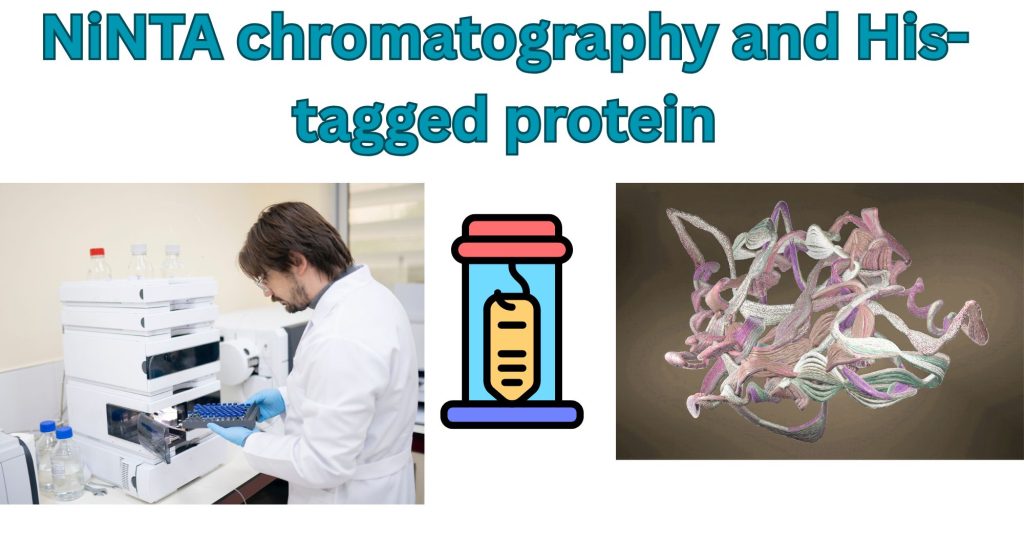
- One such important chromatography is Affinity Chromatography, where the separation is based on highly specific, temporary biological attraction between the molecule you want to isolate (the target molecule) and its designated chemical partner, known as the ligand. This allows for extremely precise separation.
- The core of the separation is that the target molecule is selectively retained by the ligand on the stationary phase, while non-binding impurities pass through the mobile phase.
- Affinity chromatography is mainly used to purify specific proteins, antibodies, or enzymes from a complex mixture.
What are His-Tagged Proteins?
- Bioengineered recombinant proteins with a short sequence of successive histidine residues (typically 6–10) fused to either their N- or C-terminus are known as histidine-tagged proteins, or His-tagged proteins.
- The His-tag coding sequence (comprised of CAC/CAT codons) is fused to the target protein’s gene.
- Since the tag is very small (only about for a tag), it’s a major benefit because it rarely disrupts the target protein’s natural structure or activity.
- These tags are affinity handles for purification, mainly by binding selectively to metal-charged resins (usually nickel or cobalt) in immobilized metal affinity chromatography (IMAC).
- His-tags facilitate streamlined protein purification from complex biological mixtures, simplifying downstream processing steps.
What is Ni-NTA Chromatography?
Ni-NTA chromatography is the leading method for quickly purifying His-tagged recombinant proteins in a single step. It’s a specialized form of Immobilized Metal Affinity Chromatography (IMAC).
- Immobilized Metal Affinity Chromatography (IMAC) is an effective technique for separating proteins by exploiting their natural attraction to metal ions that are fixed onto the chromatography column material.
- The core principle of IMAC relies on the coordinate covalent bond formed between certain electron-donating amino acid side chains on a protein’s surface and a transition metal ion.
- The solid material inside the column (chromatography beads) is chemically modified with a chelating agent (like NTA or IDA). This agent functions as a chemical claw to securely grip a divalent or trivalent transition metal ion
- Chelation is a chemical process where a molecule, known as a chelating agent, binds to a single central metal ion at multiple points. This multi-point attachment forms highly stable, ring-shaped structures called chelate complexes.
Principle and Mechanism of Ni-NTA Chromatography
- Ni-NTA, which stands for Nickel-nitrilotriacetic acid beads are used to purify histidine-tagged proteins
- Ni-NTA resin is made up of nitrilotriacetic acid (NTA) groups covalently bound to agarose or other appropriate support materials.
- NTA is a “four-toothed” (tetradentate) molecule, meaning it uses four bonds to firmly grasp the ion. This tight grip forms a very stable complex that effectively locks the nickel in place, preventing it from detaching (leaching) from the resin during the wash steps.
- It naturally has six binding spots (octahedral coordination). Since it uses up four of these spots to hold the nickel to the resin, two spots are left open.
- These two open spots are the “bait” for the target protein. The imidazole rings from the histidine residues in the bind specifically and strongly to these two vacant sites on the immobilized nickel, thereby capturing the His-tagged protein from the sample.
Protocol of Ni-NTA Chromatography
The general protocol for affinity chromatography involves a sequence of steps designed to selectively bind, wash, and release the target molecule from the column.
Preparation of the Stationary Phase
- Packing: The affinity medium (resin with immobilized ligand) is loaded into the chromatography column.
- Conditioning: The column is then saturated with Binding Buffer. This step is crucial: it sets the environment (, ionic strength) to favor the high-affinity binding of the target molecule and removes any unwanted chemical storage agents.
Binding (Loading Phase)
- Prepare Sample: Centrifuge and filter () the mixture to eliminate particulates.
- Apply Mixture: Pass the prepared sample slowly over the column.
- Adsorption: The target molecule selectively adheres to the stationary phase ligand.
- Isolate Contaminants: Collect the flow-through, which consists of non-target molecules that did not bind.
Washing
A wash step removes contaminants that have weakly or non-specifically bound to the column matrix.
- Washing: The column is washed with a sufficient volume of the Binding Buffer (or a slightly modified wash buffer).
- Result: This ensures that only the target molecule, which is tightly bound to the specific ligand, remains on the column, while all other impurities are eluted.
Elution (Recovery of Target)
The conditions are changed to disrupt the specific binding interaction, releasing the purified target molecule.
- Elution is achieved by passing an Elution Buffer through the column. This is done using one of two main methods:
- Non-Specific Elution (Change in Buffer Chemistry): The most common method involves a change in the buffer’s properties to weaken or break the non-covalent bonds (e.g., ionic, hydrogen bonds) responsible for the binding
- A milder method where a high concentration of a free ligand (or a ligand analogue) is added to the elution buffer. This free ligand competes with the immobilized ligand for the binding sites on the target molecule, effectively displacing the target from the column. For example, -tagged proteins are eluted by adding imidazole.
Regeneration of the column
The regeneration of an Immobilized Metal Affinity Chromatography (IMAC) column is essential for removing precipitated proteins, non-specifically bound contaminants, and restoring the metal ion capacity for subsequent runs.
- Wash the column with autoclaved mili-Q water thoroughly
- Resuspend the resin gently by adding 250mM of EDTA into the column
- Seal and put the column on the rocker for 10minutes for through mixing
- Let the EDTA pass out of the column and again give water washes to the column
- Add 1X NiSO4 to the column , resuspend it again and put it on the rocker for 10minutes
- Give water washing to the column
- Add 20% ethanol into the column and seal it with parafilm
Applications of Ni-NTA Chromatography
- Recombinant Protein Isolation: Utilizing IMAC (e.g., Ni2+ or Co2+) for the high-purity capture of polyhistidine-tagged proteins.
- Monoclonal Antibody Production: Large-scale industrial harvesting of IgG using Protein A/G ligands to bind the Fc region.
- Clinical Biomarker Detection: Employment of immunoaffinity matrices to isolate specific disease antigens from complex sera or plasma.
- Nucleic Acid Fractionation: Isolation of eukaryotic mRNA from total RNA using oligo(dT) cellulose to target poly(A) tails.
- Glycoprotein Characterization: Using Lectin-affinity chromatography to separate proteins based on specific carbohydrate-binding profiles.
- Vaccine and Vector Purification: Concentration of viral particles and recombinant antigens via heparin or receptor-specific ligands.
- Enzymatic Research: Purification of active enzymes using immobilized substrates, cofactors, or non-competitive inhibitors.
- Environmental & Food Safety: Extraction of trace toxins (e.g., aflatoxins) from samples for regulatory compliance and analysis.
- Drug-Target Interaction: Measurement of binding kinetics (Kd) by observing the retention of drug candidates on receptor-functionalized resins.
References
- Carter TD, Outten FW. Ni-NTA Affinity Chromatography to Characterize Protein-Protein Interactions During Fe-S Cluster Biogenesis. Methods Mol Biol. 2021;2353:125-136. doi: 10.1007/978-1-0716-1605-5_7. PMID: 34292547; PMCID: PMC8969215.
- Rubiyana, Yana & Santoso, Adi & Batubara, Irmanida. (2015). Comparison of Immobilized Metal Affinity Chromatography Ni-NTA and Co-TALON for the Purification of Recombinant Human Erythropoietin. Makara Journal of Science. 19. 10.7454/mss.v19i4.5167.
- Javanshad R, Taylor CJ, Delavari N, Barkman TJ, Stull F, Venter AR. Analysis of histidine-tagged recombinant proteins from nickel and copper coated surfaces by direct electrospray ionization and desorption electrospray ionization mass spectrometry. Rapid Commun Mass Spectrom. 2023;37(S1):e9516. doi:10.1002/rcm.9516
- https://cdn.gbiosciences.com/pdfs/protocol/786-942_protocol.pdf
- Spriestersbach A, Kubicek J, Schäfer F, Block H, Maertens B. Purification of His-Tagged Proteins. Methods Enzymol. 2015;559:1-15. doi: 10.1016/bs.mie.2014.11.003. Epub 2015 May 4. PMID: 26096499.
- Williams JD, Kampmeier F, Badar A, Howland K, Cooper MS, Mullen GED, Blower PJ. Optimal His-Tag Design for Efficient [99mTc(CO)3]+ and [188Re(CO)3]+ Labeling of Proteins for Molecular Imaging and Radionuclide Therapy by Analysis of Peptide Arrays. Bioconjug Chem. 2021 Jul 21;32(7):1242-1254. doi: 10.1021/acs.bioconjchem.0c00561. Epub 2020 Nov 26. PMID: 33241692; PMCID: PMC7611356.
