
- Autoimmunity is a condition where the body’s immune system, which is designed to protect against foreign invaders like viruses and bacteria, mistakenly attacks its own healthy cells and tissues.
- This failure to differentiate between “self” and “non-self” leads to a range of chronic inflammatory diseases.
- Celiac disease is a prime example of an autoimmune disorder.
- In genetically predisposed individuals, ingesting gluten, which is a protein present in wheat, barley, and rye, initiates an autoimmune response that damages the small intestine. This is the hallmark of celiac disease.

- This reaction isn’t an allergy or a simple intolerance; it’s a mistaken attack that causes inflammation and progressive damage to the finger-like projections in the small intestine called villi.
- Over time, this damage impairs the body’s ability to absorb essential nutrients, leading to a variety of symptoms and long-term health complications.
Definition of Celiac Disease and Distinction From Other Disorders
- Consuming gluten, a complex protein, triggers an abnormal immune response in the small intestine.
- Unlike other autoimmune disorders, Celiac is specifically triggered by a dietary component: Gluten, which is a differentiating point from other gastrointestinal diseases.
- Being an autoimmune disorder, there are several reasons underlying the initiation of this ailment. While a genetic predisposition is necessary, it is not sufficient on its own to cause the disease; hence, there are various factors contributing to the onset of this disease.
- Celiac disease is an autoimmune condition that causes damage to the mucosal lining of the small intestine when a person consumes gluten. This damage impairs the body’s ability to absorb nutrients properly.
- The small intestine is the primary locus for the absorption of essential nutrients from food.
- In autoimmune diseases, the immune system turns against the body, attacking its own healthy cells rather than foreign invaders. This self-inflicted damage is the root cause of conditions like celiac disease.
- When the immune system is unable to differentiate between the body’s own cells and foreign cells, this is where the self-tolerance is hampered and results in autoimmune disorders
Environmental Trigger of Celiac Disease
- Gluten is made of two main proteins: gliadin and glutenin. Gliadins are simple, single-chain proteins, while glutenins are larger, more complex proteins composed of multiple subunits.
- Prolamin (gliadin) is rich in amino acids -proline and glutamine, which make the digestive enzymes difficult to break down, leading to unbroken, large fragments of these proteins entering the small intestine.
- Gluten is mistaken as a foreign invader by the immune cells, which leads to villous atrophy, where the villi (finger-like projections on the surface of the small intestine) are damaged and flattened, resulting in malabsorption.
- Other environmental factors that may lead to damage to the small intestine are increased consumption of antibiotics and less fiber in the diet, intestinal viruses- primarily rotavirus and reovirus, Excessive use of pesticides and fluorinated chemicals.
Genetics of Celiac Disease
- Genetic factors are crucial to developing celiac disease.
- There are two specific genes linked to the initiation and regulation of celiac disease within the Human Leukocyte Antigen (HLA) complex.
- The inherited susceptibility to celiac disease is tied to the HLA-DQ2 and HLA-DQ8 genes, both found on chromosome 6. Having one or both of these genes is essential for developing the condition.
- Chromosome 6 comprises the Major Histocompatibility Complex, which is responsible for the immune system.
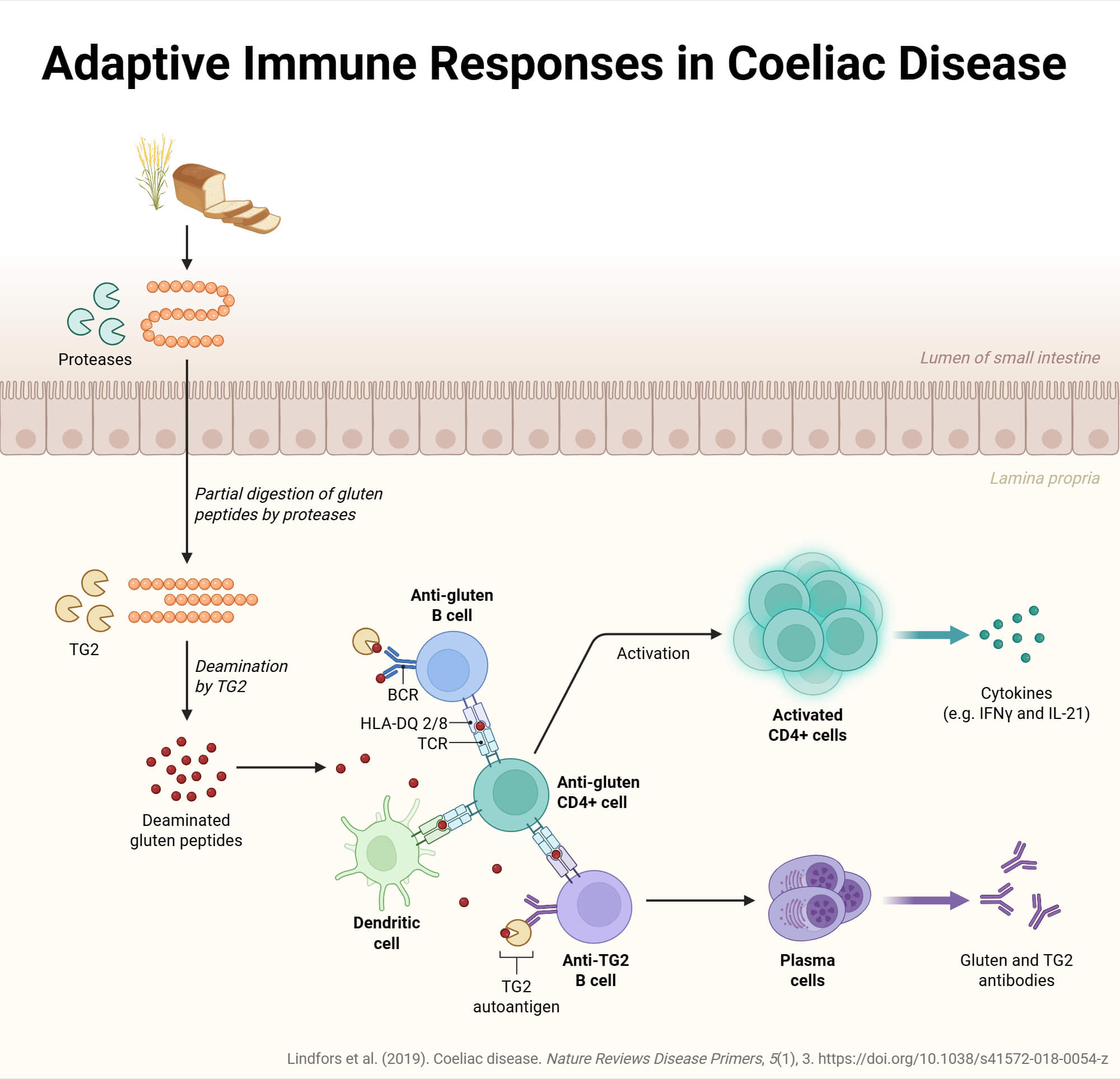
- When a genetically susceptible person, i.e., a person who has HLA-DQ2 and HLA-DQ8 genes on their chromosome, consumes gluten, the protein is broken down into gliadin and glutenin.
- Gliadin is altered by the enzyme tTG (Tissue transglutaminase). tTG’s main function is wound healing or cell death; however, in the context of celiac disease, the enzyme mistakenly identifies gliadin as a foreign invader and proceeds with the deamidation of Gliadin, which is the removal of glutamine from gliadin and converts it into glutamic acid.
- Glutamic acid carries a negative charge, and the HLA molecules have pockets within their binding grooves that carry a positive charge.
- The negatively charged glutamic acid (gliadin) shows affinity to bind to the positively charged pockets of HLA-DQ2 or HLA-DQ8 proteins. This binding triggers a powerful immune response.
- This binding of converted gliadin (glutamic acid) and HLA is then presented to T Cells, which is a central part of the immune response, leading to a mistaken immune attack.
Symptoms and Diagnosis of Celiac Disease
Celiac disease symptoms can vary greatly by age, making the condition difficult to diagnose. Some people may not show any symptoms at all.
Infants and Young Children (under 3 years):
Symptoms in this group are typically digestive and related to malabsorption.
- Chronic Diarrhoea: Frequent, watery bowel movements.
- Abdominal Bloating: A distended or swollen belly.
- Weight Loss/Poor Growth: Not gaining weight or growing as expected.
- Irritability: Can be unusually fussy or difficult to comfort.
Children and Adolescents (ages 3 to 18):
Symptoms in this age group can be more varied, often extending beyond just digestive issues
- Digestive Issues: May include abdominal pain, bloating, or constipation.
- Anaemia: Iron-deficiency anaemia is a common sign, leading to fatigue.
- Dental Defects: Pitting or discoloration of tooth enamel. Delayed
- Puberty: Overall growth can be stunted, which often results in a delay in the onset of puberty.
- Dermatitis Herpetiformis: A very itchy, blistering skin rash on the elbows, knees, and buttocks.
Adults:
Adult symptoms are often subtle and may not be digestive at all, making diagnosis difficult.
- Fatigue and Anaemia: Persistent, unexplained fatigue is a prevalent symptom.
- Joint Pain: Unexplained pain in the joints.
- Osteoporosis: The disease prevents the body from properly absorbing essential bone-building nutrients, particularly calcium and vitamin D.
- Neurological Symptoms: “Brain fog,” migraines, and tingling or numbness in the hands and feet.
- Reproductive Issues: Infertility or recurrent miscarriages.
Diagnosis of Celiac Disease
- The tTG-IgA test measures the level of tissue transglutaminase (tTG) antibodies.
- To prevent a false negative, a Total Serum IgA Test is performed to confirm that a patient has enough IgA antibodies for the primary tTG-IgA test to be reliable.
- Duodenal biopsy to check for villous atrophy (the flattening of the villi) and inflammation.
- A genetic test for the HLA-DQ2 and HLA-DQ8 genes can be used to rule out celiac disease. If a person does not have either of these genes, they are extremely unlikely to develop the condition.
Treatment of Celiac Disease
- For those with celiac disease, the only way to prevent the immune system’s damaging reaction is to eliminate all gluten from their diet.
- To correct nutritional deficiencies from before diagnosis, doctors might suggest supplements for iron, folic acid, vitamin B12, vitamin D, and calcium.
- Regular doctor’s visits are recommended to track how well the small intestine is healing.
References
- Celiac disease – Diagnosis and treatment – Mayo Clinic. (n.d.). https://www.mayoclinic.org/diseases-conditions/celiac-disease/diagnosis-treatment/drc-20352225
- Adams, S. (2025, March 12). The environmental Triggers of Celiac disease: Are we missing something? (+VIDEO). Celiac.com. https://www.celiac.com/celiac-disease/the-environmental-triggers-of-celiac-disease-are-we-missing-something-video-r6837/
- Daley, S. F., & Haseeb, M. (2025, February 4). Celiac disease. StatPearls – NCBI Bookshelf. https://www.ncbi.nlm.nih.gov/books/NBK441900/
- Siddiqui, K., Uqaili, A. A., Rafiq, M., & Bhutto, M. A. (2021). Human leukocyte antigen (HLA)-DQ2 and -DQ8 haplotypes in celiac, celiac with type 1 diabetic, and celiac suspected pediatric cases. Medicine, 100(11), e24954. https://doi.org/10.1097/md.0000000000024954
- https://www.youtube.com/watch?v=TWwvgst42IA
