
Biodiversity is the term used to describe the diversity of life forms in the world, i.e., all plants, animals, and microorganisms, as well as the various species and ecosystems they occupy.
‘Biological diversity’ was first used by Norse and Mecmenus in 1980.
The term biodiversity was invented as an abbreviation for ‘biological diversity’ by E.O. Wilson in 1985. The word ‘biodiversity’ was coined by G Rosen in 1985. Biodiversity, in simple words, is the sum of all the species.
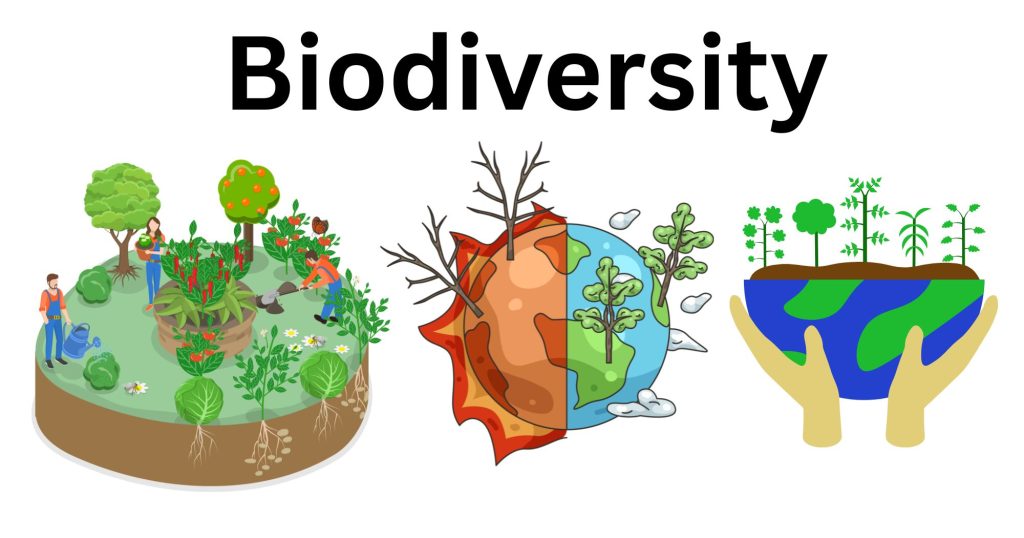
The International Union for Conservation of Nature and Natural Resources IUCN and the United Nations Environmental Program (UNEP), 1992, have defined biodiversity as the sum of og genes, species, and ecosystems of a region in the world.
As per the Convention of Biological Diversity (1992), Biodiversity has been defined as ‘the variability within and between living organisms from all sources, including terrestrial, marine and other aquatic ecosystems and the ecological complexes of which they are a part.’
Levels of Biodiversity
There are three levels of biodiversity, which are as follows:
Genetic diversity– The variation in the number and kinds of genes and chromosome organization is referred to as genetic diversity. It allows a population to cope with its environment and prepare the ground for natural selection, and it is crucial for the formation of new species (Speciation) and the maintenance of species diversity in a community.
Example- There are roughly 50,000 genetically varied strains of rice in India.
Species diversity– The variety of the organisms at the species level is termed species diversity. It indicates the diversity of the species in a region. Every species is considered to be a unit of biodiversity. In an ecosystem, every species has a specific function. In a region, some species may be present in larger quantities than others, and this includes the species richness in the region.
Example– In the Western Ghats, more amphibian species are present than in the Eastern Ghats.
Ecological diversity– The variety of organisms due to various kinds of ecosystems is referred to as ecological diversity. Ecological diversity comes under three types-
• Alpha diversity– The diversity of organisms in a small localized region is referred to as alpha diversity. It denotes the diversity of species in a community or habitat. It is also called local or point diversity.
• Beta diversity– The species diversity between various habitats within the same geographical area is known as beta diversity.
• Gamma diversity– Organismal diversity in various parts of a vast geographical region is termed gamma diversity. It is also referred to as regional diversity, and it is the diversity of habitats or ecosystems on a large scale.
Global status of Biodiversity- Current species loss rates
Biodiversity loss is growing exponentially with the rise in extinction rates, largely attributed to human-controlled factors. Currently, the rate of extinction of species is approximately 1000 to 10,000 times greater than the natural background rate. Extinction is advancing at a much faster rate than species can adjust to the changes in their environment.
The IUCN Red List concludes that 44,000 species are already facing extinction, and it is still increasing, which reflects a biodiversity crisis at a global level.
Loss of species is primarily influenced by habitat loss, climate change, overexploitation, and invasive species introduction.
Ecosystem services offered by Biodiversity
Ecosystem services offered can be categorized into four primary groups, which are provisioning services, regulating services, supporting services, and cultural services.
Provisioning Services– Provisioning services are the services that are defined as the goods that human beings receive from ecosystems. These services comprise food, water, medicinal products, and raw materials. For example, nearly half of the world’s food relies on biodiversity, with crops, fish, and livestock all using healthy working ecosystems to survive. Besides, freshwater used for human life and farming also comes from systems that store and purify water, such as wetlands and forests. The majority of drugs that have been discovered in recent history stem from natural products in animals, plants, and microbes.
Besides these, ecosystems also provide raw materials like timber, fibers, and biofuels used in building, clothing, and energy production.
Regulating Services– Regulating services are those services that govern environmental processes to maintain stability in ecosystems.
The most important regulating service is climate regulation. Forests, soils, and oceans act as sinks for carbon, capturing carbon dioxide from the atmosphere and mitigating climate change.
Pollination is another key service; approximately 75% of flowering plants require bees, butterflies, and birds for pollination to reproduce.
Wetlands and riparian zones provide water purification through the filtration of pollutants and stabilization of water cycles. Regulation of pests and diseases is another, wherein predators, parasites, and pathogens maintain harmful organisms in equilibrium without the application of chemical pesticides, hence preventing outbreaks of disease.
Supporting Services– Supporting services form the foundation upon which all other ecosystem functions are built. These supporting services encompass nutrient cycling, where organic matter breaks down, and nutrients required by animal and plant life are recycled. Soil formation is also a key process, considering that soils are essential in agriculture and plant upkeep.
Photosynthesis, the process of plants absorbing sunlight and producing oxygen, sustains life on our planet. Lastly, ecosystems provide habitat for millions of species, promoting biodiversity and guaranteeing ecosystem resilience.
Cultural Services– Biodiversity also provides cultural services that add to human enrichment. These include recreation and tourism, with natural ecosystems getting millions of tourists every year, increasing the local economy. Nature is associated with identity, with cultures enjoying certain species or landscapes as heritage.
Major threats to biodiversity- Threats to biodiversity are as follows
Habitat destruction and fragmentation– Through land clearing for industry, agriculture, infrastructure, overgrazing, and pollution due to industrialization, etc., natural habitats are lost, which finally results in habitat loss. During habitat fragmentation, a large habitat is divided into smaller ones through many human activities resulting in the decline of species.
Climate change– Climate change is also among the greatest threats to biodiversity. Increasing temperature and shifting precipitation patterns can cause species to disappear, and alter food webs and ecological processes. Climate change has the potential to drive species extinction by shifting the timing of ecological events like flowering, breeding, and immigration, breaking the ecological balance.
Pollution– It is also one of the biggest threats to biodiversity that can impact ecosystems on a global scale. It hurts species, damages habitat, and changes ecological processes, which can cause long-term loss of biodiversity. Pollution is in various forms that can impact ecosystems and species in a particular way.
Overexploitation– It is an unsustainable or uncontrolled utilization of environmental resources, resulting in disturbance and extinction of species. Some human activities that cause a reduction in the number, disturbing the overall equilibrium in the ecosystem, are included.
Introduction of invasive species– New species could be introduced that lead to competition with the native species, which may result in loss of native species and habitat alteration. For instance, the invasion of weed-like species of Lantana threatens native species.
Keystone species of Biodiversity
The species that is the central supporting hub of the ecosystem, whose loss causes a collapse in an ecosystem’s function and loss of co-existence species in an ecosystem, is called a keystone species. Keystone species exert strong impacts on community composition. Tigers, African elephants, and flying foxes are examples.
Trophic Cascade
A trophic cascade is an ecological process initiated by adding or removing top predators, which leads to drastic changes in ecosystem structure and nutrient cycling.
Trophic Levels- Trophic levels include: the primary producers (plants, algae, and phytoplankton), which refer to the first level of the food chain, herbivores (primary consumers), who eat plants and are at the second level, and carnivores (secondary consumers), which are animals that eat herbivores, and they are at the third level. Apex predators are at the top of the food chain and feed on other consumers, but are mostly not preyed upon by other animals.
Types of Trophic Cascades- Two types of trophic cascades are as follows-
Top-Down Cascades: Top-down trophic cascades occur when a top predator is introduced or removed from an ecosystem, which impacts the abundance of organisms at lower trophic levels.
Bottom-Up Cascades: Bottom-up trophic cascade is the process in which a change in the availability of primary producers (like plants or phytoplankton) or nutrients controls the rest of the food chain.
Examples of Trophic Cascades-
Sea Otters and Kelp Forests– One such example of a top-down trophic cascade exists in sea otter, sea urchin, and kelp forest coastal ecosystems.
Sea otters are the apex predators of kelp forests and feed on sea urchins, herbivores that graze on kelp. Removing sea otters would increase sea urchin populations, which would overgraze the kelp forests. Kelp provides critical habitat for a range of marine animals, so losing the kelp has cascading effects, reducing biodiversity.
Sea otters, they keep sea urchin populations in check so that kelp forests are preserved, which then supports other species, like fish, crabs, and invertebrates.
Sharks and Coral Reefs– Sharks in coral reef ecosystems are apex predators and regulate the population of small fish and other predators. When shark populations are reduced (i.e., through overfishing), the populations of smaller fish and carnivore fish (e.g., groupers and snappers) increase. These smaller fish eat herbivorous fish that graze on algae. With fewer herbivores present, algae can overgrow and destroy coral reefs as corals lose space and light to algae. Therefore, sharks’ decline indirectly drives the devastation of coral reefs in a trophic cascade.
Genetic diversity as the origin of adaptation and crop improvement
Genetic diversity is the basis on which plant breeding advancement stands. Thus, varied genetic resources have always remained of significant importance in crop improvement from wild ancestors to superior varieties. Genetic diversity occurs at individual levels, population levels, and species levels. It includes differences in alleles, gene sequence, chromosomal organization, and epigenetic variation, which result from mutation, recombination, gene flow, and natural selection.
Genetic diversity is unevenly distributed since wild varieties would be more capable than domestic ones. Genetic variation assists in adaptation based on environmental changes, while low genetic variation reduces adaptability, which can increase the risk of extinction. Genetic variation is essential in generating new varieties of crops.
Desired genes from a single or two plants are intercrossed among themselves by hybridization and sophisticated molecular tools to generate a new variety of plants.
For instance, IR8, a high-yielding rice variety, was developed as a result of cross-breeding between the Asian variety of rice and wild species.
With the relatively narrow genetic base of most of today’s crops, having access to a wide spectrum of genebank resources will be necessary in order to enable breeders to adapt crops to the extreme conditions expected under climate change, as well as breed plants with the ability to counteract them.
Plant breeders have already integrated genebank collection diversity into numerous crop cultivars, particularly for resistance to biotic stresses.
Nevertheless, the bases that define the genes have been reduced because there has been a wide use of homogeneous traits and the resulting gene erosion. Genetic erosion reduces crop resilience to pests, diseases, and environmental stress.
Biodiversity Hotspots
Biodiversity hotspots are those regions that are characteristically species-rich, especially endemic species, but are also most urgently in need of protection from human activities.
Developed by Norman Myers in 1988, the approach was designed to focus conservation efforts at the places where it is most urgently needed.
An area will qualify as a hotspot if it meets two conditions:
- It should possess a minimum of 1,500 endemic vascular plant species, and
- It should have lost at least 70% of its native vegetation.
Endemism
Endemism is the ecological status of a species being endemic to a certain geographical area. Endemic species naturally do not exist anywhere else outside that area on Earth. These species are inclined to emerge in separated habitats such as islands, mountain ranges, or isolated systems, where the exchange of genes with other populations is reduced. Endemism is a significant indicator of a region’s evolutionary uniqueness and ecological significance.
There are two general categories of endemism:
Paleo-endemism: Refers to the species that were previously found in extensive distribution but are currently restricted to a narrower extent due to environmental or geological change. They are usually relic species with extremely ancient lineages.
Neo-endemism: Includes recently evolved species that have originated within a limited area and have not yet radiated outside of it. These species usually arise through adaptive radiation in geographically or ecologically isolated areas.
Causes of Endemism
Endemism results from a synergy of ecological isolation, evolutionary pressure, stability within the environment, and restricted dispersal. Mountain ranges, deep gorges, isolated islands, and unique soil or microclimate promote the evolution of endemic species. Natural selection over long time frames, genetic drift, and mutation lead to these species diverging from their ancestral species.
Conservation Significance
Endemic species have small populations and narrow ranges and thus are especially vulnerable to extinction from habitat loss, invasive species, and climate change. The extinction of an endemic species is a complete loss to the world in terms of that lineage. As such, the conservation of endemics needs to be a priority. Endemism patterns can be used to define biogeographic boundaries, evolutionary hotspots, and high conservation priority zones.
Conservation strategies- Protected areas, restoration policy
Various methods can be applied for biodiversity conservation. These methods are divided into two major categories depending on the place of conservation. When life forms are conserved in their original habitat, it is called in situ conservation. When conservation is done outside their original habitat, it is called ex-situ conservation.
In-Situ conservation– The method of conservation of biodiversity in the natural habitat of the organism is called in-situ conservation. In situ conservation consists of hot spots and protected areas.
Protected areas– The ecological areas where biodiversity, along with natural and cultural resources, is protected, maintained, and managed through legal or other effective measures are known as protected areas.
The protected areas are National Parks, Wildlife Sanctuaries, Biosphere reserves, Reserve forests, sacred groves, and lakes.
Advantages-
- It is a cheap and convenient way of conserving biodiversity.
- The natural habitat provides the organism with sufficient space, and it can live and multiply well.
Disadvantages-
- It requires a large area of the earth’s surface with a full complement of biodiversity of a region, which minimizes the area for human activities and uses it for the needs of mankind.
- Injured or sick animals are not getting any treatment, so they are naturally exterminated.
Ex-situ conservation– The method of conservation of biodiversity outside its natural habitat in the man-made system is called ex-situ conservation. Examples are Botanical gardens, Zoological parks, wildlife parks, etc.
Advantages–
- Organisms are protected from predators.
- If a species becomes extinct, it could be recovered from a cryopreserved sample.
- Human interference is required for the effective and healthy rearing of organisms.
Disadvantages-
- Animals may not adjust to the new environment.
- It’s an expensive method and can only be adopted for a few selected species.
Economic Value of Biodiversity and Natural Capital
Biodiversity is an important part of the global economy and plays an important role in ensuring food security, climate regulation, and public health. Natural capital means natural assets such as soil, forests, water, and living organisms that generate steady ecosystem services. These services support almost every part of the economy, from agriculture and fisheries to pharmaceuticals and tourism. Mangroves, for example, shield coastlines from cyclones while benefiting fisheries, and bees pollinate crops, adding billions each year to agricultural output.
Economic valuation of biodiversity using such tools as natural capital accounting and The Economics of Ecosystems and Biodiversity (TEEB) aids in bringing to the fore the usually neglected benefits of nature to human wellbeing.
Payment for Ecosystem Services (PES) programs, in which communities are rewarded for maintaining forests or watersheds, provide incentives by which ecological sustainability becomes wedded to economic development.
Such recognition inspires its mainstreaming into planning for development, budgeting, and assessing corporate risk. Appreciating biodiversity economically supports policymakers in making better decisions that account for the real cost of environmental damage and long-term returns on conservation.
Tracking Biodiversity: from eDNA to Remote Sensing
Tracking biodiversity is crucial to understanding ecosystem health, early detection of species decline, and informing conservation action.
Certain traditional biodiversity monitoring tools are species inventories, quadrat sampling, and visual or auditory surveys. Although useful, these are normally constrained in terms of scope and necessitate a lot of manpower and time.
New technologies now augment and extend the capabilities of monitoring. Environmental DNA (eDNA) analysis, for example, enables scientists to identify the presence of species from water, soil, or air samples without capturing or observing them themselves.
This technique is especially helpful for monitoring elusive or threatened species in aquatic or closed-canopy forest habitats. Remote sensing tools, such as satellite imagery and drone-mounted LiDAR, allow monitoring at large spatial scales for forest cover, habitat fragmentation, and vegetation health. Proxies such as the Normalized Difference Vegetation Index (NDVI) aid researchers in measuring changes in vegetation productivity and stress. Geographic Information Systems (GIS) combine spatial data to plot species distribution, migration patterns, and climate effects.
Artificial intelligence is even being applied to automate species recognition from camera traps and audio recordings.
Citizen science initiatives like eBird and iNaturalist, on the other hand, involve the masses in data gathering, significantly broadening biodiversity databases.
These technological advancements allow for more accurate, timely, and comprehensive biodiversity assessments, informing both conservation policy and scientific research.
Individual’s role in biodiversity conservation
Government policies and scientific innovation are crucial for biodiversity conservation; individual actions play an equally important role in protecting the planet’s biological richness.
Every person can contribute to conservation through mindful consumption, sustainable lifestyle choices, and community involvement. Decreasing plastic consumption, eating food grown locally, purchasing certified sustainable products, and reducing waste are realistic measures that ease pressures on the environment.
Growing with native plants, not using chemical pesticides, and designing pollinator habitats in cities promote biodiversity even in built-up environments.
Citizens can also contribute to citizen science projects that gather useful ecological information, such as bird surveys or butterfly observations, which contribute to global conservation databases. Volunteering with local conservation groups, contributing to afforestation initiatives, and donating to wildlife charities are other ways of helping. Informing others about biodiversity importance, pushing for green policies, and spreading the word via social media or school initiatives can also create a ripple effect within communities.
Respecting and aiding Indigenous conservationists by buying responsibly, engaging in responsible tourism, or speaking up on their behalf completes the circle of biodiversity protection. Fundamentally, daily choices, when aggregated over a million people, have the capability to turn around the decline in biodiversity and create a more sustainable relationship with nature.
Conclusion
Biodiversity is the premise of life on our planet, supporting ecosystem resilience, economic well-being, and cultural heritage. From tiny microbes to great trees and top predators, every species contributes to keeping natural systems in balance. Yet this wonderful diversity of life is facing growing threats from human actions like habitat loss, climate change, pollution, overhunting and overharvesting, and invasive species. The degradation of biodiversity not only threatens ecological processes but also food security, public health, and global development.
Conservation is done by protected areas, community stewardship, restoration ecology, or policy institutions, which are the keys to arresting and reversing biodiversity decline.
Synthesizing new technologies such as remote sensing and eDNA with indigenous ecological knowledge provides novel avenues for effective management and sustainable monitoring. Additionally, quantifying the economic value of biodiversity and natural capital enables the integration of ecological considerations in planning and policy across all levels.
Finally, the conservation of biodiversity is not only the job of governments or scientists. It will need a combined effort from people, communities, institutions, and countries. Only through participatory, science-informed, and ethically guided actions can we ensure that biodiversity will flourish not just for its intrinsic worth, but for the welfare of current and future generations.
References
- Contributors, N. I. (2024, August 22). Biodiversity: Definition, Levels, Components & More. NEXT IAS Blog. https://www.nextias.com/blog/biodiversity/
- Rafferty, & P, J. (2025, June 11). Biodiversity loss | Causes, Effects, & Facts. Encyclopedia Britannica. https://www.britannica.com/science/biodiversity-loss
- How many species are we losing? (n.d.). WWF. https://wwf.panda.org/discover/our_focus/biodiversity/biodiversity/
- Weiskopf, S. R., Rubenstein, M. A., Crozier, L. G., Gaichas, S., Griffis, R., Halofsky, J. E., Hyde, K. J., Morelli, T. L., Morisette, J. T., Muñoz, R. C., Pershing, A. J., Peterson, D. L., Poudel, R., Staudinger, M. D., Sutton-Grier, A. E., Thompson, L., Vose, J., Weltzin, J. F., & Whyte, K. P. (2020). Climate change effects on biodiversity, ecosystems, ecosystem services, and natural resource management in the United States. The Science of the Total Environment, 733, 137782. https://doi.org/10.1016/j.scitotenv.2020.137782
- Trophic cascades across diverse plant ecosystems | Learn Science at Scitable. (n.d.). https://www.nature.com/scitable/knowledge/library/trophic-cascades-across-diverse-plant-ecosystems-80060347/
- https://doi.org/10.1016/j.biocon.2019.06.024
- Dyson, K., Nicolau, A. P., Tenneson, K., Francesconi, W., Daniels, A., Andrich, G., Caldas, B., Castaño, S., De Campos, N., Dilger, J., Guidotti, V., Jaques, I., McCullough, I. M., McDevitt, A. D., Molina, L., Nekorchuk, D. M., Newberry, T., Pereira, C. L., Perez, J., . . . Saah, D. (2024). Coupling remote sensing and eDNA to monitor environmental impact: A pilot to quantify the environmental benefits of sustainable agriculture in the Brazilian Amazon. PLoS ONE, 19(2), e0289437. https://doi.org/10.1371/journal.pone.0289437
- Granqvist, E., Goodsell, R. M., Töpel, M., & Ronquist, F. (2025). The transformative potential of eDNA-based biodiversity impact assessment. Current Opinion in Environmental Sustainability, 73, 101517. https://doi.org/10.1016/j.cosust.2025.101517
- 5 Ways Protecting Biodiversity Helps the Climate – Legacy Landscapes Fund. (2023, December 8). https://legacylandscapes.org/2023/12/5-ways-protecting-biodiversity-helps-the-climate/
- Biodiversity Why it matters and how we can help protect it | CEMASYS. (n.d.). https://www.portal.cemasys.com/post/biodiversity-why-it-matters-and-how-we-can-help-protect-it
- NCERT. (2023). Biology: Textbook for Class XII. New Delhi: National Council of Educational Research and Training, pp. 260–274.
