
- Industrial wastewater, a hazardous liquid byproduct from manufacturing, poses a major threat to the global environment and public health.
- This effluent contains a dangerous mixture of pollutants, including heavy metals (such as lead and mercury), toxic organic chemicals (solvents and dyes), and high levels of nutrients.
- When this wastewater is untreated or improperly treated and released into rivers, lakes, or coastal waters, it causes widespread contamination and ecological harm.
- Because of its dangerous composition, industrial wastewater must adhere to strict regulations and undergo specialized treatment (involving physical, chemical, and biological methods) to ensure it is safe for discharge or suitable for reuse.
- Zero Liquid Discharge (ZLD) represents a highly engineered and comprehensive methodology for industrial wastewater management, fundamentally designed to achieve net-zero liquid effluent discharge to the environment.
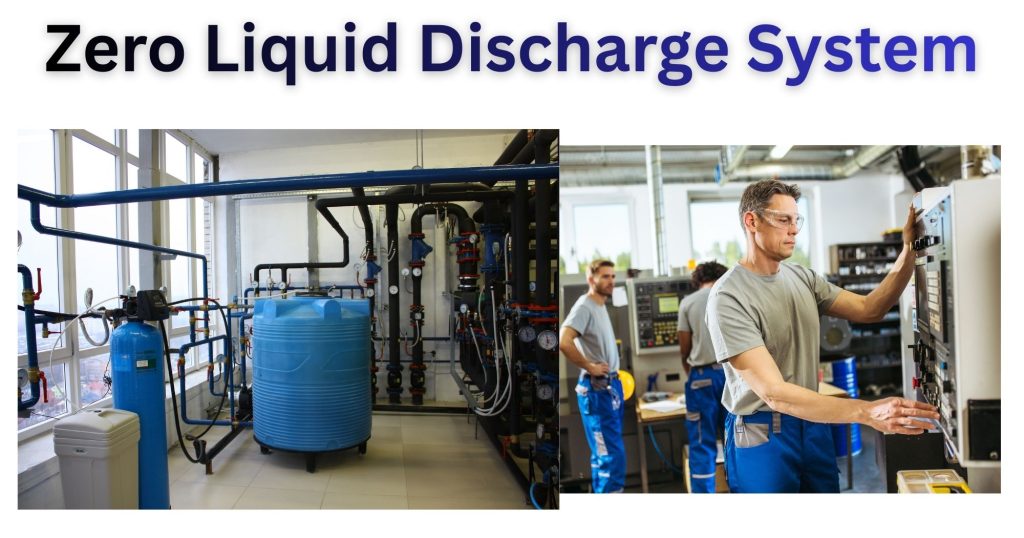
- This advanced strategy is predicated upon the dual imperatives of mitigating environmental pollution and addressing acute water resource constraints. ZLD systems utilize a sequence of systemic purification processes to maximize the recovery and internal recycling of wastewater.
- The constituent pollutants are hyper-concentrated into a minimal volume of solid or crystalline residue, facilitating secure disposal or, in advantageous cases, the valorisation of recovered resources. This approach transforms industrial effluent from an environmental liability into a reusable resource
How does Zero Liquid Discharge (ZLD) work?
The working of a ZLD plant can be divided into 3 main processes:
Pre-treatment
- For any wastewater system, the pre-treatment process is a major step to lay the foundation of a successful process
- Pre- treatment is a crucial step for ZLD, designed to prepare the industrial wastewater for the more advanced and sensitive downstream processes, such as membrane filtration (Reverse Osmosis) and thermal processes (Evaporation and Crystallization).
- The primary goal of pretreatment is to remove gross impurities and prevent scaling and fouling of the expensive equipment used in later stages, which significantly enhances the overall efficiency and longevity of the ZLD system.
- The exact configuration of the pretreatment section is highly dependent on the specific wastewater’s composition, but generally involves a combination of physical and chemical processes.
- The very first step in pre-treatment is screening and equalization in which large, coarse solids are removed to shield the pumps and downstream equipment.
- The wastewater is collected in a large tank to mix and homogenize the stream, which helps to buffer variations in flow rate, concentration, and temperature, ensuring a consistent feed to the subsequent treatment units.
- After homogenizing, the water is subjected to chemical treatment, which converts dissolved scale-forming ions into insoluble solids (precipitates) .pH correction is carried out during this step due to the presence of scale-forming ions such as calcium, magnesium, and other heavy metals
- Wastewater’s pH is increased (made alkaline) through the addition of chemicals like lime or caustic soda. This elevated pH environment drastically reduces the solubility of these contaminants, causing them to precipitate as solid hydroxides or carbonates. Once converted into solids, these precipitates can be easily separated and removed through filtration or settling.
- Chemicals (coagulants like alum or ferric chloride) are added and rapidly mixed. These chemicals neutralize the charge on fine suspended and colloidal particles, causing them to clump together.
- The water is gently stirred after a polymer (flocculant) is added. This causes the small clumps to collide and stick together, forming larger, settleable particles called flocs.
- Processes like cold-lime softening are used to precipitate calcium and magnesium hardness, as well as silica and heavy metals, preventing them from forming scale in evaporators and on membranes.
- The wastewater moves into a clarifier (settling tank), where the heavy flocs and precipitated solids sink to the bottom by gravity, forming a dense layer called the sludge blanket. The cleaner, treated water, known as supernatant, then flows out over the top.
- Following this, the concentrated sludge is sent for dewatering. Equipment like a filter press or belt press squeezes out the remaining moisture, maximizing water recovery and leaving behind a compact solid waste cake that is ready for disposal or potential repurposing.
- After dewatering, media filtration is done, where the water flows through beds of granular material (like sand or coal) to clear out residual suspended solids and turbidity.
- Before the water goes to high recovery concentration stages, a final pH adjustment is done for anti- scaling of the downstream equipment and membrane
Evaporation
- Evaporation, using technologies like Multi-Effect Evaporators MEE or Mechanical Vapor Recompression MVR, is essential for reclaiming the vast majority of water
- Evaporators are designed to recover 90-99% of the water from the incoming concentrated wastewater stream (brine).
- The water vapor is condensed into high-purity distillate (condensate), which is clean enough to be recycled back into sensitive industrial processes, such as boiler feed water or cooling tower makeup
- The concentrated liquid stream (brine) that remains after water has been removed is continuously discharged from the evaporator.
- This small volume of highly concentrated brine (now often near its saturation limit) is sent to the Crystallizer to achieve the final step of ZLD, converting the liquid into a dry solid.
Crystallization
- This is the final step in ZLD, where the separation of solid and liquid takes place. Its purpose is to take the highly concentrated brine (the reject stream from the evaporator) and recover the last remaining water while converting all dissolved salts into a dry solid product suitable for disposal or potential reuse.
- Crystallization is a solid-liquid separation technique used to purify substances by forming solid crystals from a dissolved solute in a solution
- The process is driven by creating supersaturation, a condition where the solute concentration is higher than its solubility limit. The core mechanism involves two main, simultaneous stages:
- Nucleation (Birth): The initial formation of tiny, stable solid clusters called nuclei (or “seeds”). The upstream evaporator achieves this by removing water, which makes the brine unstable because the salts now exceed their maximum saturation point.
- Crystal Growth (Maturity): Solute molecules attach to the nuclei in a highly ordered, repetitive pattern to form larger, pure crystals, actively excluding impurities from the crystal lattice.
- The ultimate crystal size and shape (morphology) is tightly controlled by balancing the following operational factors:
- Temperature: Affects solubility and the rates of both steps.
- Degree of Supersaturation: The primary driving force.
- Agitation/Mixing Rate: Influences mass transfer and the creation of new seeds through secondary nucleation.
- These two stages, nucleation (the birth of new, small crystals) and crystal growth (the maturing of existing crystals), occur simultaneously.
- The balance between their respective rates dictates the final properties of the recovered solid.
- For instance, a high nucleation rate relative to growth produces many small crystals, whereas a high growth rate with low nucleation yields fewer, larger crystals.
Key Drivers for Zero Liquid Discharge (ZLD) Adoption
The decision to implement ZLD is generally driven by a combination of factors:
- Regulatory Compliance: Meeting increasingly strict government mandates that prohibit or severely limit the discharge of industrial effluents, especially in environmentally sensitive or highly polluted areas.
- Water Scarcity: Maximizing water reuse and minimizing reliance on increasingly expensive or diminishing freshwater resources.
- Resource Recovery: Recovering valuable materials (such as sodium sulphate, lithium, or other specialty chemicals/salts) from the waste stream, turning a disposal cost into a revenue opportunity.
- Corporate Sustainability Goals: Enhancing public image and demonstrating a commitment to environmental responsibility and the circular economy.
Applications of Zero Liquid Discharge (ZLD)
- Chemical & Petrochemical: Treats complex, hazardous process effluents and recovers valuable salts and chemicals
- Textile & Dyeing: Eliminates the discharge of coloured, high-salt wastewater and reclaims salts for reuse.
- Pharmaceuticals: Manages wastewater containing drug residues and solvents to ensure environmental safety and water purity.
- Mining & Metallurgy: Treats highly mineralized wastewater, preventing heavy metal pollution and often recovering resources.
- Food & Beverage: Recycles high-volume, organic-load wastewater to reduce consumption and meet hygiene standards.
- Inland Desalination: Manages and crystallizes concentrated brine reject from RO plants where ocean discharge is not an option.
References
- What is Crystallizers in Zero liquid discharge systems https://www.netsolwater.com/crystallizers-in-zero-liquid-discharge-systems.php?blog=3484
- https://www.youtube.com/watch?v=kdSbRkTKF8c
- https://www.youtube.com/watch?v=sgbjG4gIwLU
- Mane, A. A., & Bhosale, S. M. (2022). Study and Implementation of Zero Liquid Discharge System in Shivaji University Campus. International Journal of Engineering Research & Technology IJERT, 11, 212–216.DOI: 10.17577/IJERTV11IS070212
- Liang, Y., Lin, X., Kong, X., Duan, Q., Wang, P., Mei, X., & Ma, J. (2021). Making Waves: Zero Liquid Discharge for Sustainable Industrial Effluent Management. Water, 13(20), 2852.DOI: 10.3390/w13202852
- How ZLD is Transforming Industrial Water Management with Genviss https://genviss.in/zld-transforming-industrial-water-management/
- https://admisionposgrado.unsch.edu.pe/fulldisplay/Aj255Q/5S9098/water__treatment__exam__questions-and-answers.pdf
- https://pubmed.ncbi.nlm.nih.gov/34783327//
