
The measurement of Total Solids (TS) is an absolute necessity in water and wastewater analysis because it serves as the foundational parameter for quantifying the total physical content of pollution.
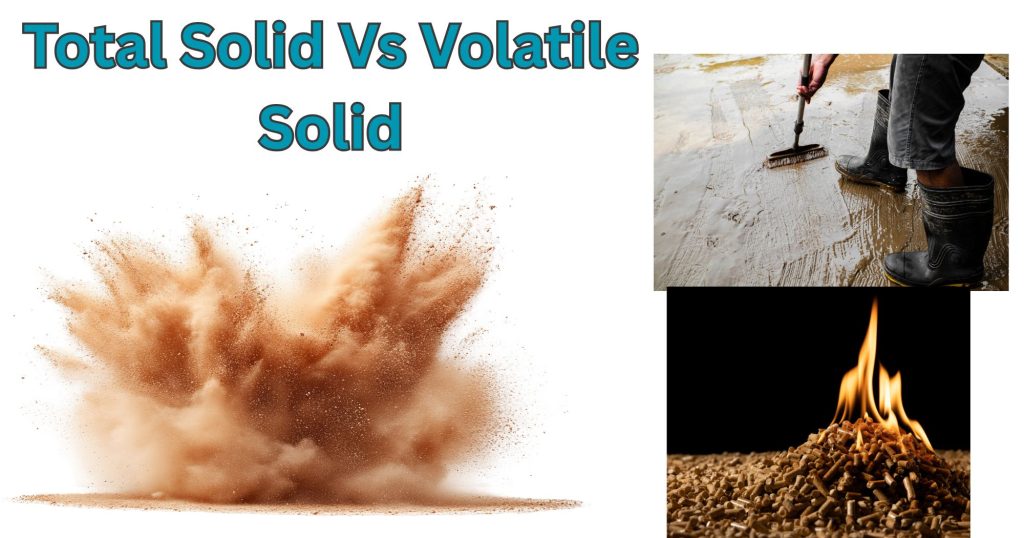
It is the most direct indicator of all matter, both suspended and dissolved, present in a water sample other than the water itself. The concentration and character (volatile vs. fixed) of solids determine the required capacity for physical treatment units, such as sedimentation tanks and filters, and govern the design of sludge handling and disposal systems.
The concentration and character (volatile vs. fixed) of solids determine the required capacity for physical treatment units, such as sedimentation tanks and filters, and govern the design of sludge handling and disposal systems.
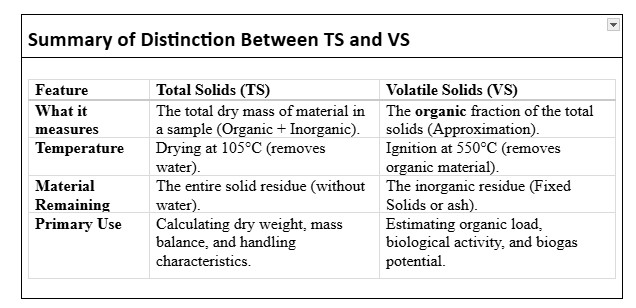
TS encompasses all types of solids present in the original liquid, including both dissolved salts and suspended particles. In TS a known volume of the sample is evaporated in a pre-weighed dish, and the remaining residue is dried until its mass is constant. This final mass represents the Total Solids content.
Principle of Total Solids (TS)
The core principle involves the physical separation of the solid matter from the liquid phase (water) through the application of heat, and then quantifying the mass of the remaining residue. It is gravimetric analysis based on the fundamental concepts of mass conservation and water evaporation.
Procedure of Total Solids (TS)
- Take a clean evaporating porcelain dish, wash and dry it in the oven set at 105 °C for 15 minutes
- Transfer the dish immediately to a desiccator and let it cool for about 10 minutes
- Weigh the dish on an analytical balance and record the initial weight as W1.
- Mix the sample thoroughly and take the fixed volume of sample and transfer it into the dish, in case of solids, weigh a fixed amount of sample. Record the sample volume as V
- Let the sample evaporate placed on water bath set at 92- 100° C in case of solids, dry the sample at 105 °C in hot air oven for 1 hour
- After the sample has been evaporated, transfer the dish into hot air oven at 105 °C for 1 hour
- After drying, transfer the dish into a desiccator and let it cool for 10 minutes. Record the final weight of the dish as W2
- Calculate TS value by referring the given formula:
Calculation of Total Solids (TS)
TS (mg/L) = (W2-W1) X 1000 X 1000 / Volume
Where:
W1 = Initial weight of empty dish (g)
W2 = Final weight of dish + residue (g)
V =Volume of sample filtered (mL)
The formula contains two factors of 1000, each serving a distinct unit
Conversion purpose: Converting grams to milligrams and millilitres to Liters.
Significances of Total Solids (TS)
- TS gives a basic quantification of the total physical contaminant mass present in the water before treatment. Used to gauge the overall strength or weakness of wastewater.
- Crucial for calculating the total mass of sludge (often called Dry Matter, DM) produced during the treatment process.
- TS concentration directly influences the physical properties (rheology) of the sludge. Hence it determines the feasibility and capacity requirements for pumping, conveying, and mechanical dewatering processes (e.g., filter presses).
- Since TS = TSS + TDS, the total solids value includes the dissolved inorganic load. Helps assess the potential for water quality issues like scaling, corrosion, and salinity in the receiving environment or water reuse systems.
Volatile Solids (VS)
Volatile Solids (VS) are a vital analytical parameter, forming a fraction of the Total Solids (TS) in samples like wastewater, sludge, or biomass. They function as a reliable, practical estimate of the organic content present in the material. Essentially, VS represents the portion of the dried solid residue that can be chemically altered and driven off as gas when exposed to intense heat.
VS is precisely defined as the mass lost when the dried residue from the Total Solids (TS) test is ignited in a muffle furnace at a high, specified temperature (typically between 500 and 600°C, often set at 550°C for a duration of 1 hour
Principle of Volatile Solids (VS)
The analytical method for determining Volatile Solids (VS) is fundamentally a gravimetric technique based on thermal decomposition, commonly referred to as loss-on-ignition. The dried residue from the Total Solids (TS) test is subjected to intense heat (typically 550°C) in a muffle furnace. This high temperature causes the organic compounds (such as carbohydrates and proteins) within the residue to rapidly oxidize. This process converts the solid organic matter into volatile gases (like carbon dioxide (CO2), water vapor, and other combustion products), which then escape from the sample. The resulting reduction in the sample’s mass (the difference between the weight before and after ignition) is precisely measured and reported as the Volatile Solids (VS) concentration. This loss in mass directly quantifies the amount of organic material originally present.
Procedure of Volatile Solids (VS)
- A known volume of sample is dried at 105° C in hot air oven for 1 hour and determine the TS (W2)
- The same dish containing the TS residue is transferred to a muffle furnace at high temperature – 550° C (pre-set) for 1 hour
- Carefully remove the crucible from the furnace and cool it into desiccator for 30 to 40 minutes and weigh the final weight
- This final remaining mass is the total fixed solids (TFS), often called the Ash content W3
- The mass of the Volatile Solids is determined by the weight loss during ignition
Calculation of Volatile Solids (VS)
Mass of Volatile Solids (g) = W2 – W3
Where:
W2 = Weight of dish + Total Solids residue (after105° C drying)
W3 = Weight of dish + Fixed Solids residue (after550 °C ignition)
The concentration of Volatile Solids in mg/L is then calculated similarly to Total
Solids:
VS (mg/L) = W2 – W3 X 1,000,000 / V
Where V is the sample volume in mL and the weights are in g.
Significances of Volatile Solids (VS)
- Provides a quick, practical measure of the biodegradable (i.e., organic) fraction of the solids.
- The primary measure for evaluating the efficiency of anaerobic and aerobic sludge digesters. Digestion aims to destroy organic matter; the percentage of VS reduction (VSR) is the key metric used to determine if the process is achieving stability and generating maximum biogas.
- The Volatile Suspended Solids (VSS) (a component of VS) is often used as a direct proxy for the concentration of active microbial biomass (bacteria, protozoa) in an activated sludge reactor.
- A low VS content in the final digested sludge indicates greater stability.
References
- U.S. Environmental Protection Agency (EPA). (2001). METHOD 1684: Total, Fixed, and Volatile Solids in Water, Solids, and Biosolids (Draft, January 2001). Office of Water, Office of Science and Technology, Engineering and Analysis Division (4303). Washington, DC.Method 1684: Total, Fixed, and Volatile Solids in Water, Solid, and Biosolids Exp-5.pdf
- Kiepper, B. H. (2017, March 28). Total Volatile Solids (TVS) Wastewater Test. Poultry Tips, UGA Cooperative Extension. Total Volatile Solids (TVS) Wastewater Test | Poultry Tips Waste_SM2540.pdf
