
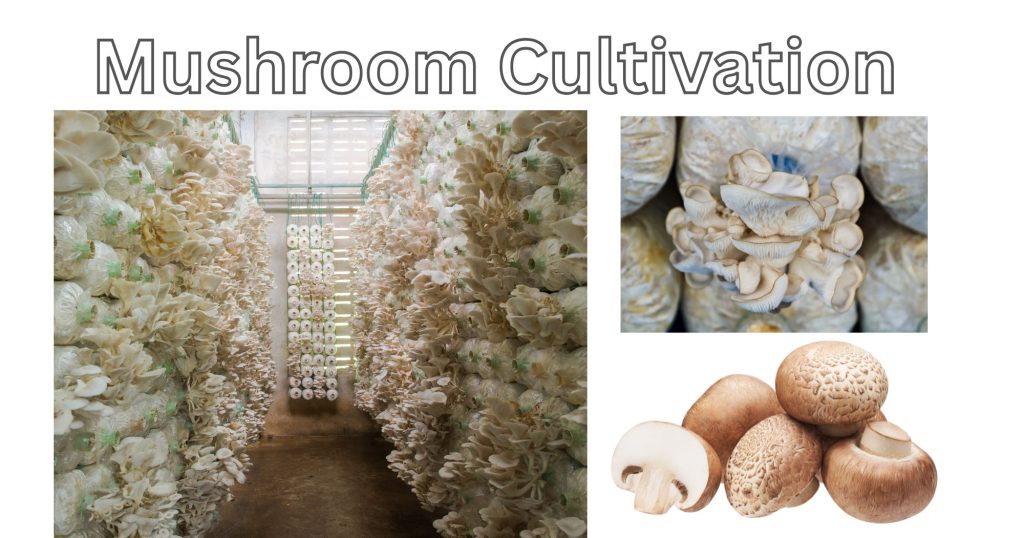
- Mushroom cultivation has become a significant global enterprise, providing both nutritional and environmental advantages.
- More than just a versatile food, these unique fungi offer a powerful combination of protein, vitamins, and minerals. They also contain bioactive compounds that contribute to health and wellness.
- Beyond their dietary benefits, mushrooms are essential for sustainable ecosystems, acting as natural recyclers that decompose organic matter and enrich soil fertility.
Life Cycle of a Mushroom
A mushroom begins its life as a spore, which is much like a plant seed. When a spore lands in a good spot, like on damp, decaying wood, soil, or compost, it starts to germinate. From the germinating spore, a single, thread-like filament called a hypha begins to grow.
-After spores germinate, the resulting hyphae (thread-like filaments) spread and intertwine, forming a dense web called a mycelium. This mycelium is the true body of the fungus, and its main job is to grow through the substrate, absorbing nutrients by breaking down organic matter. This extensive, nutrient-gathering phase is known as the vegetative stage.
Once the mycelium has fully colonized its food source, it’s ready to transition from growing to reproducing. This shift is known as primordial formation, or “pinning,” because the initial mushroom structures often look like tiny pins. This process is triggered by changes in the environment, such as a drop in temperature, an increase in fresh air, or higher humidity. These signals tell the fungus that the time is right to create a mushroom.
The small primordia then develop, absorbing water and nutrients from the mycelium as they grow. They quickly expand into the familiar cap and stem structure of a mature mushroom. When the mushroom is ready, it releases its spores from the gills or pores on the underside of its cap, allowing the life cycle to begin all over again.
Types of Mushrooms
- Mushrooms are the macroscopic, fleshy fruiting bodies of certain fungi. Most edible and poisonous mushrooms belong to the phyla Basidiomycota and Ascomycota, which are two of the major groups of fungi classified based on their reproductive structures.
- Mushrooms are not single-celled organisms like bacteria or yeast. They are complex multicellular structures that represent only one stage in the life cycle of a fungus.
- The primary body of the fungus, known as the mycelium, is a network of microscopic filaments called hyphae that live underground or within a substrate.
- The mushroom itself is the temporary reproductive organ that emerges to produce and disperse spores.
Cultivation Process of Mushroom
Substrate preparation is a vital first step in mushroom cultivation, ensuring the fungal mycelium has a clean, nutritious base to grow on. Different mushroom species have specific dietary needs, which determine the best type of substrate to use.
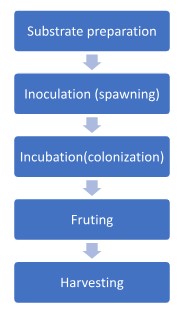
- A substrate is the material used as a food source for mushroom mycelium. It’s essentially the “soil” on which a fungus grows, providing all the necessary nutrients, moisture, and structure. The type of substrate is chosen based on the mushroom species being cultivated.
- Common substrates include hardwood sawdust for species like shiitake, straw for oyster mushrooms, and compost for button mushrooms.
- Sterilization is a process that uses high heat and pressure to kill all microorganisms in a substrate. This is typically done with a pressure cooker or autoclave, heating the substrate to at least 250°F (121°C).
- This method is crucial for nutrient-rich substrates (like grains or supplemented sawdust), as it creates a sterile, competition-free environment that allows the mushroom’s mycelium to grow without being overtaken by Mold or bacteria.
- Inoculation is the critical step in mushroom cultivation where the living mushroom culture, or spawn, is introduced into the prepared substrate. It’s essentially “seeding” the substrate. This process must be done in a very clean environment to prevent contaminants like Mold or bacteria from outcompeting the mushroom’s mycelium.
- The goal of inoculation is to evenly distribute the spawn throughout the substrate so that the mycelium can colonize it quickly and efficiently. This sets the stage for the next phase, incubation, where the mycelium grows and takes over the entire food source before the mushrooms are ready to fruit.
- Incubation is the crucial, “hands-off” phase in mushroom cultivation that follows inoculation. During this time, the inoculated substrate is kept in a controlled, protected environment to allow the mycelium to grow and fully colonize its food source. The main goal of incubation is to create optimal conditions for the fungus to expand its network. The key parameters are temperature, darkness, and limited air exchange. The incubation period lasts until the entire substrate is a solid, white mass, indicating it is fully colonized and ready for the next stage of growth.
- After the incubation phase is complete and the substrate is fully colonized with a solid, white mass of mycelium, the next exciting step is to initiate fruiting. This is when the mycelium transitions from a purely vegetative state to a reproductive one, forming the actual mushrooms.
- This transition is triggered by a change in environmental conditions that mimics the natural signals a fungus would receive in the wild, telling it that it’s time to produce mushrooms. This is often called “primordia formation” or “pinning” because the first tiny mushrooms resemble little pins.
- During incubation, CO₂ levels are kept high. By introducing fresh air and then significantly lowering the CO₂ concentration, which is a major signal for the mycelium that it has reached the surface and can now fruit. This is often done by cutting holes in the grow bag or placing the block in a fruiting chamber.
- Mushrooms are mostly water and require a very high-humidity environment (85-95% is often ideal) to form and grow without drying out. This is typically achieved by misting the environment with a spray bottle or using a humidifier in a fruiting chamber.
- A slight decrease in temperature (often 5-15°F lower than the incubation temperature) mimics a seasonal change, signalling to the fungus that it’s time to fruit.
- While mushrooms don’t use light for photosynthesis, it acts as a trigger and helps them orient themselves. A low level of indirect or ambient light is sufficient to tell the fungi which way to grow.
References
- Tewari, R. P., & Yadav, B. S. (2018). Mushroom: Cultivation and Processing. International Journal of Food Processing Technology, 5(2), 11-20.
- Patel, S. H. (2023). Review Article on Mushroom Cultivation. International Journal of Pharmacy Research & Technology, 4(1), 47–59.
- Pathania, S., G. R., N., Thakur, P., & Chandel, B. S. (2017). Production and Processing of Mushroom. International Journal of Current Microbiology and Applied Sciences, 6(8), 357–362.
- https://www.agricultureinindia.net/cultivation/mushroom-cultivation/mushroom-cultivation-introduction-classification-steps-pests-and-diseases-agriculture/20733
