
The Moving Bed Biofilm Reactor (MBBR) is an advanced biological wastewater treatment process that utilizes a hybrid approach, combining the best features of conventional activated sludge systems (suspended growth) and fixed-film reactors (attached growth).
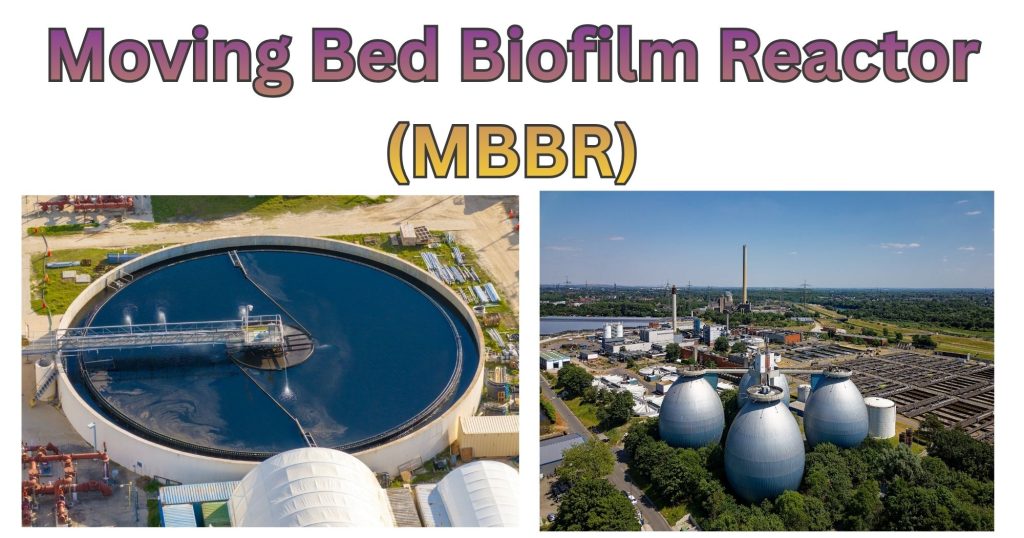
The “biological process” in the context of wastewater treatment, and specifically in the Moving Bed Biofilm Reactor (MBBR), refers to the natural, metabolic activities of microorganisms (primarily bacteria) that consume and transform pollutants in the water.
In MBBR technology the core principle relies on biofilm formation of a microbial population on thousands of small plastic elements (carriers) moving freely. These carriers are continuously mixed within the reactor by aeration or mechanical means. This process is highly effective and compact, relying on the stable attached biomass to efficiently remove organic matter and nutrients.
The development of the Moving Bed Biofilm Reactor was a crucial step in the evolution of wastewater treatment, designed to overcome the limitations of earlier biological processes.
In the year late 1980s to early 1990s, in the university of Norwegian University of Science and Technology (NTNU) in Trondheim, Norway, Professor Hallvard Ødegaard and his team paved the way for a new generation of compact, highly efficient, and robust pollutants removal systems now used globally to upgrade and expand municipal and industrial wastewater treatment facilities
The initial research was largely motivated by increasingly strict environmental regulations, particularly the need for cost-effective methods to reduce nitrogen discharges to sensitive water bodies like the North Sea. Existing technologies, such as activated sludge, often required extensive and expensive tank expansions to meet new nutrient removal targets.
The key innovation he introduced was small, buoyant plastic media designed to move freely within the reactor. This free movement successfully prevented the clogging problems that had historically troubled static fixed-film systems.
The success of early pilot plants led to the installation and start-up of the first full-scale MBBR plant in Norway in 1985
The technology was patented and subsequently commercialized by the Norwegian firm, Kaldnes Miljøteknologi. This company, now known as AnoxKaldnes (part of Veolia Water Technologies), developed specialized carriers (often referred to simply as Kaldnes media) that became the industry benchmark.
Components and working mechanism of Moving Bed Biofilm Reactor (MBBR)
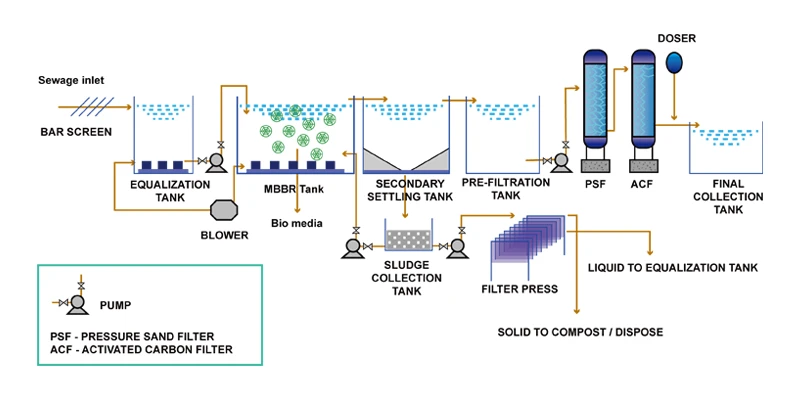
- BASIN: The MBBR tank basin is meticulously engineered to be the main biological treatment zone. Its structure and configuration are critical for achieving efficient biological action and proper fluid dynamics, which are necessary to keep the media (carriers) suspended and well-mixed.
The basin is the core biological reactor, built to promote contact between the wastewater, oxygen, and the biofilm carriers. The tank’s mixing design keeps the carriers continuously suspended so that microorganisms can efficiently degrade all pollutants and prevent any untreated “dead zones.
Structurally, the MBBR tank resembles a conventional aeration basin but is specifically configured for floating media. The choice between rectangular and cylindrical shapes depends on available space. Hydrodynamically, the tank’s core purpose is to create a rolling circulation using aeration/mixing, which ensures the carriers are dispersed and constantly collide with pollutants. Finally, the tank volume is sized based on key operational parameters: the required Hydraulic Retention Time (HRT) and the Surface Area Loading Rate (SALR)
https://www.snowate.com/knowledge-calculator/knowledge/mbbr-process.html
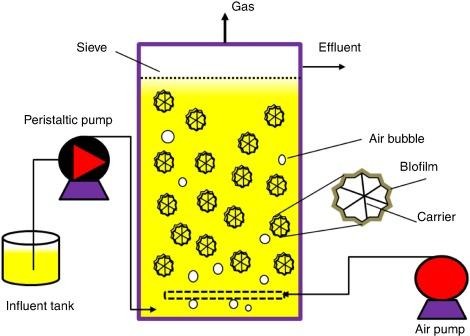
- Biofilm carrier (media): Serving as a stable, protected surface, the MBBR carrier promotes the growth of a concentrated biofilm. This attached growth is the key difference from activated sludge, where bacteria are suspended. Functioning as the primary biological engine, the fixed biofilm aggressively removes pollutants (including BOD/COD and Nitrogen compounds). The resulting high biomass density ensures superior treatment performance using a smaller tank volume and less contact time. The preferred construction material for MBBR carriers is virgin HDPE (though PP or PU foam are sometimes used), due to its superior resistance to chemical degradation and overall durability.
Crucially, these carriers are manufactured to be slightly lighter than, enabling them to be continuously fluidized and mixed throughout the tank by the aeration system. The MBBR carriers are engineered with complex internal geometries (such as cylindrical, wheel, or star shapes) to create a massive surface area in a small volume
This surface area is largely protected within the carrier’s structure, shielding the biofilm from turbulence. This protection is vital because it:
- Retains slow-growing, specialized bacteria (like nitrifiers).
- Ensures biofilm stability and resilience against sudden toxic shock loads.
The MBBR carrier’s small, uniform size (typically 10-25 mm and open, engineered structure are designed for superior movement and continuous activity within the reactor.
This optimized design achieves three critical hydrodynamic goals:
- Circulation: Ensures an ideal rolling circulation pattern that distributes the carriers evenly throughout the tank.
- Clogging Prevention: The structure prevents clumping and solids entrapment, guaranteeing constant, unhindered contact between the media and the wastewater.
- Self-Cleaning: The turbulent mixing action generates a shear force that automatically sloughs off inactive or excess biofilm. This continuous self-cleaning mechanism maintains a thin, highly active layer of microorganisms, maximizing treatment efficiency.
https://www.sciencedirect.com/science/chapter/edited-volume/abs/pii/B978032385583900020X
- Aeration and mixing system: The aeration and mixing system in a Moving Bed Biofilm Reactor (MBBR) is a critical, dual-purpose component that is essential for both the biological treatment process and the physical movement of the biofilm carriers.
The primary objective of this process is to introduce sufficient dissolved oxygen (DO) into the wastewater to meet the respiratory demands of the aerobic microorganisms (primarily heterotrophic bacteria for BOD/COD removal and autotrophic bacteria for nitrification).
oxygen is the final electron acceptor for aerobic respiration. Without adequate DO, the microorganisms cannot efficiently degrade organic pollutants and ammonia, leading to process failure
Blowers deliver compressed air to a distribution grid at the bottom of the reactor, where it is released through diffusers to form bubbles. The oxygen transfers from the bubbles into the water, sustaining the biofilm.
When it comes to the physical aspect, the kinetic energy necessary to keep the plastic biofilm carriers (media) in continuous, fluidized motion throughout the entire reactor volume is provided by agitation
The energy from the rising air bubbles creates a turbulence and circulation pattern (like a rolling boil) that ensures the buoyant carriers are fully suspended and uniformly distributed.
Continuous mixing guarantees that all carriers have frequent contact with the wastewater (substrate and oxygen), prevents them from settling or clumping, and provides the essential shear force to slough off old, excess biofilm, maintaining an optimal, active biofilm thickness.
- Carrier retention: The carrier retention sieves (also called screens or grids) are essential physical barriers that fulfil the crucial role of separating the buoyant plastic media from the treated wastewater as it exits the reactor.
The primary function of the sieves is to ensure that the valuable, biomass-carrying plastic media remains contained within the reactor basin.
By keeping the media out of the effluent, the sieves prevent potential damage to downstream equipment (like pumps) and ensure that the treated water is free of larger plastic solids before it moves to clarification or final discharge
Typically constructed from durable, corrosion-resistant materials like stainless steel or high-density polyethylene (HDPE).
The mesh or slot size of the sieve must be smaller than the smallest dimension of the carrier media used in the reactor. This guarantees that the media cannot pass through.
The sieves are designed to have a large effective open area to allow for a high flow rate of water while minimizing the buildup of biofilm or debris, which could cause clogging.
The sieves are installed at the outlet points of the reactor basin, separating the treatment zone from the effluent weir or channel.
In multi-stage MBBRs (e.g., zones for BOD removal, nitrification, and denitrification), separate sets of sieves are installed between compartments if different types or filling ratios of carriers are used.
The Biological Core and Biofilm Maturation in MBBR
The core function of the Moving Bed Biofilm Reactor (MBBR) is based on its attached-growth mechanism
Microorganisms must adhere to the carrier media to form a protective biofilm.
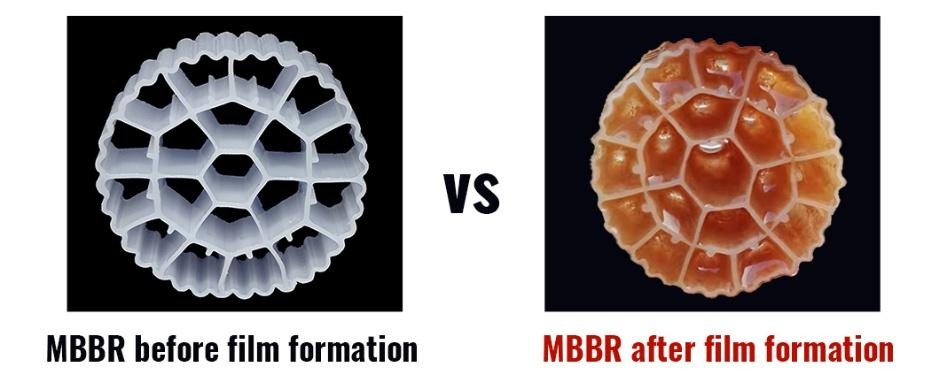
Biofilm can be defined as a microbial community which grows on a living or inert object.
This microbial community is often enclosed in a slimy protective layer or matrix which is self -produced by the micro-organisms itself.
This slimy layer is hydrated gel composed mainly of polysaccharides, proteins, and nucleic acids termed as Extracellular Polymeric Substances (EPS) that provides the structural scaffold, acts as glue for adhesion, protects the microbes from environmental stress, predators, and antimicrobials.
https://www.nihaowater.com/news/Case/understanding-the-moving-bed-biofilm-reactor.html
Biofilm developmental stage:
Adhesion
The process of biofilm maturation in an MBBR begins with Initial Attachment, also known as Adhesion. This stage is the critical first step where planktonic (free-floating) microorganisms from the wastewater first encounter and stick to the surface of the plastic carrier media.
For the MBBR to start working, these cells must shift from a free-swimming lifestyle to a surface-bound one.
The initial attachment occurs rapidly and is dictated mainly by non-specific physical forces rather than a deliberate biological action. The microbes are essentially pulled onto the surface by weak Van der Waals, Electrostatic and Hydrophobic/Hydrophilic Interactions.
This stage is essentially a transient association. For the biofilm to truly form, the microbes must quickly proceed to the next stage and transition to irreversible adhesion by secreting their protective glue.
Colonization
This stage is the make-or-break point in MBBR biofilm development. It’s the transition from a temporary, physical attachment to a permanent, biologically anchored structure, marking the concrete start of colonization.
Once microorganisms have initially attached, production of EPS (Extracellular Polymeric Substances) is triggered.
The secretion of EPS cements the microbes to the carrier surface, creating a robust, permanent bond.
The EPS provides strong anchorage entrapping the cell overriding the weak, reversible physicochemical forces that characterized the initial attachment. This is why the adhesion becomes irreversible.
The cells begin to divide and reproduce while embedded in this new matrix. EPS also acts as an adhesive to promote cell-to-cell cohesion, causing the multiplying cells to aggregate into distinct clumps or microcolonies. This is the first sign of the developing three-dimensional biofilm structure.
The carrier material is specifically designed to enhance these properties such as Hydrophilicity (Affinity for water), Surface Charge, Micro-roughness, ensuring a rapid “seeding” of the reactor and a fast start-up of the biological treatment process.
| Carrier Property | Effect on Adhesion and Colonization |
| Hydrophilicity (Affinity for water) | A more hydrophilic (water-attracting) surface makes it easier for the water-rich bacterial cells and EPS to spread and stick, promoting faster colonization. |
| Surface Charge | Since most bacterial surfaces and EPS components are negatively charged, the carrier’s surface charge and the resulting electrostatic interactions significantly influence the initial sticking and strength of the bond. |
| Micro-roughness | A surface with fine micro-roughness or pores provides sheltered areas where microbes can settle and multiply, protecting them from the high shear forces caused by the movement and mixing in the MBBR. This acts as a ‘safe harbour’ for initial growth |
Biofilm growth and maturation
This stage marks the full development of the microbial community into a stable, functional structure. It’s where the nascent microcolonies expand and organize into the efficient pollutant-removing engine of the MBBR.
Continued cell division and massive production of Extracellular Polymeric Substances (EPS) lead to the vertical and lateral expansion of the microcolonies, resulting in a fully structured, three-dimensional (3D) mature biofilm
As the biofilm thickens, the transport of substances from the bulk liquid into the deeper layers slows down. This restricted movement creates steep concentration gradients, leading to functional specialization within the biofilm:
| Layer in Biofilm | Condition | Dominant Biological Process | Function |
| Outer Layer | Aerobic (High Oxygen) | Heterotrophic Respiration and Nitrification | Degradation of Carbon (BOD/COD) and Conversion of Ammonia to Nitrite and Nitrate |
| Inner Layer/Core | Anoxic or Anaerobic (Low/No Oxygen) | Denitrification and other Anaerobic Processes | Conversion of Nitrate to Nitrogen Gas and further carbon degradation. |
This spatial arrangement of diverse microbial communities within the single biofilm layer is what allows the MBBR to perform multiple, sequential wastewater treatment steps (like carbon removal and nitrogen removal) simultaneously in a single reactor volume. The thickness of the mature biofilm must be carefully balanced; if it is too thick, the deep layers may become entirely inactive due to nutrient starvation.
Detachment (sloughing)
This final stage of biofilm maturation is crucial for the long-term efficiency and stability of the Moving Bed Biofilm Reactor (MBBR). It represents the natural process by which the biofilm self-optimizes its thickness.
The sloughing (detachment) of biofilm is triggered by a combination of internal and external factors:
- Internal Stress (Starvation): As the biofilm grows thicker, the diffusion path for substrate (pollutants/food) and oxygen becomes longer. The deeper layers of cells eventually become starved of essential nutrients and oxygen. These inactive cells either die or produce enzymes that break down the internal EPS matrix, weakening the biofilm’s structural integrity from the inside out.
- External Stress (Shear Forces): The continuous, chaotic motion of the carriers in the reactor—driven by aeration or mechanical mixing—imparts significant shear forces on the attached biofilm. This constant physical stress acts like a natural knife, peeling off the weakest, outermost, and dead layers of the film.
- Changes in Growth Rate: Sudden changes in the organic or hydraulic loading (shock loads) can rapidly alter the microbial growth rate, leading to internal pressure that can trigger mass detachment events.
By preventing the film from becoming diffusion-limited, sloughing guarantees that the maximum number of cells are actively and efficiently degrading pollutants. This leads to stable and high volumetric removal rates for pollutants like BOD/COD and ammonia.
Advantages of Moving Bed Biofilm Reactor (MBBR)
- Requires significantly less space than conventional activated sludge systems due to the high concentration of biomass on the carriers.
- The biofilm on the carriers provides high tolerance to fluctuations in hydraulic and organic loading, as well as toxic shock
- As a fixed-film process, the biomass is retained on the carriers, eliminating the need for a sludge return line, simplifying operation.
- Achieves a long effective Sludge Retention Time, which is beneficial for the growth of slow-growing bacteria (like nitrifiers).
- The process is fast, typically requiring only a few hours of HRT, allowing for high throughput.
- Generally, produces less excess sludge compared to conventional activated sludge systems.
Disadvantages of Moving Bed Biofilm Reactor (MBBR)
- Biological systems, including MBBR, often require manual sampling and lab analysis to ensure the biofilm is healthy, as continuous sensor monitoring of the bacteria is difficult.
- While the physical operation is relatively simple, understanding and managing the complex biological processes requires personnel with expertise in biological water treatment
- There is a risk of carrier media washing out of the reactor if the retention sieves are damaged or improperly designed.
- The initial design and construction costs can be higher than those of conventional systems, primarily due to the cost of specialized plastic carrier media.
References
- What Is MBBR, and How Does It Work? | SSI Aeration
- Santos, A. D., Martins, R. C., Quinta-Ferreira, R. M., & Castro, L. M. (2020). Moving bed biofilm reactor (MBBR) for dairy wastewater treatment. Energy Reports, 6, 340–344. https://doi.org/10.1016/j.egyr.2020.11.158
- Aslam, Z., Alam, P., Islam, R., Khan, A. H., Samaraweera, H., Hussain, A., & Zargar, T. I. (2025). Recent developments in moving bed biofilm reactor (MBBR) for the treatment of phenolic wastewater: A review. Journal of the Taiwan Institute of Chemical Engineers, 166(2), 105517-105530. https://doi.org/10.1016/j.jtice.2024.105517
- https://www.youtube.com/watch?v=H6S0MxUfNc8
- https://www.youtube.com/watch?v=FzvMF0JySsM
- Gupta, B., Gupta, A. K., Ghosal, P. S., Lal, S., Saidulu, D., Srivastava, A., & Upadhyay, M. (2022). Recent advances in application of moving bed biofilm reactor for wastewater treatment: Insights into critical operational parameters, modifications, field-scale performance, and sustainable aspects. Journal of Environmental Chemical Engineering, 10, 107742. https://doi.org/10.1016/j.jece.2022.107742
- https://www.youtube.com/watch?v=3cU-E3bFy_A
- Biological Wastewater Treatment II – MBBR Processes R1.pdf
- Odegaard, Hallvard, “Compact Wastewater Treatment with MBBR,” DSD International Conference, Hong Kong, 12, 11-14-2014.
- Improved Nutrient Removal With Biofilm Reactors – PDF | PDF
- McQuarrie, J. P., & Boltz, J. P. (2011). Moving Bed Biofilm Reactor Technology: Process Applications, Design, and Performance. Water Environment Research, 83(6), 560–575.
- Experimental comparíson between MBBR and activated sludge system for the treatment of municipal wastewater
- Hem, L. J., Rusten, B., φdegaard, H. (1994). Nitrification in a moving bed biofilm reactor. Wat. Res., 28(6), 1425-1433.
- Pastorelli, G., Andreottola, G., Canziani, R., Darriulat, C., de Fraja Frangipane, E. and Rozzi, A. (1997). Organic carbon and nitrogen removal in moving-bed biofilm reactors. Wat. Sci. Tech., 35(6), 91-99.
- https://www.bing.com/videos/riverview/relatedvideo?&q=mbbr&&mid=E477BD8A185AEA7E5CF6E477BD8A185AEA7E5CF6&&FORM=VRDGAR
- https://www.bing.com/videos/riverview/relatedvideo?&q=mbbr&&mid=FB7DFAAFA27AA96F5968FB7DFAAFA27AA96F5968&&FORM=VRDGAR
- https://www.bing.com/videos/riverview/relatedvideo?&q=mbbr&&mid=9ABE23EAAF93695917D69ABE23EAAF93695917D6&&FORM=VRDGAR
- https://www.bing.com/videos/riverview/relatedvideo?&q=mbbr&&mid=97DC9406438502A6B59F97DC9406438502A6B59F&&FORM=VRDGAR
