
A thermometer, as the name suggests, is an instrument used to measure temperature. Among the various thermometers, the digital thermometer is widely used worldwide due to its accuracy, safety, ease of use, and rapid results.
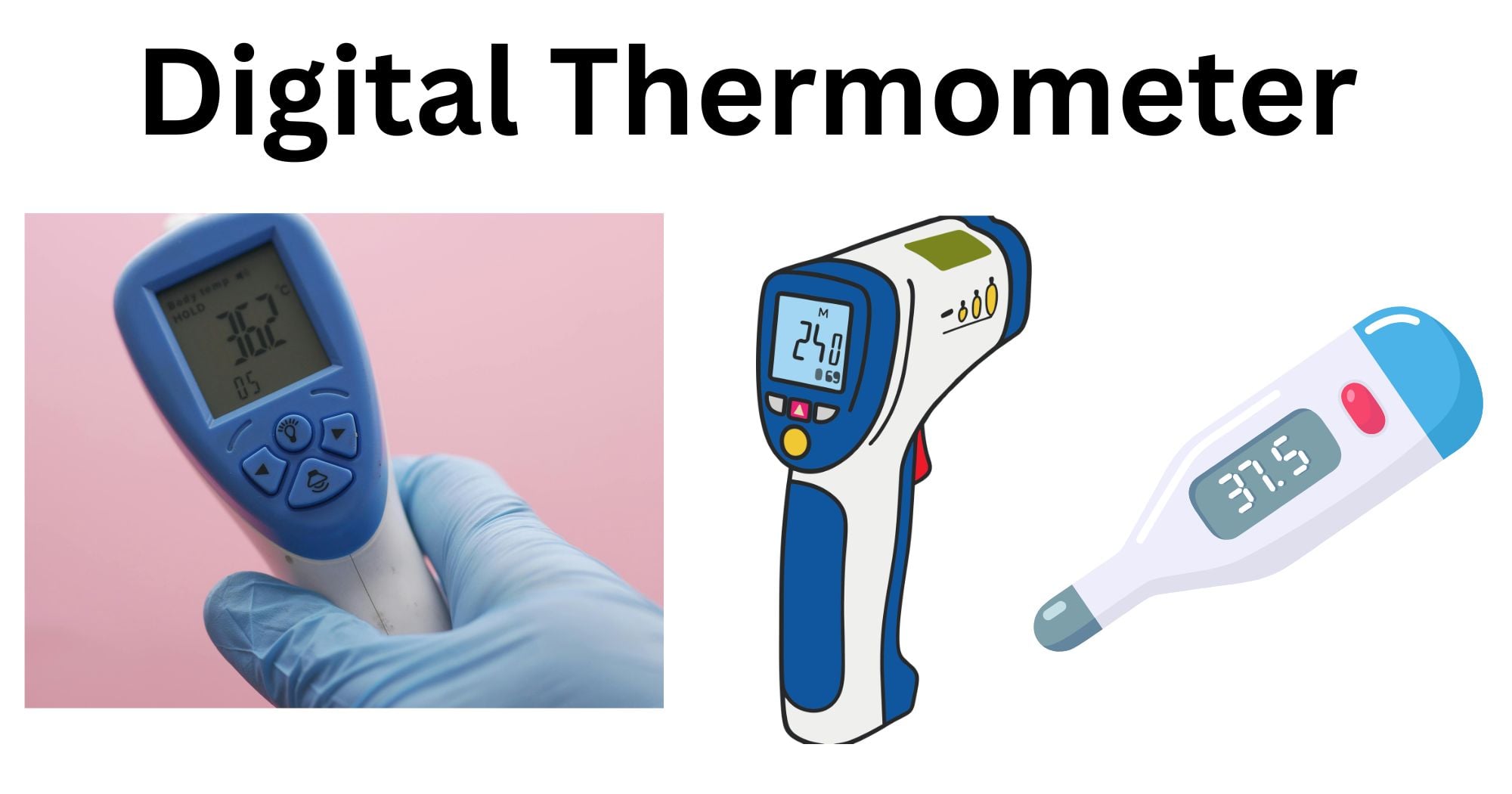
Digital thermometers are medical devices used to measure body temperature electronically and display the reading on a screen. They use electronic heat sensors (thermistors or thermocouples) to detect temperature changes and convert them into numerical values that are displayed digitally. They are classified as Class II medical devices by the FDA. Digital thermometers are widely used in hospitals, clinics, and homes to monitor body temperature.
Importance of Digital Thermometers in Clinical Temperature Monitoring
In healthcare, body temperature is one of the four vital signs assessed in clinical practice alongside blood pressure, pulse rate, and respiratory rate. A small change can indicate infection, inflammation, hormonal problems, or other abnormal conditions. So, digital thermometers are used to measure temperature accurately, as temperature measurement is essential in clinical settings to:
- Detect fever, which may indicate infection or systemic illness
- Monitoring responses to treatments such as antibiotics, antipyretics, etc.
- Assessing hypothermia in critically ill or exposed patients
- Guiding clinical decisions such as hospitalization, isolation, or further testing.
Digital thermometers are widely used as standards in many settings because they provide quick readings, have easy-to-read displays, are clear and convenient to use, and reduce the risk of mercury exposure or glass breakage. In busy clinical settings, the speed, safety, and accuracy of digital thermometers make them important.
Principle and Working of Digital Thermometers
The working of digital thermometers is based on the basic principles of electronics and thermodynamics. Digital thermometers rely on electronic temperature sensors like thermistors, thermocouples, or infrared sensors (for non-contact models). When the sensor is exposed to body heat, its resistance changes. This change is converted into an electrical signal (voltage or current) by the internal circuitry. A microcontroller inside the thermometer receives this signal and uses a pre-programmed calibration curve to convert it into a temperature value, usually in degrees Celsius (°C) or Fahrenheit (°F). The temperature is displayed on a digital display. All of this happens very quickly, so we get results within a short time.
Note: In thermistors, resistance decreases as temperature rises, which allows a small current to pass through it. Thermocouples generate a small voltage based on the temperature difference between two dissimilar metals, and infrared sensors detect thermal radiation emitted by the body. Working differs based on the type of sensing element, but the basic principle is the same.
Types of Digital Thermometers Used in Healthcare
Digital thermometers are of various types designed for different measurement sites, each with specific clinical applications. Healthcare providers select thermometers based on patient age, condition, and required accuracy.
Oral digital thermometer
It is placed under the tongue with the lips closed around the probe to measure the temperature. It is common in adults and cooperative older children and is moderately accurate when used correctly.
Rectal digital thermometer
This is inserted gently into the rectum, typically 1-2 cm in infants and slightly more in adults. It is considered very accurate, especially for infants and small children, and is often used in neonatal and pediatric care. It is a gold standard for core temperature.
Axillary (underarm) digital thermometer
It is placed under the armpit with the arm held close to the body. It is less invasive but usually less accurate than other methods.
Tympanic (ear) thermometer
It uses infrared sensors to detect heat radiation from the tympanic membrane (eardrum). It provides very rapid readings, often within 1-3 seconds, and accuracy depends on proper positioning and an unobstructed ear canal.
Infrared thermometer (temporal)
It measures infrared radiation emitted from the temporal artery area of the forehead. It requires no contact or minimal contact, improving infection control and patient comfort, and is useful for quick screening of large numbers of people, e.g., during outbreaks.
Parts and Components of a Digital Thermometer
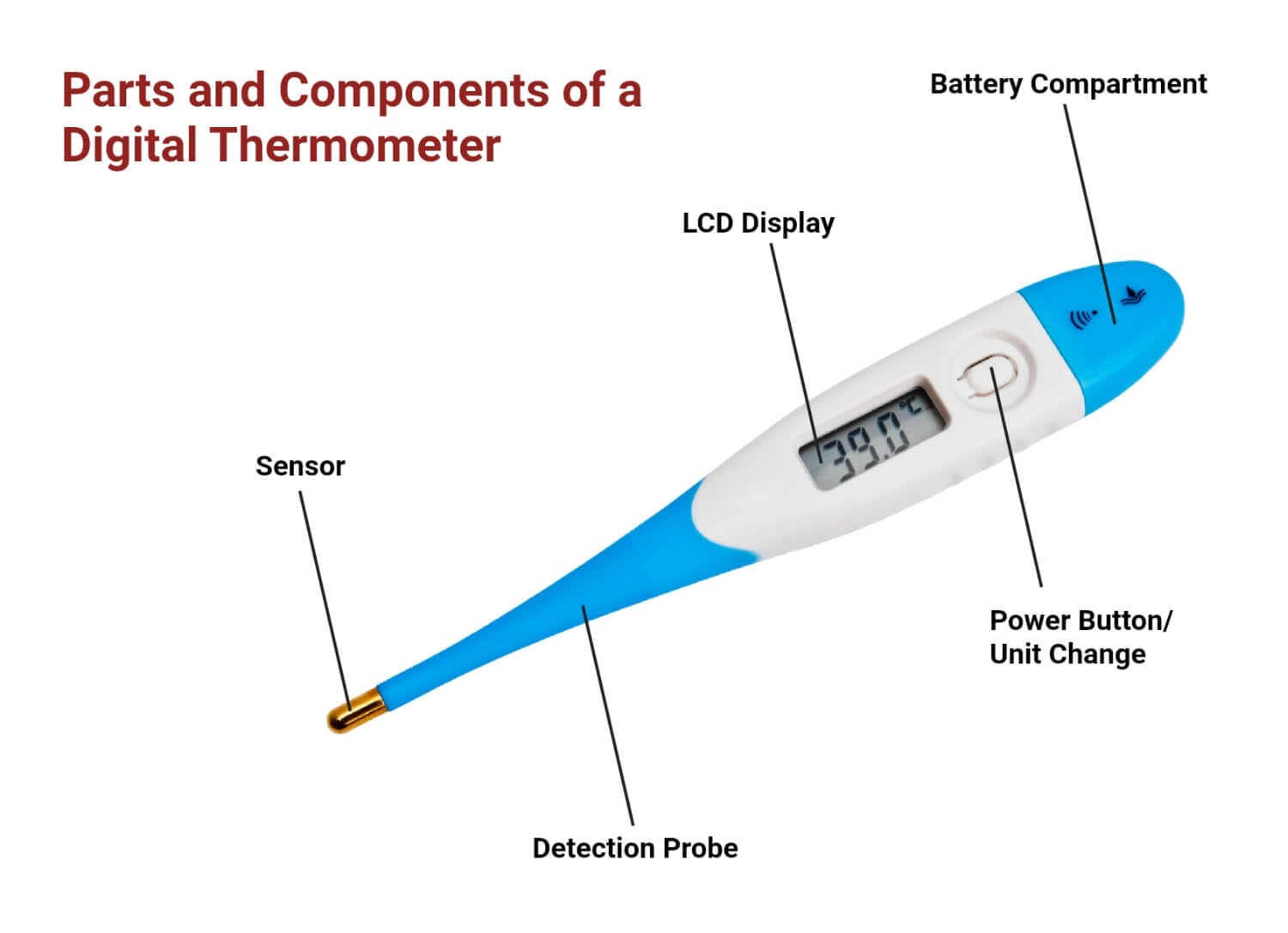
Most digital thermometers consist of:
- Probe/ sensor tip: It is the part that contacts the body and contains a temperature sensor. It is covered by a protective cover to reduce cross-infection and keep the probe clean.
- Body/ handle: This part encloses all the electronics and allows the user to hold the device.
- Display screen (LCD/LED): This is a screen that shows temperature readings, units, and sometimes additional icons like battery, memory, etc.
- Control buttons: Buttons for power on/off, mode selection (°C or °F)
- Battery compartment: A small compartment to keep small button cells or AAA batteries.
- Electric circuitry and microcontroller: It processes the sensor signal and converts it to a temperature reading.
- Buzzers or alarm: It emits a beep when the measurement is complete.
How to Use a Digital Thermometer Correctly in Clinical Practice
Wash your hands, use a new probe cover, and explain the procedure to the patient so they are at ease.
The correct technique depends on the route.
- Oral use: Ensure the patient hasn’t eaten, drunk, or smoked in the last 10-15 minutes. Place the probe under the tongue, towards the back, and ask the patient to close their mouth. Wait for the thermometer to beep to indicate completion. Then, remove from the mouth, read the display, and discard the probe cover.
- Rectal use: Apply water-based lubricant to the probe. Position the patient in the left lateral position. Insert the probe to the recommended depth. Hold until completion. Then remove and read the display. Clean and discard the probe cover according to protocol.
- Axillary use: Wipe the underarms to make them sweat-free. Place the probe in the center and have the patient press the arm against the body. Wait for the completion beep, read the display, and document.
- Tympanic and infrared forehead use: Ensure the forehead and ear are clear of sweat, dirt, or obstruction. For tympanic, pull the ear gently back and up to straighten the canal, insert as directed, and press the button. For the forehead, aim at the specified area at the correct distance (as per the manufacturer) and press the button.
Always follow the manufacturer’s instructions and institutional protocols.
Document the reading. Clean, disinfect, and discard the probe cover properly.
Interpretation of Temperature Readings (Normal Body Temperature, Fever, and Hypothermia)
Normal body temperature can vary slightly by site and individual.
- Average normal oral temperature: 36.5 – 37.5 °C (98.6 °F)
- Rectal temperature: approx. 0.3-0.6 °C higher than oral
- Axillary temperature: approx. 0.3-0.6 °C lower than oral
- Fever (pyrexia): often defined as more than or equal to 38.0 ° orally
- High fever (hyperpyrexia): more than 41.0 °C (medical emergency)
- Hypothermia: less than 35.0 °C (core body temperature). Hypothermia is classified as mild (32-35°C), moderate, or severe (less than 28°C).
Patient context, such as age, clinical conditions, and measurement sites, should be considered while interpreting.
Factors Affecting the Accuracy of Digital Thermometers
The variables that can alter the readings of a digital thermometer are:
- Improper placement
- Recent activities like hot/cold drinks, exercise, smoking, or bathing before measurement
- Environmental temperature
- Sweat or moisture
- Battery levels
- Device damage or poor calibration
- Ear conditions like wax, infection, or any obstruction in case of tympanic measurement
- Inconsistent technique and not following the manufacturer’s instructions carefully
Calibration, Cleaning, Disinfection, and Maintenance of Digital Thermometers
Calibration ensures that the thermometer reads the temperature correctly over time. Some devices are factory-calibrated. Hospitals perform periodic calibration checks against a reference thermometer or water baths of known temperatures. Calibrations should be performed according to the specifications by the manufacturer and institutional schedules annually or as recommended.
Cleaning and Disinfection: To reduce the risk of cross-contamination and spread, probe covers are used whenever possible. The covers are removed and disposed of properly after use. The probe and the body can be cleaned with disinfectant wipes or solutions like 70% isopropyl alcohol. Some probes are heat-stable and can be autoclaved, while some can be chemically disinfected.
Maintenance: The thermometers must be stored in a clean, dry place away from extreme temperatures and direct sunlight. Replacement of batteries and checking for cracks, loose parts, or display fall under routine maintenance requirements.
Clinical Applications of Digital Thermometers in Healthcare Settings
Digital thermometers are used in:
- Emergency departments assess febrile or hypothermic patients.
- Inpatient wards and ICUs for routine vital signs monitoring.
- Pediatrics and neonatology to monitor infants and children.
- Outpatient clinics and primary care for evaluation of infection.
- Home healthcare, telemedicine, and public health screening.
Advantages of Digital Thermometers
The major advantages of digital thermometers that have made them widely used are:
- They are safer to use as they lack mercury or glass, reducing the risk of poisoning and injury.
- They provide rapid readings, often within seconds.
- They are easier to read as they have a clear number display. So, fewer chances of misreading.
- They are versatile with multiple sites and modes available.
- Some may have additional features like memory, fever alarms, backlight, °C/ °F change, etc.
Limitations of Digital Thermometers
- Dependence on batteries
- Sensitive to the technique, as incorrect placement or use can lead to errors
- Potential electronic failure
- They may be expensive initially.
Digital Thermometer vs. Mercury Thermometer vs. Infrared Thermometer
| Feature | Digital Thermometer | Mercury Thermometer | Infrared Thermometer |
| Working principle | Electronic sensors convert temperature into electrical signals displayed digitally | Thermal expansion of mercury in a glass tube | Detects thermal (infrared) radiation emitted from skin |
| Speed | 10-60 sec | 2-4 minutes | 2-5 sec |
| Accuracy | ± 0.1°C (high) | ±0.1 °C (very high) | ±0.3 °C (moderate) |
| Safety | Safe | Toxic if broken | Very safe |
| Best for | Clinical precision | Historic reference | Mass screening for infants and children |
| Ease of use | Easy use, digital display | Hard to read scale | Very easy |
Regulatory Standards and Safety Guidelines for Digital Thermometers (FDA, ISO)
FDA regulations: The FDA has classified digital thermometers as Class II medical devices requiring 510(k) premarket notification. The FDA has also established special controls, including performance standards, labelling requirements, and post-market surveillance.
ISO: ISO 80601-2-56 specifies requirements for clinical thermometers, including accuracy, testing methods, labeling, and instructions. Manufacturers must validate that their devices meet these performance criteria.
Conclusion
Digital thermometers have made it very convenient to measure temperature accurately, rapidly, and safely in various settings. They have advanced from traditional mercury thermometers that relied on the expansion of mercury in glass and have provided a safer and non-toxic alternative. It is essential to understand the principles and correct working techniques to accurately measure body temperature. As technology evolves, with smarter integrations and improved sensors, these devices will continue to play a vital role in patient care.
References
- Risks, C. &. (2023, November 7). FDA’s Latest Update on Class II Clinical Electronic Thermometers. Compliance & Risks. https://www.complianceandrisks.com/blog/fdas-latest-update-on-class-ii-clinical-electronic-thermometers/
- Del Bene, V. E. (1990). Temperature. In H. K. Walker, W. D. Hall, & J. W. Hurst (Eds.), Clinical Methods: The History, Physical, and Laboratory Examinations (3rd ed.). Butterworths. http://www.ncbi.nlm.nih.gov/books/NBK331/
- How to take your temperature. (2020). Mayo Clinic. https://www.mayoclinic.org/healthy-lifestyle/adult-health/in-depth/how-to-take-temperature/art-20482578
- How Does A Digital Thermometer Work? (2019). Advancedenergy.Com. https://www.advancedenergy.com/en-us/about/news/blog/how-does-a-digital-thermometer-work/
- Digital Thermometer: Types, Working Principle, and Industrial Applications. (2026). Scispectrum Lab Essentials Pvt Ltd. https://scispectrum.in/blog/digital-thermometer-types-working-principle-and-industrial-applications/
- Agarwal, T. (2013, November 5). Digital Thermometers and Its Applications. ElProCus – Electronic Projects for Engineering Students. https://www.elprocus.com/digital-thermometers/
- Raval, D. B. (2026, July 15). Digital Thermometer Working Principle & Calibration: Complete Guide. Infinita Lab; Infinita Lab Inc. https://infinitalab.com/blog/digital-thermometer-working-principle-calibration/?srsltid=AfmBOop2tuRCFIi_Ervfv_Fsgq6AzCo67xWEtV80umntGB9btvywxTdX
- Raková, V. (2026, February 17). How to Properly Use an Electric Thermometer and Get Reliable Results. Truelife. https://truelife.eu/en-cz/blogs/truelife-world/how-to-properly-use-an-electric-thermometer-and-get-reliable-results?srsltid=AfmBOor0ycgyQnyCIRQmGXV_NuXn0xHI2qYeffNKNPm7mit3IMeioMrO
- Clinic, C. (2023, April 11). Heat Check: How To Take Your Temperature. Cleveland Clinic. https://health.clevelandclinic.org/thermometers-how-to-take-your-temperature
