
Molds are multicellular filamentous fungi. The techniques of culturing and observing fungi differ from the methods used to study bacteria. Fungi grow at comparatively slow rates, often requiring several days to form macroscopically visible colonies.
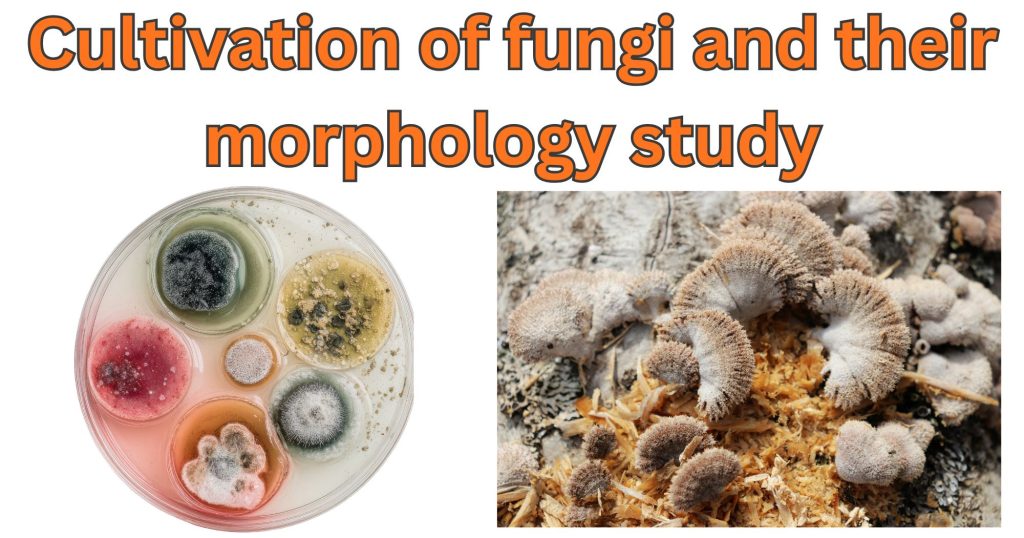
Molds produce brightly coloured spores on aerial hyphae grown best at 25 °C rather than 35 °C. The growth will spread over the entire culture plate.
The macroscopic aggregation of mold cells is called a thallus. A thallus is composed of a mass of strands called mycelium; each strand is called a hypha. Vegetative hyphae grow on the surface of culture media. The aerial hyphae, called reproductive hyphae bears asexual reproductive spores or conidia. The hyphae that rows below the surface of culture media are called rhizoidal hyphae. The hyphal strand of some Molds may be separated by a cross wall called a septum. Molds that lack septa are called coenocytic hyphae.
Molds are characterized according to the appearance of the colony, organization of the hyphae and structural organization of the spores
Structure of Filamentous Fungi (Molds)
The structures of Molds are composed of microscopic, thread-like filaments that collectively form the body of the fungus, or the thallus.
Hyphae is the basic structural unit of a mold. It is a tubular filament that contains the cytoplasm, organelles, and nuclei. Growth is primarily restricted to the tips of the hyphae, a process called apical extension. Hyphae are classified based on the presence or absence of internal cross-walls, called septa. Septate Hyphae possess cross-walls that divide the hypha into distinct cells, often with central pores allowing movement of cytoplasm and small organelle. Coenocytic Hyphae Lack septa, forming one continuous, multinucleated cell.
Mycelium is the macroscopic, tangled mass or network formed by the collective growth of hyphae. It is the vegetative body of the mold. The mycelium is often differentiated into two types: Vegetative/Substrate Mycelium and Aerial Mycelium
The portion of the hyphae that grows on or into the culture medium or substrate, absorbing nutrients and anchoring the fungus is called Vegetative/Substrate Mycelium whereas The portion that projects above the surface of the medium and produces the reproductive structures (spores) are aerial mycelium.
Reproduction Structures
The morphology of asexual reproductive structures is the most crucial characteristic for identifying molds.
Sporangium/Sporangiospores: Found in lower fungi (e.g., Rhizopus). The asexual spores (sporangiospores) are contained within a sac-like structure called a sporangium, which is borne on a stalk called a sporangiophore.
Conidiophore/Conidia: Found in higher fungi (e.g., Aspergillus, Penicillium). The asexual spores (conidia) are produced externally on the tips or sides of specialized stalks called conidiophores. They are not enclosed in a sac
Why Sabouraud’s Dextrose Agar (SDA)?
Sabouraud’s Dextrose Agar (SDA) is a selective medium used to cultivate fungi (Molds and yeasts). It contains a low, acidic pH (around 5.6) and high dextrose concentration.
This specific composition inhibits the growth of most common bacteria. It is standard for isolating pathogenic fungi, including dermatophytes and Candida species. Essential in clinical mycology labs and for quality control testing in food/pharmaceutical industries.
Modified SDA: A variation that lowers the dextrose concentration to 20 g/L and raises the pH to 6.9 to support more fastidious fungi (those that are sensitive to very low pH)
To ensure complete bacterial inhibition, SDA is often supplemented with Chloramphenicol (to inhibit many bacteria) and/or Cycloheximide (to inhibit rapid-growing saprophytic Molds and focus on pathogenic species like Dermatophytes).
Lactophenol cotton blue
Lactophenol cotton blue is one of the important stains used in mycology. It has dual role 1. As a staining agent 2. Mounting medium to preserve the fragile morphology of the fungi.
| Component | Function | Mechanism |
| Cotton blue (Aniline blue) | Staining agent | The positive charge on chitin easily takes up the acidic dye which makes it stand out clearly against the pale background. |
| Phenol | Inhibiting agent | It acts as a disinfectant, killing any live organisms in the specimen. This also deactivates the fungal lytic enzymes, which prevents the fungus from self-digesting (autolysis) |
| Lactic Acid | Preserving agent | It acts as a clearing agent and helps preserve the fungal cell wall structures by maintaining their size and shape. |
| Glycerol | Mounting Agent | It acts as a high-viscosity mounting fluid, preventing the specimen from drying out (desiccation) and helping to keep the coverslip in place. |
Requirements:
Sabouraud’s dextrose agar plate
Saline suspension of Aspergillus spp, Penicillium spp, Rhizopus spp, Mucor spp
Procedure:
- Using sterile technique, inoculate each of the labelled plates by placing a single loopful of mold suspension in the centre of the plate. Do not spread the inoculum
- Incubate the plates at 25 C for 3 to 7 days. Do not invert the plates
- Examine the plates for colonial morphologies, pigmentation of the mycelium and spores
- Take a of drop mounting fluid that is lactophenol cotton blue solution on the clean grease free slide
- Sterilize the needle and cool it then transfer a mycelium mat on fluid and gently tease it with another needle to separate the mycelium carefully
- Take a clean coverslip and with the help of a forceps place the cover slip on mycelial mat taking care that no air bubble get trapped in the preparation
- Take a blotting paper and wipe the excess stain
Observe under a low to high power objectives of microscope
Observations
| Characteristics | Aspergillus spp | Rhizopus spp | Mucor spp |
| Color/Pigmentation | Black | Greyish white | White |
| Texture | Rough | Cottony | Cottony |
| Aerial Hyphae | Present | Present | Present |
| Sporangiophore/Conidiophores | Conidiophores | Sporangiophores | Sporangiophores |
| Sporangiopores/Conidiopores | Conidiopores | Sporangiopores | Sporangiopores |
| Specific features | Sunflower shaped | Rhizoid shapes | Cottony shaped |
| Mycellium type | Septate | Aseptate | Aseptate |
References
- https://www.shutterstock.com/image-photo/colony-mucor-fungus-black-bread-mold-1412270852
- https://www.google.com/url?sa=i&url=https%3A%2F%2Fwww.researchgate.net%2Ffigure%2FGrowth-of-Rhizopus-in-SDA-plate_fig1_374160022&psig=AOvVaw2JQ0al287OlIWckF_Kea7D&ust=1763655651690000&source=images&cd=vfe&opi=89978449&ved=0CBgQjhxqFwoTCLCn-4_Q_pADFQAAAAAdAAAAABAE
- https://encrypted-tbn0.gstatic.com/images?q=tbn:ANd9GcQPdm9EVF5JAK38iYvZ8pal_UPOKLVSBibYqA&s
